As the world celebrates the International Volunteer Year 2026 (IVY 2026), experts from across Europe gathered at an EESC hearing to underline the vital contribution that volunteers make to building resilient, prepared and cohesive societies. The hearing, organised as part of the EESC's work on the forthcoming opinion on the role of volunteering for European preparedness, explored how volunteering strengthens communities before, during and after crises.
Europe is facing a pivotal moment. Social and economic inequalities, rapid technological change, anti-democratic forces and geopolitical instability are straining the foundations of the European project.
With democracy and civic space under mounting pressure, civil society organisations, human rights defenders and free media face growing constraints - from restrictive laws and disinformation campaigns to underfunding and public distrust. Deepening polarisation and eroding trust in institutions further undermine Europe’s democratic model.
Download — Avis du CESE: La contribution du bénévolat et du volontariat à la préparation de la population européenne dans un monde de plus en plus dangereux
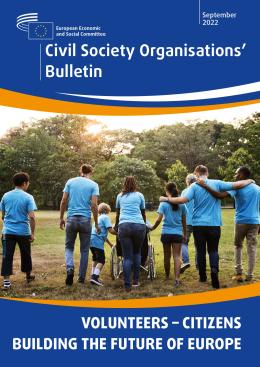
Volunteers – citizens building the future of Europe
In this issue:
Members' on the role and future of volunteering in Europe
Guest articles by Lejla Šehić Relić, President of the Centre for European Volunteering (CEV), and Mary Cunningham, CEO of the National Youth Council of Ireland
Interview with co-rapporteur Ody Neisingh on the EESC opinion "SOC/726 Combatting violence against women"
Civil Society Organisations' Bulletin - September 2022
Soucieux de prendre la mesure de la contribution sociétale des bénévoles et des volontaires et d’en réaffirmer la valeur, le Groupe des organisations de la société civile du Comité économique et social européen tiendra le 7 juillet 2022 une conférence intitulée «Le bénévolat et le volontariat: les citoyens construisent l’avenir de l’Europe». Organisée à Gdańsk, la conférence s’inscrit dans le contexte d’une mission de trois jours dans la ville polonaise, désignée capitale européenne du volontariat en 2022.
L’UE comme moteur d’une prospérité partagée – la société civile pour une économie au service des personnes et de la planète
-
Location
EDITION HYBRIDE • CESE
Bruxelles
Belgium
Alors que l’Europe et ses sociétés sont toujours aux prises avec la pandémie de COVID-19 et que la conférence sur l’avenir de l’Europe entre dans sa phase de conclusion, le CESE organisera ses Journées annuelles de la société civile au mois de mars 2022. Comme d’habitude, cette conférence phare de la société civile rassemblera citoyens individuels, société civile organisée et institutions européennes dans le cadre d’un processus inclusif visant à relever un certain nombre de grands défis sociétaux auxquels l’Union est aujourd’hui confrontée pour définir son avenir.
Le présent rapport examine la manière dont la pandémie de COVID-19 a affecté le travail des organisations de la société civile (OSC) à travers l’Europe et s’attache en outre à étudier comment les démarches adoptées dans les différents États membres de l’Union européenne ont influé sur la capacité de ces organisations à exercer leurs droits et libertés fondamentaux..