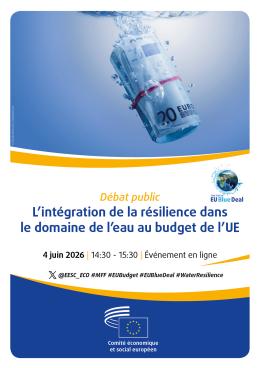
L'intégration de la résilience dans le domaine de l'eau au budget de l'UE est un sujet d’actualité pour garantir l’avenir de l’eau en Europe. Découvrez comment des investissements européens plus judicieux peuvent renforcer la résilience, la durabilité et la préparation en matière d’eau, et comment définir les priorités de financement des programmes de demain dans le cadre du prochain cadre financier pluriannuel de l’UE.
« Politique de cohésion 2028–2034 : un nouveau fonds, un nouveau cadre, un nouveau rôle pour la société civile ? » réunit les institutions de l'UE, les partenaires sociaux et les représentants de la société civile afin de réfléchir à l'avenir de la politique de cohésion dans le prochain Cadre financier pluriannuel. L'audition explore les propositions de réforme du financement et de la gouvernance de la cohésion, évalue les implications du nouveau cadre à travers les Plans de partenariat nationaux et régionaux et examine comment les organisations de la société civile peuvent jouer un rôle plus important dans la conception, la mise en œuvre et le suivi de la politique de cohésion. La discussion vise à identifier comment la politique de cohésion peut continuer à promouvoir la cohésion territoriale, sociale et économique tout en répondant aux nouveaux défis et transitions auxquels l'Union européenne est confrontée.
As part of its ongoing work on generational renewal in agriculture, the European Economic and Social Committee’s Section for Agriculture, Rural Development and the Environment (NAT) will hold a dedicated debate on youth in agrifood systems during its meeting on 28 January 2026 from 16:00 to 17:15.
Audition publique dans le cadre de l'avis ECO/689 – La dimension insulaire dans les politiques européennes en faveur de la cohésion, de la compétitivité et du développement durable.
L'objectif du débat publique dans le cadre de l'avis ECO/675 est de souligner l’importance d’aligner les stratégies macro-régionales avec les plans nationaux de partenariat régional (PNPR) afin de renforcer la cohésion et la coopération transfrontalière.
L'audition publique dans le cadre de l'avis ECO/683 examinera comment les acteurs nationaux, locaux et de la société civile collaboreront ensemble à travers le principe de partenariat et la gouvernance à plusieurs niveaux, afin de favoriser des résultats plus inclusifs, durables et résilients dans toutes les régions.
rue Belliard 101, Jacques Delors building, room JDE 70
Brussels
Belgium
The European Commission is in the process of developing a European Affordable Housing Plan, to be launched in 2026. This political debate will explore what elements and policies should be included in order to produce a holistic and inclusive housing plan.
Public hearing with Polish civil society and policy makers
Event type
Public hearing
Location
Online event
ul. Wspólna 2/4
00-926 Warszawa
Warsaw
Poland
In the context of the ongoing exploratory opinion, requested by the Polish Presidency, to examine how civil society actors can make use of a results-orientation approach in cohesion policy in the next programming period, the EESC is organizing a hearing in Warsaw on 17 January 2025. The hearing will be important as the EESC will explore how civil society and local actors understand the concept of a results-orientation approach to cohesion policy, to which degree they are prepared and if they have the administrative capacity to implement it.
The hearing is co-organized with the Polish Presidency of the Council of the EU and it has the patronage of the Polish Presidency. The venue is the premises of the Ministry of Development Funds and Regional Policy of Poland.