"Cohesion policy 2028–2034: A new fund, a new framework, a new role for civil society?" brings together EU institutions, social partners and civil society representatives to reflect on the future of cohesion policy in the next Multiannual Financial Framework. The hearing explores proposals for reforming cohesion funding and governance, assesses the implications of the new framework through the National and Regional Partnership Plans and examines how civil society organisations can play a stronger role in the design, implementation and monitoring of cohesion policy. The discussion aims to identify how cohesion policy can continue to deliver territorial, social and economic cohesion while responding to new challenges and transitions facing the European Union.
As part of its ongoing work on generational renewal in agriculture, the European Economic and Social Committee’s Section for Agriculture, Rural Development and the Environment (NAT) will hold a dedicated debate on youth in agrifood systems during its meeting on 28 January 2026 from 16:00 to 17:15.
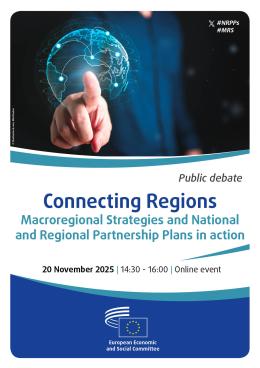
The EESC's objective with this debate is to underscore the importance of aligning macroregional strategies with national regional partnership plans (NRPPs) in order to boost cohesion and cross-border cooperation.
The public hearing will examine how national, local and civil society actors will work together to foster collaboration through partnership principle and multi-level governance in order to deliver more inclusive, sustainable, and resilient outcomes across all regions.
rue Belliard 101, Jacques Delors building, room JDE 70
Brussels
Belgium
The European Commission is in the process of developing a European Affordable Housing Plan, to be launched in 2026. This political debate will explore what elements and policies should be included in order to produce a holistic and inclusive housing plan.
Public hearing with Polish civil society and policy makers
Event type
Public hearing
Location
Online event
ul. Wspólna 2/4
00-926 Warszawa
Warsaw
Poland
In the context of the ongoing exploratory opinion, requested by the Polish Presidency, to examine how civil society actors can make use of a results-orientation approach in cohesion policy in the next programming period, the EESC is organizing a hearing in Warsaw on 17 January 2025. The hearing will be important as the EESC will explore how civil society and local actors understand the concept of a results-orientation approach to cohesion policy, to which degree they are prepared and if they have the administrative capacity to implement it.
The hearing is co-organized with the Polish Presidency of the Council of the EU and it has the patronage of the Polish Presidency. The venue is the premises of the Ministry of Development Funds and Regional Policy of Poland.
The EESC is organising this public debat to discuss how civil society partners can use a results-orientation approach in cohesion policy for the next programming period. The principles of multi-level governance and shared management are contradictory or complementary to the results-focused cohesion policy ?
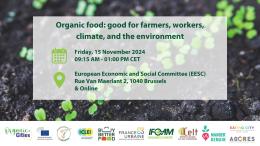
On 15 November the EESC will host a pivotal event focusing on the benefits of organic food and the critical role of public procurement in advancing sustainable practices. This event will bring together representatives from cities, national governments, and institutions to discuss the future of organic farming and its impact on farmers, workers, the climate, and the environment.