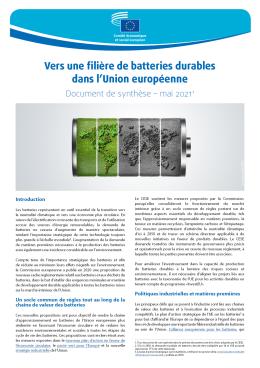
La Commission européenne a publié une proposition de nouveau cadre réglementaire relatif aux batteries et aux déchets de batteries, dans le but d’établir des exigences minimales en matière de développement durable applicables à toutes les batteries mises sur le marché intérieur de l’Union. Le CESE soutient les mesures proposées par la Commission mais demande toutefois des instruments de gouvernance plus précis et opérationnels pour la mise en œuvre du nouveau règlement, à laquelle toutes les parties prenantes doivent être associées.
Le Comité économique et social européen (CESE) et la Commission consultative des mutations industrielles (CCMI) estiment que la résilience actuelle et future des matières premières critiques est une préoccupation essentielle de la société civile organisée de l’UE.
Cette étude vise à définir un cadre pour la reconnaissance juridique des droits de la nature dans l'ordre juridique de l'UE, en tant que condition préalable à une relation différente et améliorée entre les êtres humains et la nature. Cet objectif devrait éventuellement être atteint grâce à l'élaboration d'une charte européenne des droits fondamentaux de la nature.
La mission principale de l’Observatoire du développement durable du CESE (ODD) est de promouvoir la durabilité dans l’UE en favorisant la prospérité économique, l’inclusion sociale et la responsabilité environnementale d’une manière intégrée et équilibrée. Ses membres proviennent d’un large éventail de groupes d’intérêt, disposant d’une expertise dans tous les domaines de nos travaux et de vastes contacts avec les organisations de la société civile dans les États membres de l’UE.
Members on the future of housing and public spaces in the EU
Guest articles by Laura KLITGAARD (The Danish Society of Engineers - IDA), Signe HELLEDI (Cycle Superhighways), Nils Thor ROSTED (Amager Resource Centre), and Gustavo GHIDINI (Movimento Consumatori)
Interview with rapporteur Elena-Alexandra CALISTRU on Measures for a resilient, cohesive and inclusive European economy (EESC opinion ECO/661)
Comments on three years of war in Ukraine and President Trump's first days in office;
Reports on our recent elections and 2024 work programme;
Interview with rapporteur Alain COHEUR on EESC opinion INT/1044 on 'Combatting poverty and social exclusion: harnessing the power of the social economy and socio-economic innovations'.
Civil Society Organisations' Bulletin - February 2025
Protecting the most vulnerable in European societies
In this issue:
Our members reflect on ways for protecting the most vulnerable in European societies;
Guest articles by Carlos SUSÍAS RODADO (European Anti Poverty Network), Sirpa RAUTIO (European Union Agency for Fundamental Rights), Rocío URÍAS MARTÍNEZ (European Federation of National Organisations Working with the Homeless) and Rainer HUB (National Network for Civil Society in Germany);
Report on our recent conference on intergenerational solidarity in the EU;
Interview with rapporteur Pietro Vittorio BARBIERI on the new EESC opinion on 'Caregivers'.
Civil Society Organisations' Bulletin - October 2024