
European Economic
and Social Committee
COP17: EESC calls for stronger action to turn global biodiversity commitments into reality
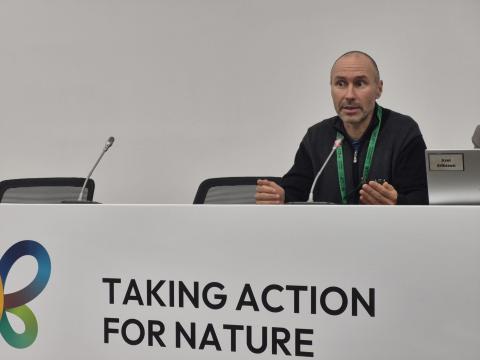
At the UN Biodiversity Conference in Yerevan, the European Economic and Social Committee (EESC) called for faster implementation of global biodiversity targets, stronger civil society participation and more effective financing to protect and restore nature.
The EESC participated in the 17th Conference of the Parties to the UN Convention on Biological Diversity (COP17), held in Yerevan, Armenia, from 19 to 30 October 2026. Represented by EESC member Arnaud Schwartz and EESC Youth Delegate Axel Eriksson, the Committee brought the perspectives of organised civil society and young people to international biodiversity discussions.
COP17 marked the first global review of collective progress in implementing the Kunming-Montreal Global Biodiversity Framework. The review confirmed that the world is not on track to meet its 2030 biodiversity targets. In response, Parties adopted the Yerevan Pathway, setting out priorities to accelerate implementation, address harmful subsidies, mobilise biodiversity financing and strengthen monitoring and accountability.
From commitments to action
The EESC stressed the need for stronger monitoring and accountability, more accessible biodiversity financing and the gradual elimination of subsidies harmful to nature. Redirecting public resources towards conservation, restoration and sustainable practices is essential to closing the biodiversity financing gap.
A central priority was strengthening the involvement of farmers, fishers and forest owners in international biodiversity governance. The EESC brought representatives of these groups together to encourage better coordination and more active participation through the Farmers' Major Group within the Convention on Biological Diversity.
Local action and youth engagement
On 26 October, the EESC and the European Committee of the Regions jointly organised a side event highlighting the role of local and regional authorities and civil society organisations in translating global biodiversity commitments into concrete action.
Axel Eriksson also contributed to discussions on the links between biodiversity, climate change and human health, highlighting the importance of youth participation in shaping sustainable solutions.
Protecting nature requires coherent policies
The EESC called for closer coordination between biodiversity and climate policies, emphasising that climate action must also support healthy ecosystems. Stronger cooperation between international environmental agreements and meaningful civil society involvement will be essential to achieving the 2030 targets.
As the world moves towards 2030, the EESC will continue to advocate for biodiversity policies that translate international commitments into measurable results, bringing grassroots expertise into decision-making and ensuring that local communities are part of the solution. (ks)
Work organisation
Recommended for you
Tetyana Ogarkova: "The day of victory will come but it will not bring normality back"
Agenda
On 24 February 2022, the lives of millions of Ukrainians were turned upside down. Now, when we say the word "victory", we expect that day to be the way things used to be. A normal day, a day of peace…
Lutte contre la précarité énergétique: garantir un approvisionnement énergétique abordable devrait figurer au premier rang des priorités politiques des pays de l’UE
News
Alors que le nombre de ménages qui sont dans l’incapacité de chauffer leur logement va vraisemblablement augmenter dans l’Union, avec une inflation annuelle de l’énergie qui dépasse 40 %, il y a…
Les zones rurales ont le potentiel pour produire davantage de résultats
News
Si l’attrait de la vie à la campagne s’est accru ces toutes dernières années, de nombreuses zones rurales de l’Union restent confrontées à un certain nombre de problèmes qui dissuadent les personnes…
Pour lutter contre le sans-abrisme, il faut une approche globale et une action collective
News
Le 7 octobre dernier, le Comité économique et social européen (CESE) a tenu une conférence sur le sans-abrisme et les moyens d’éradiquer ce phénomène d’ici à 2030, en appliquant le principe du…
Un rôle actif pour la société civile organisée est essentiel à la résilience de l’Union européenne
News
Le CESE a tenu un débat en session plénière sur l’importance croissante de la société civile organisée et des villes pour mettre l’Europe en capacité de faire face aux chocs asymétriques et aux…