
European Economic
and Social Committee
EESC urges EU to simplify farm policy and adopt coherent food strategy
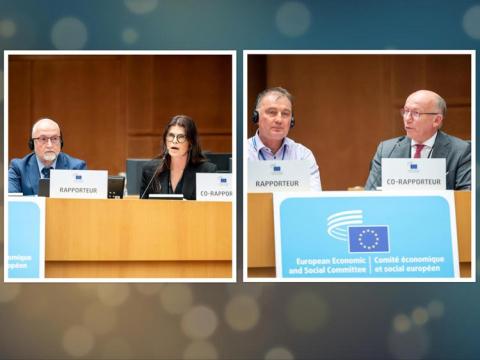
EESC adopts two opinions at September session: one pushing for reduced red tape in the Common Agricultural Policy, the other calling for a cross-cutting food policy to boost quality and organic products.
The European Economic and Social Committee (EESC) adopted two opinions at its September session, calling on the EU to build a coherent food policy around organic and quality products while also simplifying the Common Agricultural Policy (CAP) to cut red tape for farmers.
In its own-initiative opinion on the future of organic and quality foods, the Committee argues that the current patchwork of measures does not go far enough to address climate, biodiversity and consumer concerns about food standards. It calls for a comprehensive framework that combines fiscal incentives, minimum procurement targets, streamlined certification, reinforced traceability and more ambitious promotion strategies.
Among the headline proposals is a harmonised EU rule allowing Member States to apply reduced VAT rates on certified quality products, making them more affordable and accessible. The opinion also calls for schools, hospitals and public canteens to serve at least 25% certified food, with priority given to locally sourced products.
Rapporteur Decebal-Ștefăniță Pădure stressed that farmers must be recognised as central actors in Europe’s food transition. “A coherent EU food policy is not only about agricultural output, but about protecting biodiversity, improving public health and ensuring resilient rural economies,” he said.
Co-rapporteur Kerli Ats highlighted that consumer affordability remains one of the biggest obstacles to scaling up quality food. “Affordability remains a real barrier,” she said. “By combining reduced VAT, fairer procurement rules and stronger consumer education, we can make sustainable food choices accessible to everyone, not just a privileged few.”
The EESC notes that the organic sector is “at a crossroads”, with strong consumer demand in some Member States but stagnation in others. High certification costs, lower yields and market volatility continue to weigh on farmers. To overcome this, the opinion urges more investment in research and innovation, as well as targeted support for young farmers, women and family-based farming models.
The Committee also wants quality products to be embedded in promotion strategies linked to food education, sustainable tourism and territorial branding, and calls for stricter labelling rules to prevent misleading use of terms such as “natural” or “traditional” when not backed by certification. It further urges the Commission to ensure EU quality standards and geographical indications are safeguarded in international trade agreements.
Alongside this, the EESC adopted a mandatory opinion requested by the European Commission on the simplification of the CAP, drafted by rapporteur John Comer and co-rapporteur Arnold Puech d’Alissac. That report sets out detailed recommendations to reduce administrative burdens and make EU farm policy more practical for farmers and authorities alike.
It highlights digitalisation as a key tool for simplification, urging Member States to expand the use of digital applications, pre-populated forms and automated data collection while also funding digital skills training for farmers. It also recommends that each CAP Strategic Plan should include a specific roadmap for cutting red tape in applications and payments.
Other proposals include:
- granting new farmers setting up holdings the same investment support terms as young farmers,
- extending complementary income support when multiple young farmers join a holding in different years,
- ensuring lump-sum payments for small farmers do not exceed €5,000, combined with fewer on-the-spot checks through digital monitoring,
- allowing farmers to correct applications in good faith without penalty,
- introducing emergency funding that does not eat into basic income support,
- revising GAEC standards to make them more “farmer-friendly” while still safeguarding the environment,
- and ensuring irrigation investment support balances food security needs with ecosystem protection.
Together, the two opinions reflect the EESC’s twin priorities: cutting bureaucracy in farm policy while building a food system that is fair, sustainable and accessible to all.
The adopted opinions will now be transmitted to the European Commission. With food policy identified as one of Ursula von der Leyen’s priorities under the forthcoming Omnibus package on food, the EESC insists its recommendations are not only timely but essential. For the Committee, they demonstrate how food and farming policy remain at the heart of Europe’s economic, social and environmental future, and underline the EESC’s role as the EU’s expert bridge between institutions and civil society. The message is clear: the Commission must now act on this guidance, drawing on the EESC’s knowledge to deliver a simpler, fairer and more sustainable food system for Europe. (ks)
Work organisation
Recommended for you
Tetyana Ogarkova: "The day of victory will come but it will not bring normality back"
Agenda
On 24 February 2022, the lives of millions of Ukrainians were turned upside down. Now, when we say the word "victory", we expect that day to be the way things used to be. A normal day, a day of peace…
Lutte contre la précarité énergétique: garantir un approvisionnement énergétique abordable devrait figurer au premier rang des priorités politiques des pays de l’UE
News
Alors que le nombre de ménages qui sont dans l’incapacité de chauffer leur logement va vraisemblablement augmenter dans l’Union, avec une inflation annuelle de l’énergie qui dépasse 40 %, il y a…
Les zones rurales ont le potentiel pour produire davantage de résultats
News
Si l’attrait de la vie à la campagne s’est accru ces toutes dernières années, de nombreuses zones rurales de l’Union restent confrontées à un certain nombre de problèmes qui dissuadent les personnes…
Pour lutter contre le sans-abrisme, il faut une approche globale et une action collective
News
Le 7 octobre dernier, le Comité économique et social européen (CESE) a tenu une conférence sur le sans-abrisme et les moyens d’éradiquer ce phénomène d’ici à 2030, en appliquant le principe du…
Un rôle actif pour la société civile organisée est essentiel à la résilience de l’Union européenne
News
Le CESE a tenu un débat en session plénière sur l’importance croissante de la société civile organisée et des villes pour mettre l’Europe en capacité de faire face aux chocs asymétriques et aux…