
European Economic
and Social Committee
Do AIs dream of electric worker strikes?
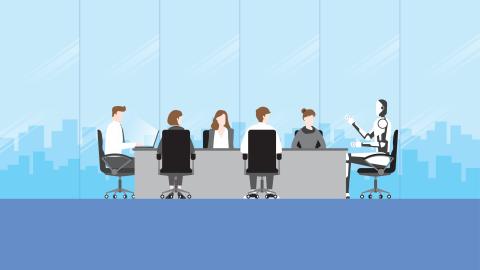
Artificial Intelligence has a tremendous potential to improve our lives, our workplaces, and to free us from repetitive tasks, allowing for much more productive and enjoyable work and free time for workers and citizens at large. It is already changing our world of work, and to explore how can we better shape that future already happening, the EESC adopted in January 2025 an opinion on pro-worker AI.
As AI becomes more and more common in our daily lives, we must make sure humans remain in control of it. Not because of AI taking over the world (so far, it struggles with simple mathematical tricks), but because of how workers and citizens can be left unprotected if all decisions are made by AI. Large Language Models (LLMs) are far from free of error and biases, and despite being potentially very useful tools, we must remember they are tools.
AI's potential to better our lives can only be harnessed if social partners are involved, if workers are trained and consulted, if the process of incorporating AI at the workplace is done through social dialogue and in collaboration with the affected parts. Any instance of computer-mediated work management must be transparent and accessible to workers' representatives.
On the recent EESC adopted opinion, rapporteur Franca Salis-Madinier said 'As things stand today, neither the EU nor its member states have the regulatory tools to tackle this: existing AI legislation does not deal with the labour market and world of work (such as the AI Act), and the only exception, the Platform Workers directive, is limited to that particular sector of the labour market.'
The debate is often framed as regulation v innovation, but this is a fallacy. If AI regulation were behind the lack of AI innovation, in the EU we should have several leading AI companies by now, taking into account that the regulation dates from only 2024, and most models in discussion are far older. No, there are other barriers to innovation in the EU (low expenditure in R&D, market fragmentation, difficulty in accessing capital and funding, among others).
Making our laws a legislative wild west will not bring AI champions, and lowering our social standards is not a sustainable way of becoming competitive. An integrated AI strategy should seek to take advantage of its potential, but ensure that the fruits of it are shared fairly. We must close the loopholes in current legislation and create a framework that can integrate AI into our workplaces as seamlessly and sustainably as possible.
Work organisation
Related content
Downloads
-
Do AIs dream of electric worker strikes - EN
Recommended for you
Tetyana Ogarkova: "The day of victory will come but it will not bring normality back"
Agenda
On 24 February 2022, the lives of millions of Ukrainians were turned upside down. Now, when we say the word "victory", we expect that day to be the way things used to be. A normal day, a day of peace…
Lutte contre la précarité énergétique: garantir un approvisionnement énergétique abordable devrait figurer au premier rang des priorités politiques des pays de l’UE
News
Alors que le nombre de ménages qui sont dans l’incapacité de chauffer leur logement va vraisemblablement augmenter dans l’Union, avec une inflation annuelle de l’énergie qui dépasse 40 %, il y a…
Les zones rurales ont le potentiel pour produire davantage de résultats
News
Si l’attrait de la vie à la campagne s’est accru ces toutes dernières années, de nombreuses zones rurales de l’Union restent confrontées à un certain nombre de problèmes qui dissuadent les personnes…
Pour lutter contre le sans-abrisme, il faut une approche globale et une action collective
News
Le 7 octobre dernier, le Comité économique et social européen (CESE) a tenu une conférence sur le sans-abrisme et les moyens d’éradiquer ce phénomène d’ici à 2030, en appliquant le principe du…
Un rôle actif pour la société civile organisée est essentiel à la résilience de l’Union européenne
News
Le CESE a tenu un débat en session plénière sur l’importance croissante de la société civile organisée et des villes pour mettre l’Europe en capacité de faire face aux chocs asymétriques et aux…