
European Economic
and Social Committee
Do AIs dream of electric worker strikes?

Artificial Intelligence has a tremendous potential to improve our lives, our workplaces, and to free us from repetitive tasks, allowing for much more productive and enjoyable work and free time for workers and citizens at large. It is already changing our world of work, and to explore how can we better shape that future already happening, the EESC adopted in January 2025 an opinion on pro-worker AI.
As AI becomes more and more common in our daily lives, we must make sure humans remain in control of it. Not because of AI taking over the world (so far, it struggles with simple mathematical tricks), but because of how workers and citizens can be left unprotected if all decisions are made by AI. Large Language Models (LLMs) are far from free of error and biases, and despite being potentially very useful tools, we must remember they are tools.
AI's potential to better our lives can only be harnessed if social partners are involved, if workers are trained and consulted, if the process of incorporating AI at the workplace is done through social dialogue and in collaboration with the affected parts. Any instance of computer-mediated work management must be transparent and accessible to workers' representatives.
On the recent EESC adopted opinion, rapporteur Franca Salis-Madinier said 'As things stand today, neither the EU nor its member states have the regulatory tools to tackle this: existing AI legislation does not deal with the labour market and world of work (such as the AI Act), and the only exception, the Platform Workers directive, is limited to that particular sector of the labour market.'
The debate is often framed as regulation v innovation, but this is a fallacy. If AI regulation were behind the lack of AI innovation, in the EU we should have several leading AI companies by now, taking into account that the regulation dates from only 2024, and most models in discussion are far older. No, there are other barriers to innovation in the EU (low expenditure in R&D, market fragmentation, difficulty in accessing capital and funding, among others).
Making our laws a legislative wild west will not bring AI champions, and lowering our social standards is not a sustainable way of becoming competitive. An integrated AI strategy should seek to take advantage of its potential, but ensure that the fruits of it are shared fairly. We must close the loopholes in current legislation and create a framework that can integrate AI into our workplaces as seamlessly and sustainably as possible.
Work organisation
Related content
Downloads
-
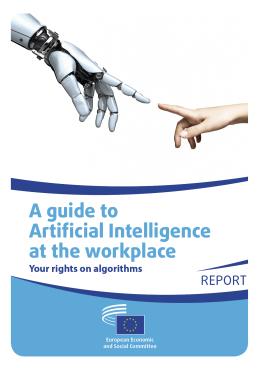
Do AIs dream of electric worker strikes - EN
Recommended for you
Solidarity Letter from the Workers’ Group of the EESC with strikes in Belgium
News
Greek national strike: Letter of solidarity from the EESC Workers' Group
News
We would like to express our full support on the occasion of the national strike announced by the Greek General Confederation of Labour on 20th November 2024 to demand concrete measures to…
Standing in Solidarity: EESC Workers’ Group Supports Italian General Strike
News
On behalf of the Workers’ Group at the European Economic and Social Committee, I want to express our full support with the Italian workers and the CGIL, who are organising a general strike on the…
Letter of solidarity from the EESC Workers' Group – Greek National Strike 17 April 2024
News
To: Yannis Panagopoulos, GSEE Brussels, 16 April 2024 Dear President, dear Yannis, On behalf of the Workers' Group, I want to express our full support and solidarity on the occasion of…
Electricity market reform
News
Background In March 2023, the European Commission adopted a legislative proposal for targeted reform of the electricity market, focusing on two different aspects: the remuneration of renewables and…