
European Economic
and Social Committee
Speech by President Séamus Boland, EESC plenary debate with Commission Vice-President Dubravka Šuica
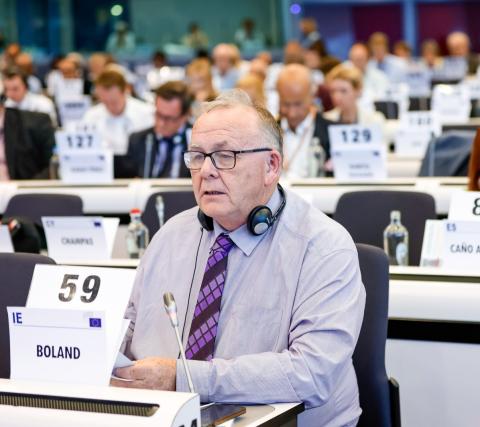
EESC plenary debate on the European Strategy for Older Persons with Dubravka Šuica, European Commission Vice-President for Democracy and Demography, and Dr Heidrun Mollenkopf, President of the AGE Platform Europe
Dear EC Vice-President and President of AGE Platform Europe,
Before the end of this century, it is expected that the number of people on Earth will shrink for the first time since the Black Death;
As I recently read in an article: "The result will be that in much of the world, the patter of tiny feet will be drowned by the clatter of walking sticks";
According to projections, by 2050, the rich world will have only two people working for every person over 65;
However, longevity and declining fertility rates are not only a challenge in the rich world. Middle income countries are also facing difficulties. In South Korea, the fertility rate last year was only 0.8%.
The second reality we are facing is that at least in the rich world, society favours the young – or at least, those who are of working age;
Generally speaking, there are negative views in society as the elderly being a socio-economic burden;
According to a Eurobarometer survey in 2019, age discrimination, together with gender discrimination, are the two most prevalent forms of discrimination in the EU;
Among pensioners, this discrimination translates into isolation and a sense of invisibility within society;
And I think that we can all agree that during the Covid-19 pandemic, elderly people were largely 'sacrificed' for the benefit of younger sectiors of society...
So the question today, is how to best manage and adapt our societies and economies to the realities of longevity and falling birth rates?
This debate is very much linked to that on sustainable European health systems, a topic that our Group has addressed only recently, at our Group conference in Stockholm;
And I would like to reiterate what we said at that event. Namely, that we must rethink our societies from many perspectives;
And we can start by viewing active ageing as an investment and not as a burden for society;
This implies moving away from a care-based approach to ageing;
We must move towards one which encourages, supports and recognises the positive contribution that pensioners can make as engaged citizens;
I am thinking in particular of the potential enormous contribution that the elderly as volunteers working with civil society organisations;
Volunteering has a measurable economic and a social value, but it is often neglected;
In addition, volunteering by the elderly can directly contribute to strengthening inter-generational cooperation, which clearly benefits everyone.
This is why I strongly support the draft Opinion of my colleague Michel Angel and particularly, his proposals for a European Strategy for Older Persons, for a Guarantee for Older Persons and for the EC to set up a European Year of Older People;
These instruments would contribute to upward convergence of national EU strategies on the elderly;
I also believe that civil society organisations could do more to help create a positive image of the elderly;
We almost need a marketing campaign on what elderly citizens already contribute to our societies and economies;
And this campaign should involve local governments and an array of civil society actors, not only those which represent the elderly.
I will bring my comments to a close by a quotation by the playwright George Bernard Shaw and I quote: "We don't stop playing because we grow old; we grow old because we stop playing";
Thank you for your attention.
Work organisation
Downloads
-
Speech by Séamus Boland, EESC debate with Commission Vice-president Dubravka Šuica
Recommended for you
Tetyana Ogarkova: "The day of victory will come but it will not bring normality back"
Agenda
On 24 February 2022, the lives of millions of Ukrainians were turned upside down. Now, when we say the word "victory", we expect that day to be the way things used to be. A normal day, a day of peace…
Lutte contre la précarité énergétique: garantir un approvisionnement énergétique abordable devrait figurer au premier rang des priorités politiques des pays de l’UE
News
Alors que le nombre de ménages qui sont dans l’incapacité de chauffer leur logement va vraisemblablement augmenter dans l’Union, avec une inflation annuelle de l’énergie qui dépasse 40 %, il y a…
Les zones rurales ont le potentiel pour produire davantage de résultats
News
Si l’attrait de la vie à la campagne s’est accru ces toutes dernières années, de nombreuses zones rurales de l’Union restent confrontées à un certain nombre de problèmes qui dissuadent les personnes…
Pour lutter contre le sans-abrisme, il faut une approche globale et une action collective
News
Le 7 octobre dernier, le Comité économique et social européen (CESE) a tenu une conférence sur le sans-abrisme et les moyens d’éradiquer ce phénomène d’ici à 2030, en appliquant le principe du…
Un rôle actif pour la société civile organisée est essentiel à la résilience de l’Union européenne
News
Le CESE a tenu un débat en session plénière sur l’importance croissante de la société civile organisée et des villes pour mettre l’Europe en capacité de faire face aux chocs asymétriques et aux…