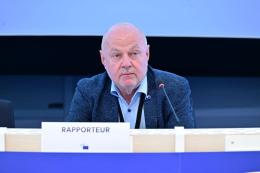
The European Economic and Social Committee (EESC) backs the Commission’s proposed Digital Networks Act and says there is a need to remove internal market barriers and ensure uniform rules. Effective governance is essential, with a clear allocation of competences between the EU and national authorities, which avoids overlaps and institutional duplication.
During its June plenary session, the European Economic and Social Committee (EESC) adopted an opinion evaluating the implementation of the EU Whistleblower Protection Directive, warning that significant gaps remain between legal protections and their practical application. The Committee calls for stronger safeguards against retaliation, better support for whistleblowers, greater involvement of civil society and a cultural shift that sees whistleblowing as a contribution to democracy, transparency and the public interest.
The European Economic and Social Committee (EESC) has adopted an information report and a resolution calling for a stronger role for social partners and civil society organisations in shaping national reforms and investments. The EESC calls for the creation of a European code for structured consultations and mandatory assessments of partnership practices to improve transparency, effectiveness and democratic legitimacy.
Le Comité économique et social européen (CESE) a adopté un avis où il fait valoir que l’application du nouveau Bauhaus européen peut contribuer à lutter contre la crise du logement. Cela suppose de passer de projets pilotes inspirants à une mise en œuvre qui soit à la fois systémique, modulable et territorialisée.
On World Refugee Day (20 June), the European Economic and Social Committee (EESC) reaffirms its long-standing commitment to a fair, humane and comprehensive European approach to migration, asylum and refugees: one that upholds fundamental rights while recognising the social and economic contributions of people on the move.
Lors d’une conférence organisée à Bruxelles par le Comité économique et social européen et le gouvernement basque, il a été mis en évidence l’importance politique et sociale que revêtent les services d’intérêt général pour faire de la solidarité intergénérationnelle une réalité en Europe et pour construire une société plus inclusive.
The EESCConsultative Commission on Industrial Change (CCMI) is holding a high-level conference under the theme: "The future of the European battery industry" in the context of the Battery Booster Strategy adopted by the European Commission.
Date: 11 June 2026
Time: 14.30-17.00
Venue: EESC, rue Belliard 99, JDE, 6th floor, room 62
Insufficient enforcement of common EU rules, threats to consumer confidence, excessive complexity for SMEs and a loss of competitiveness in the digital sector are among the greatest challenges facing the Single Market. The EU has a duty to protect it in order to promote economic growth and maintain social cohesion.