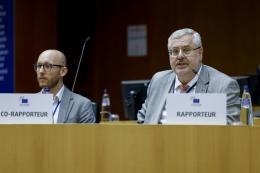
On 13 April 2023, the European Economic and Social Committee (EESC) held a public hearing to address the pressing issue of water poverty and its implications on social policy. The event brought together water experts and stakeholders to mitigate the effects of water poverty, particularly on vulnerable communities. The hearing is part of the EESC's efforts to put water at the top of the EU agenda through a call for an "EU Blue Deal."
At its April plenary, the European Economic and Social Committee (EESC) adopted an exploratory opinion requested by the European Commission to gather input from civil society on the impact of the metaverse on society. The document, which examines the business environment, working conditions and development of civil society, suggests that the metaverse will bring with it both opportunities and risks that the EU must address rapidly to create an ethical, safe, and inclusive virtual environment for all.
Lors de sa session plénière d’avril, le Comité économique et social européen (CESE) a adopté un avis sur les facteurs clés de la transition vers un système de transport durable à long terme.
Le 9 mai, l’Union européenne célébrera la Journée de l’Europe 2023, qui donnera lieu à la commémoration de la déclaration de Schuman du 9 mai 1950. Afin de marquer cette occasion particulière, les institutions de l’UE, y compris les délégations et représentations de l’UE dans le monde, organiseront toute une série d’activités en ligne et sur place, donnant ainsi aux citoyens la possibilité de découvrir l’Union européenne et de se familiariser avec elle.
Un débat organisé par le Comité économique et social européen (CESE) a révélé qu’il était essentiel d’ajuster le marché européen de l’électricité afin de remédier à sa faiblesse et à sa forte dépendance au gaz, et également de fournir aux consommateurs et aux entreprises de l’UE une énergie fiable et abordable.
Dans un contexte de montée du populisme et de l’autoritarisme dans toute l’Europe, les organisations de la société civile sont confrontées à une hostilité croissante. Face aux contraintes financières, aux campagnes de dénigrement, aux attaques politiques et aux obstacles juridiques et administratifs, elles ont besoin d’un soutien renforcé sur tous les fronts pour pouvoir jouer leur rôle essentiel, qui est de rendre nos sociétés plus ouvertes, plus responsables et plus justes.
Agissant en lanceur d’alerte, le Comité économique et social européen (CESE) tient à signaler que les avantages de la numérisation du système énergétique ne se concrétiseront qu’à condition de supprimer les lourdeurs administratives, d’encourager les consommateurs à jouer un rôle actif et de dégager des ressources pour que les travailleurs perfectionnent leurs compétences.
In its March plenary, the European Economic and Social Committee (EESC) adopted an opinion urging the European Institutions to address the fragmented implementation of foreign policy sanctions across Member States. The EESC is concerned about the inconsistency in standards and in the application of sanctions in national legislation, and is calling for immediate action to protect humanitarian aid and journalists in sanctioned regimes.