L’objectif de l’audition est d’examiner comment la politique de cohésion peut relever plus efficacement les défis de l’abordabilité du logement afin de faire progresser ses objectifs fondamentaux de cohésion économique, sociale et territoriale. Les participants examineront comment les investissements stratégiques dans le secteur du logement peuvent stimuler le développement économique régional, accroître la compétitivité, améliorer l’efficacité du marché du travail et réduire les disparités territoriales. L’objectif est de formuler des recommandations concrètes en vue d’améliorer l’efficacité des instruments existants pour le reste de la période 2021-2027 et d’élaborer une approche plus globale en matière de logement abordable dans le cadre de la politique de cohésion pour l’après-2027.
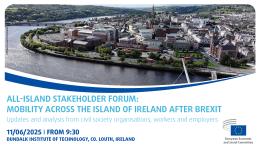
An All-Island Stakeholder Forum is being organised by the European Economic and Social Committee together with an All-Island Advisory Group of nine representative workers, employers and civic organisations from both Ireland and Northern Ireland.
The focus will be on the theme of ‘Mobility across the island of Ireland after Brexit’. The Forum will be in two parts: (i) plenary sessions in the morning in hybrid format, and (ii) in-person breakout sessions in the afternoon at which stakeholders will discuss specified topics in more detail.
This 2025 All-Island Stakeholder Forum is an ambitious EESC initiative feeding into the development of the EU-UK relationship and complements the European Commission and the UK government commitments to stakeholder engagement in the Windsor Framework. It will gather the widest possible range of business, worker and civil society stakeholders on the island together to share insights and expertise.
Le CESE organise une audition publique sur la communication relative à une union de l’épargne et des investissements. Il réunira des institutions, de représentants de l'industrie et des parties prenantes de la société civile, afin de discuter sur la manière d’offrir des possibilités aux ménages, aux entreprises et à l’ensemble de l’économie de l’UE.
Lorsque l’intelligence artificielle et l’intelligence authentique conjuguent leurs forces: l’avenir des professions liberales
Event type
Conference
Location
Rue Van Maerlant 2,
Salle VMA 22
Bruxelles
Belgium
Rejoignez-nous le 11 juin 2025, lorsque la catégorie des professions libérales du CESE présentera la 9e édition de la Journée des professions libérales. La conférence est ouverte au public, mais les inscriptions pour une participation en personne sont closes. Nous vous invitons à suivre via le webstreaming.
La précarité énergétique reste une préoccupation majeure pour les Européens. Des textes de loi adoptés récemment s’efforcent de protéger les consommateurs contre les coupures d’électricité. Dans le cadre du pacte pour une industrie propre, la Commission européenne a publié cette année un «plan d’action pour une énergie abordable», qui s’attache à faire baisser les prix énergétiques, dans toute l’Union européenne, pour les citoyens comme pour les entreprises et la collectivité. Ce plan propose un ensemble de mesures visant à diminuer le montant des factures énergétiques, accélérer les économies de coûts et renforcer les réformes structurelles au sein de notre système énergétique.
C’est dans ce contexte que la section TEN organisera, le 11 juin 2025, la cinquième conférence du CESE sur l’accessibilité financière de l’énergie.
CESE, Rue Van Maerlant/Van Maerlantstraat 2, 1040 Brussels
Bruxelles et en ligne
Belgium
La Charte des droits fondamentaux de l'UE, proclamée il y a 25 ans en décembre 2000, joue un rôle crucial dans le respect des droits fondamentaux, de la démocratie et de l'État de droit dans l'ensemble des États membres. Afin de faciliter la mise en œuvre et l’application effectives de la charte, la Commission européenne a présenté en 2020 sa «stratégie visant à renforcer l’application de la charte des droits fondamentaux dans l’UE». Cette année, la Commission entreprend un examen à mi-parcours de sa stratégie visant à renforcer l'application de la Charte.
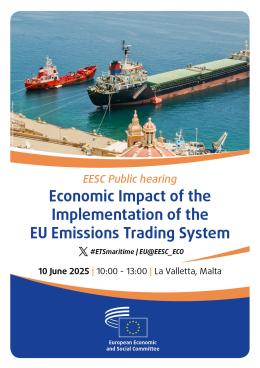
The European Economic and Social Committee (EESC) is organising a public hearing to assess the economic impact of extending the EU Emissions Trading System (ETS) to the maritime sector.
The hearing will focus on the risks of carbon and business leakage, and how these developments may affect port competitiveness and trade flows- particularly in smaller and peripheral EU Member States. The event will provide a platform for maritime stakeholders, economic experts, and EU institutions to discuss real-world implications and explore fiscal and strategic solutions to mitigate negative effects.
Speakers will include representatives from DG CLIMA, maritime and port organisations, as well as leading economists and policy analysts.
Malta’s strategic location and role in European maritime logistics make it an ideal setting for this timely discussion.
Economic and Social Council of Spain,
c/ Huertas, 73
Madrid
Spain
The 20th meeting of the EU-China Round Table took place in Madrid, Spain on 9 and 10 June 2025.
The EU-China Civil Society Round Table was established in 2007 following a decision taken by the 9th EU-China Summit in Helsinki. The delegations from the EESC and its Chinese counterpart, the China Economic and Social Council, meet regularly to discuss topics relating to economic and social issues relevant to both parties.
By elaborating reports, discussing them and exchanging ideas, the representatives of the European Economic and Social Committee and the China Economic and Social Council contribute to the development of the overall EU-China relationship, from a civil society perspective.
Le CESE organise une audition publique sur les compétences et l’éducation des européens en matière financière. Il réunira des institutions, de l’industrie et des parties prenantes de la société civile, afin de discuter sur des actions politiques souhaitables, ainsi que partager des bonnes pratiques autour de l’UE.
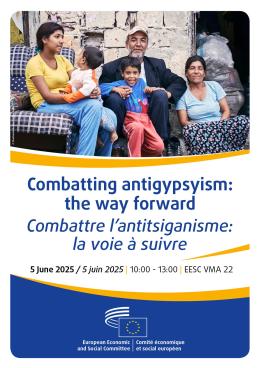
Les enquêtes continuent de faire état de taux élevés de discrimination subis par les membres de la communauté rom en raison de leur origine. Une longue histoire de discrimination et de perceptions négatives à l’égard de la communauté rom renforce les pratiques préjudiciables et les sentiments anti-tsiganes, qui se manifestent dans divers contextes. Axée sur différents domaines politiques, cette audition se penchera sur l’antitsiganisme institutionnel et discutera des moyens de le combattre efficacement.