European Green Deal

This page is also available in:

On 11 December 2019, the European Commission launched the European Green Deal reinforcing the EU’s commitment to tackling climate and environmental-related challenges that is this generation’s defining task. The objective of the European Green Deal is to transform the EU into a modern, resource-efficient and competitive economy, ensuring:

  • no net emissions of greenhouse gases by 2050;
  • economic growth decoupled from resource use;
  • no person and no place left behind.

To deliver the European Green Deal, the EU is carrying out a comprehensive package of initiatives, including policy and legislative proposals and the development and modernisation of financing instruments.

The EESC has been calling for a "Green and Social Deal", stressing the close link between the Green Deal and social justice. It is essential to hear the voice of all stakeholders in order to foster the sustainable and competitive companies of tomorrow in a healthy environment.

The European Green Deal placed a strong emphasis on investment and the financing of the green and sustainable transition. The Green Deal is Europe’s lifeline out of the COVID-19 pandemic. One third of the 1.8 trillion euro investments from the NextGenerationEU Recovery Plan, and the EU’s seven-year budget finances the European Green Deal. This boost in funding opportunities aims to turn the crisis into a transformational opportunity for the future of Europe.

The EESC plays a crucial role in monitoring the implementation of the European Green Deal initiatives and actions. The EESC prepares opinions and organises activities (see side menu on the left of this page) to ensure the EU institutions take into account the views of organised civil society and the Green Deal initiatives are coherent with the economic, social and civic circumstances on the ground.

Due to the transversal and all-encompassing nature, the European Green Deal is covered by all EESC Sections and CCMI.

  • Published in
    12 pages

    EESC Employers’ Group priorities 

    This document presents the five priorities of the EESC Employers’ Group and the policy actions for policymakers to improve the business environment, and thereby the EU’s competitiveness and conditions for creating prosperity for citizens.

  • Published in
    Study
    104 pages

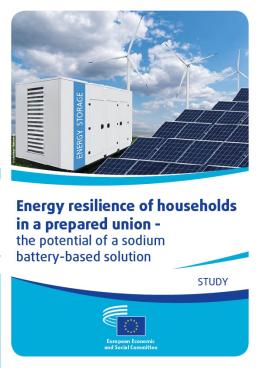
    This study examines the potential of sodium ion battery technology to strengthen energy resilience in European households and businesses, particularly in meeting a 72 hour electricity self sufficiency objective under the EU’s preparedness strategy.

  • The EU needs a long-term vision that takes greater account of geographic specificities. Sustainable water management and food security must become top priorities, with food security and biodiversity going hand in hand. 

  • The Italian Alliance for Sustainable Development (ASviS) organised this event in collaboration with the EESC Civil Society Organisations’ Group and with the support also of SDG Watch Europe.

  • Published in
    8 pages

    This publication presents the Civil Society Organisations’ Group of the European Economic and Social Committee (EESC) and outlines its priorities for the term 2025-2028. Under the theme 'Striving for sustainable communities, the beating heart of civil society and democracy', the group will focus on the following priorities:

  • Event in the framework of the Cyprus Presidency of the Council of the EU
    Event type
    Conference

    Watch the recording of the event.

  • Adopted on 15/07/2026 - Bureau decision date: 19/02/2026
    Reference
    TEN/877-EESC-2026
    Plenary session number
    607
    -
    Download format:
    Download — EESC opinion: European High-Speed Railways Network 2040 – A Strategic, Social and Industrial Project for the European Union
    Download — Keypoints
    Download — Record of Proceedings
  • Adopted on 18/02/2026 - Bureau decision date: 22/10/2025
    Reference
    TEN/865-EESC-2025
    Workers - GR II
    France
    Plenary session number
    603
    -

    This opinion explores modernising grids, adopting smart technologies, expanding connections and investing in storage and transmission innovation. It aims to improve integration and reliability to build a resilient European energy system in collaboration with neighbouring regions.

    • Record of proceedings TEN/865
    Download format:
    Download — EESC opinion: Energy connectivity, electricity grids
  • Adopted on 18/03/2026 - Bureau decision date: 16/09/2025
    Reference
    TEN/862-EESC-2025
    Civil Society Organisations - GR III
    Romania
    Plenary session number
    604
    -
    • Record of proceedings TEN/862
    • Follow-up from the Commission TEN/862
    Download format:
    Download — EESC opinion: Clean corporate vehicles
  • Adopted on 18/09/2025 - Bureau decision date: 15/07/2025
    Reference
    TEN/858-EESC-2025-02488
    Workers - GR II
    Romania
    Plenary session number
    599
    -
    • Record of proceedings TEB/858
    Download format:
    Download — EESC opinion: Extension of the Eurovignette Directive