On 29 April 2026, Ms Antje Gerstein, member of the EESC Employers' Group, was elected President of the Single Market, Production and Consumption (INT) section. In this interview is her take on her new mandate.
The European Economic and Social Committee warns that expanding supplementary pensions must not weaken public pension systems. In recommendations to the European Commission, it calls for a balanced approach that strengthens both systems. Adopted in April, the EESC’s opinion supports the development of workplace and personal pension schemes, but stresses that they must remain complementary to public pensions. It calls for action at both national and European level to improve labour markets, reinforce public systems and increase trust in additional pension savings.
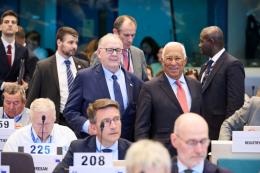
The current geopolitical context is shining a harsh spotlight on the price that Europe is paying for its dependency on third countries, as European Council President António Costa said at a plenary debate with the European Economic and Social Committee (EESC). The EU must boost its competitiveness to be able to deliver tangible results in terms of jobs, income and affordable housing.
The European Economic and Social Committee (EESC) placed fundamental rights, dignity and equality at the centre of its April plenary session, holding a high‑level debate on Union of Equality: Advancing LGBTIQ+ rights and banning conversion practices. The debate was followed by the adoption of two key EESC opinions calling for stronger enforcement of the EU’s LGBTIQ+ Equality Strategy 2026–2030 and a comprehensive EU‑wide ban on conversion practices.
The Industrial Accelerator Act (IAA) aims to support industrial transformation, strengthen strategic value chains, and accelerate the deployment of low-carbon technologies, but its implications and impact across different sectors raise concerns.