
European Economic
and Social Committee
Expanding across borders in the EU means navigating a maze of conflicting VAT rules and paperwork, driving up costs. Small and medium-sized enterprises (SMEs) face disproportionate compliance burdens, making it harder to scale up and compete. The EESC calls for urgent reforms in two opinions adopted during its February plenary, building on the Letta and Draghi reports. Proposals include harmonised financial regulations, AI-driven reporting and a coordinated industrial policy.
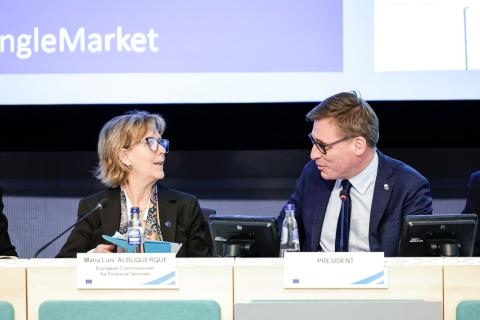
‘The single market is the backbone of European economic prosperity, yet it remains incomplete in key sectors such as finance, energy and digital services,’ said EESC president Oliver Röpke. ‘Today’s debate highlights the urgent need for reforms to remove barriers and strengthen the services sector, ensuring a level playing field for businesses across the EU.’
Maria Luís Albuquerque, Commissioner for Financial Services and the Savings and Investments Union, backed this call: ‘My vision for the Savings and Investment Union is to create wealth for our citizens and growth for our companies by bringing them together in a safe, competitive, well-regulated and well-supervised environment.’
The EESC’s opinions have identified two critical challenges to competitiveness: fragmentation in the single market, highlighted in the Letta and Draghi reports and excessive bureaucracy that particularly burdens SMEs. Both of these factors stifle innovation and economic growth.
What’s the problem?
Businesses across Europe are overwhelmed by complex and overlapping regulations. This wastes time and money, slows down the Green Deal and restricts access to financing for mid-sized companies. It results in frustrated businesses, higher consumer costs and weaker economic growth.
Beyond regulatory burdens, Europe faces deeper structural challenges that undermine its competitiveness. Slow progress in completing the single market, disparities in digital and energy infrastructure and a lack of coordinated industrial policy are limiting the EU’s ability to compete globally. While other economic blocs move swiftly to attract investment and foster innovation, Europe risks falling behind.
How can it be fixed?
Strengthening competitiveness requires a comprehensive approach, which includes removing barriers in key sectors like finance and energy, accelerating digital transformation and ensuring that SMEs can scale up and compete on a level playing field.
The EESC opinions propose:
- Simplifying regulations without lowering environmental and social standards.
- Creating a single AI-powered platform to streamline reporting for SMEs and mid-sized companies, making compliance faster and easier.
- Harmonising rules across sectors to cut down on repetitive paperwork.
- Standardising financial regulations across Member States with a coordinated EU industrial policy.
- Reforming the Carbon Border Adjustment Mechanism (CBAM) for a fairer, less burdensome system. (gb)