
European Economic
and Social Committee
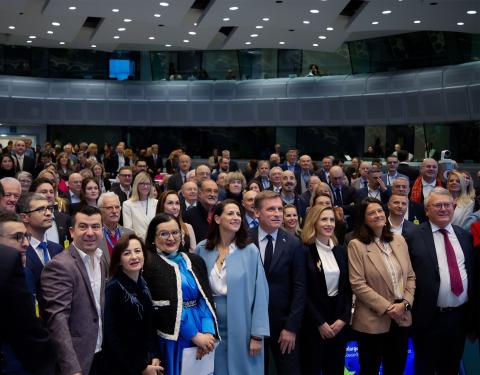
The next Commission must be the Enlargement Commission. The question is not whether to enlarge, but how to do it right, the Enlargement High-Level Forum held by the European Economic and Social Committee (EESC) concluded. The forum featured EESC President Oliver Röpke, European Commissioner for Jobs and Social Rights Nicolas Schmit and ministers from both EU Member States and Enlargement candidate countries.
The EESC, together with the European Commission, co-organised an Enlargement High-Level Forum, held back-to-back with its October plenary session. More than 140 civil society representatives from enlargement candidate countries converged for the first time ever. The participants’ main point was clear: civil society and social partners, often overlooked in the accession process, must be given a central role in the EU enlargement process.
Mr Röpke stressed: ‘This is not just about expanding the EU – it’s about preparing future Member States to actively participate in shaping the EU, ensuring that they are fully equipped to meet the challenges ahead. Through collaboration with civil society, employers’ federations and trade unions, we are creating the necessary foundation for a more inclusive and stronger Europe’.
The debate highlighted the need to keep up the recent momentum surrounding enlargement, as the 2024-2029 Commission will play a crucial role in finalising the enlargement process.
Another key message of the debate was the importance of gradual, predictable and merit-based integration, where progress is recognised and rewarded with real prospects for accession.
Mr Schmit stressed the key role played by civil society, saying: ‘A well-functioning bipartite and tripartite social dialogue and the involvement of social partners are crucial elements in the context of EU accession, as they are part of our social market economy’.
German Secretary of State Rolf Schmachtenberg said: ‘Labour and social aspects are key for successful EU accession. Those who want to improve the lives of all citizens, create opportunities and combat social inequalities need effective employment policies, good working conditions and functioning social security systems, with strong social partners’.
During the debate, Naida Nišić, Montenegrin Minister of Labour, Employment and Social Dialogue, underlined the importance of the high-level forum as a platform for dialogue allowing Montenegro to assess progress.
Niki Kerameus, Greek Minister of Labour and Social Security, emphasised: ‘It was a great privilege to participate in this important discussion on EU enlargement and the critical role that social partners play in shaping the future of the European labour and social rights landscape’.
Olta Manjani, Albanian Deputy Minister for Economy, Culture and Innovation, said: ‘Albania is actively increasing its presence in EU institutions, committees and working groups, and the establishment of the Joint Consultative Committee with the European Economic and Social Committee is one of these efforts’.
The EESC has consistently advocated EU enlargement. In 2024, it launched a pilot project, the Enlargement Candidate Members (ECMs) Initiative, which allows civil society in the candidate countries to contribute to the EESC’s work. The initiative demonstrates how the active involvement of civil society from candidate countries strengthens the enlargement process. (mt)