The EESC assesses how the EU’s sustainable finance framework can be made more robust and fit for purpose given its importance for the EU’s economic, social and climate objectives. The EESC affirms that simplification should not come at the cost of ambition. While administrative streamlining is needed, the focus should be on how requirements can be implemented more effectively, not on weakening standards. The EU’s regulatory strength and predictability are important competitive advantages that should be preserved amid growing geopolitical and economic uncertainty.
EESC Employers’ Group priorities This document presents the short- and mid-term objectives of the EESC Employers’ Group and 10 policy actions for policymakers to improve the business environment, and thereby the EU’s competitiveness and conditions for creating prosperity for citizens.
This own-initiative opinion constitutes the contribution of the ECO section to the 2025 EESC transversal own-initiative opinion package on the cost-of-living crisis, looking at specific economic policy measures that can help make the European economy future-proof.
EESC with this Resolution, calls on the Member States of the European Union and its leaders, the European institutions and the EU citizens, to safeguard and protect the economic, social and territorial cohesion of the EU according to Article 174 of the TFEU.
The fundamental principle of cohesion policy, according to which ‘no one should be left behind’, remains sound and valid. Civil society partners are ready to continue working towards it by means of a solid EU investment policy.
This document seeks to provide input to the Global Coalition for Social Justice. It highlights key messages from EESC opinions on the six priority areas identified by the International Labour Organization (ILO) for immediate action.
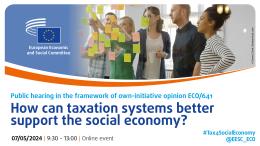
Public hearing in the framework of own-initiative opinion ECO/641 - Taxation Framework for Social Economy Entities
Event type
Public hearing
Location
Online event
Brussels
Belgium
The social economy is a vital part of the European social and economic system. It generates and maintains high-quality jobs, fosters the inclusion of marginalised groups into the labour market, promotes sustainable business practices, and provides employment for millions of people. In this way, it makes the single market more inclusive, our societies more cohesive and fosters employment models that are tailored to local and communal needs.