The European Economic and Social Committee (EESC) has endorsed the European Commission’s new strategy to overhaul the single market, while calling for fully-fledged implementation of single market-related measures and effective enforcement of EU legislation.
EESC's EU Consumer Day 2025 pointed to the urgent need to protect EU markets from an avalanche of cheap imports shipped by Temu, Shein and other third-country e-commerce platforms which are threatening to devastate the European economy and society, forcing European businesses to close and draining billions from public budgets
The European Economic and Social Committee (EESC) is pressing the EU to urgently tighten rules on third-country e-commerce platforms such as Temu and Shein, warning that their rapid expansion is undermining fair competition, consumer protection and regulatory compliance.
emphasises the urgent need to enhance European competitiveness while maintaining sustainability and social cohesion. The EU must act decisively to stay competitive without compromising environmental sustainability, workers’ rights or regional balance. The EESC advocates for growth aligned with social and territorial cohesion;
calls for greater investment in key areas such as social infrastructure, digital transformation and energy transition. The EESC emphasises the need for substantial investments in modern infrastructure - education, research, digitalisation and renewables - to sustain Europe’s economic strength and competitiveness and tackle demographic, technological and climate challenges;
stresses the need for the EU to drive global economic transformation rather than just preserve past achievements. Europe is at a crossroads: it can either take a proactive role in global economic transformation or risk falling behind. The EESC therefore calls for the proactive adaptation of the single market, reduced reliance on non-EU supply chains and stronger strategic industries.
points out that further reductions in the regulatory burden are still required, given that SMEs are facing double and triple legislative requirements as a result of the additional wave of regulation and existing requirements, including in relation to the Green Deal;
highlights that reducing the regulatory burden must not jeopardise compliance with social, environmental and consumer safety rights and standards established at international and EU levels, or with the principle of transparency and the rule of law in the EU;
recommends creating an easy-to-use ‘single reporting tool’ that can provide SMEs, mid-caps and other companies with all EU-relevant reporting obligations, deadlines and sanctions; also recommends that the SME test and the competitiveness check should be merged into one procedure and that the Regulatory Scrutiny Board (RSB) should be significantly strengthened and made more independent.
Expanding across borders in the EU means navigating a maze of conflicting VAT rules and paperwork, driving up costs. Small and medium-sized enterprises (SMEs), in particular, face disproportionate compliance burdens, making it harder to scale up and compete. To cut red tape and boost competitiveness, the EESC calls for urgent reforms in two opinions adopted during its February plenary, building on the Letta and Draghi reports. Proposals include harmonised financial regulations, AI-driven reporting and a coordinated industrial policy.
The EU needs a sharper focus on competition policy to strengthen its global competitiveness, boost productivity and ensure the single market remains a pillar of economic strength, according to the EESC.
stresses that State aid can reliably support EU companies in their transition efforts, leveraging the massive investments needed to achieve this collective goal. It is essential to ensure that public support is used as efficiently as possible, promoting cross-border projects and reinforcing European value chains.
emphasises that merger assessment should evolve further, taking infrastructure investments, innovation and sustainability better into account. All stakeholders’ views should be taken into consideration in merger analysis.
recommends that the review of the rules on Important Projects of Common European Interest (IPCEIs) must ensure a truly European approach and the European Competitiveness Fund must be designed and deployed with a European perspective too.
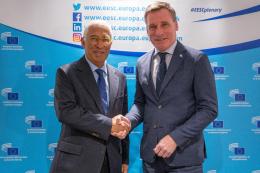
António Costa, the new President of the European Council, used his first appearance at the European Economic and Social Committee (EESC) to share his key priorities for the EU. He highlighted competitiveness as the basis for Europe’s future prosperity and reiterated his commitment to combining competitiveness with social rights to secure a sustainable future for Europe. In line with this, EESC President Röpke highlighted that the EU needs to strive for a competitiveness works for the many, not the few.
argues that, to be competitive in the area of general-purpose AI, Europe must invest in secure connectivity and resilient backbone infrastructure as well as in a resilient supply chain to ensure that the effects of generative AI can be harnessed for European actors and aligned with European values and needs;
recommends organising dialogues with stakeholders, including the social partners, about codes of practice in workplaces and workers' rights in the context of GPAI;
stresses that coordinated European and national investment in innovation and mobilisation of the tools of competition policy are needed in order to combat a market concentration dominated by large, often non-European, digital companies and to help develop EU value chains and value creation in AI.