
European Economic
and Social Committee
EESC urges fast-track EU crackdown on third-country e-commerce platforms
The European Economic and Social Committee (EESC) is pressing the EU to urgently tighten rules on third-country e-commerce platforms such as Temu and Shein, warning that their rapid expansion is undermining fair competition, consumer protection and regulatory compliance.
In an opinion adopted at its September plenary session, the EESC said the EU’s toolbox for safe and sustainable e-commerce, published in February 2025, was highly useful but 'lacked urgency' and must be implemented without delay, backed by coordinated enforcement at EU, national and regional level.
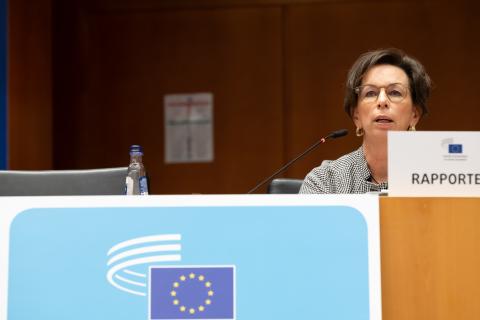
Rapporteur of the opinion, Antje Gerstein, said a strong political will was needed for a coordinated approach towards Temu, Shein and other third country e-commerce operators, with stronger enforcement of existing rules at EU, national and regional level.
'Harmonised action is essential to hold third country platforms accountable for unfair competition, tax evasion, and non-compliance with EU standards on product safety, waste, sustainability and consumer and workers' rights. A truly level playing field is needed for a fair competition for all market operators, also those from outside the EU', Ms Gerstein said.
The EESC cited soaring volumes to illustrate the scale: between 2016 and 2022 the share of EU consumers buying from non-EU sellers rose 36%; in 2024, the EU received 4.6 billion low-value parcels or about 12 million a day, with over 91% of items cheaper than EUR 150 coming from China. Every day, an estimated 400 000 Temu or Shein parcels arrive in Germany alone.
Random tests, recently conducted by several commerce or industry associations on the products of those platforms, revealed that none of the tested products were fully compliant with EU law and many failed to meet safety and environmental standards. Many non-EU platforms lack transparency with regard to their supply chains, workers’ rights and labour conditions, with some being highly exposed to risks of forced and child labour, as highlighted in the EESC opinion.
The EESC also flagged repeated breaches of consumer law, such as fake discounts, pressure selling and manipulative gamification, and called for tougher enforcement of the Price Indication Directive, Digital Services Act obligations, and waste/packaging rules, noting that disposal costs are often shifted to others.
The EESC called for rapid customs reform, urging Member States to give the Commission an immediate mandate to develop a Customs Data Hub to ensure a coordinated customs clearance of parcels from third countries destined for European end consumers. This would counter undervaluation, shipment-splitting and misuse of the Import One-Stop Shop (IOSS), practices that audits have shown to be widespread. The EESC also backed the Commission’s move to introduce a package handling fee for parcels from third countries.
To close accountability gaps, platforms must appoint an EU-based responsible economic operator with full legal liability, as required by the Digital Services Act. They must be treated as central actors in the supply chain. For this purpose, the Consumer Protection Cooperation (CPC) network should be used.
The EESC proposed 12 short-, medium- and long-term measures that will lead to fair competition and thus meet the requirements for a Social Market Economy:
- Short term: mandate an EU-based responsible operator; abolish the EUR 150 customs duty exemption; step up IOSS use with real-time data-sharing; intensify copyright protections and prosecution of large-scale plagiarism; and pursue anti-competitive practices.
- Medium term: roll out a deemed importer model EU-wide; move towards de facto mandatory IOSS for platforms; coordinate VAT/customs audits; invest in staff, training and AI-supported tools for customs and market surveillance.
- Long term: accelerate e-commerce reforms in the EU Customs Code (well before 2028); build a unified digital customs/compliance monitoring system; harmonise platform liability across the EU.