The European Economic and Social Committee (EESC) hosted on 2nd March the 7th Meeting of the representatives of African and EU economic and social stakeholders, a virtual event where speakers discussed the future of the EU-Africa partnership with a special focus in the fight against the COVID-19 pandemic and its consequences.
The European Economic and Social Committee (EESC) has adopted its position on the EU's economic priorities for 2021. It welcomes the steps taken in the strategy to address the challenges of the COVID-19 pandemic in the context of the European Green Deal, but is disappointed that the strategy proposed by the European Commission devotes too little attention to social issues. It also warns against phasing out support measures too early and advocates establishing new fiscal rules that will reflect social and economic realities after the pandemic.
Merely consulting organised civil society on the Conference on the Future of Europe will not be enough. Its participation must be meaningful and its input must shape the Conference's decisions, said speakers at the opening of the 2021 EESC Civil Society Days.
Il Comitatoeconomico e socialeeuropeo (CESE) approva la propostadellaCommissione in materia di ristrutturazione, sottolineando che essamigliorerà il benessere dei cittadini.
Members of the European Economic and Social Committee (EESC) and representatives of the Montenegrin organised civil society held on the 1st March the 14th meeting of the EU-Montenegro Joint Consultative Committee (JCC), which took place online. Members of the JCC adopted a joint declaration urging the EU to assist Montenegro to face the devastating consequences of the COVID-19 pandemic in the country.
Il Comitatoeconomico e socialeeuropeo (CESE) approva il pacchetto sulla finanzadigitalepropostodallaCommissioneeuropea. La digitalizzazioneoffregrandiopportunità, ma comportaancherischi per il settorefinanziariodell'UE che non vannosottovalutati e sui qualibisognaintervenirerapidamente.
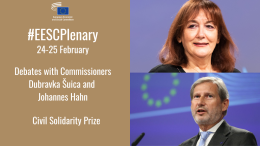
24 February, 2.45 pm DubravkaŠuica, European Commission Vice-President for Democracy and Demography, will bring the EESC up to speed on the Conference on the Future of Europe, which looks set to begin soon with the end of the stalemate over the presidency and the Council position out in the open.
25 February, 10 am Johannes Hahn, European Commissioner for Budget and Administration, will hear the findings of a pan-European EESC investigation into the Involvement of organised civil society in the national recovery and resilience plans– What works and what does not? An EESCresolution flagging areas where more civil society engagement would make for better national plans will be put to the vote straight after the debate.
25 February, 11 am The EESC plenary will review the Committee's role and action during the COVID-19 pandemic and celebrate the impressive solidarity demonstrated by civil society across Europe in its many forms through the winners of the EESCCivil Solidarity Prize.
On behalf of the European Economic and Social Committee I want to congratulate Ms NgoziOkonjo-Iweala on her appointment as Director-General of the World Trade Organization and I wish her a successful mandate. This appointment in itself brings wind of a much awaited change and marks a historic achievement.
Nel corso di una tavolarotonda ad alto livelloorganizzata dal Comitatoeconomico e socialeeuropeo (CESE), i membri del Comitato e le partiinteressatehannosottolineato che la ristrutturazioneediliziapotrebbeaiutarel'Europa a usciredallacrisi, ma che essadeveessereaccompagnata da misure per affrontare il problema
Despite being a party to the Aarhus Convention since 2005, the European Union is still not fully complying with its "access to justice" provisions. In its opinion adopted on 27 January, the European Economic and Social Committee (EESC) welcomes the Commission's proposal to revise the EU Aarhus Regulation as a step forward in improving access to administrative and judicial review procedures in environmental matters for citizens and NGOs. However, the Commission does not go far enough. Civil society organisations are asking the EU for stronger enforcement mechanisms to deliver effectively on the Aarhus Convention and on the European Green Deal.