Le Comité économique et social européen (CESE) et la Commission consultative des mutations industrielles (CCMI) estiment que la résilience actuelle et future des matières premières critiques est une préoccupation essentielle de la société civile organisée de l’UE.
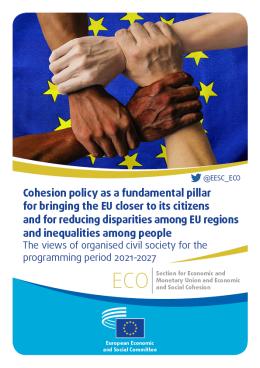
Cette brochure présente les avis du CESE relatifs à la politique de cohésion pour la période post-2020. Cette publication démontre le rôle important joué par les représentants de la société civile organisée au cours de cette période quant à leur influence sur les décideurs, qui a mené à l'adoption d'un certain nombre de paquets politiques importants concernant la prochaine période de programmation. Le CESE a été la première institution européenne à contribuer au développement de la nouvelle période de programmation (2021-2027).
Cette brochure présente les avis, prises de position, résolutions et déclarations du CESE appelant à prendre les mesures nécessaires au niveau de l'UE, ou commentant celles qui ont déjà été avancées, afin de faire face aux conséquences économiques de la pandémie de COVID-19. Nous avons mis en avant un plan de reconstruction et de relèvement à la hauteur de ce défi sans précédent.
Dans cette brochure, nous avons réuni une série d’avis relatifs au Semestre européen, ainsi qu’un rapport d’information, dans lesquels le CESE a formulé des recommandations politiques sur les différents éléments qui relèvent du Semestre.
Cette étude se concentre sur l’utilisation des trilogues et des accords précoces dans l’Union européenne (UE). De nos jours, les trilogues constituent le mode opératoire normalisé pour l'obtention d’un accord entre la Commission européenne, le Parlement européen et le Conseil de l’UE. L’utilisation des trilogues a longtemps suscité des préoccupations concernant la transparence et la responsabilité publique. Beaucoup a déjà été fait pour améliorer la manière dont les équipes de négociation de chaque institution sont tenues responsable devant leurs institutions respectives.
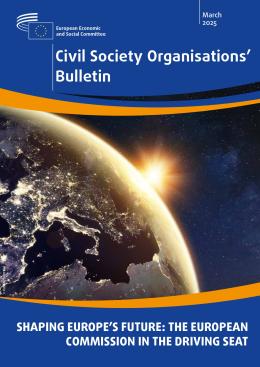
Shaping Europe's future: the European Commission in the driving seat
In this issue:
Members comment on the European Commission 2025 Work Programme
Guest articles by Juan Antonio PEDREÑO (Social Economy Europe and Spanish Confederation of Social Economy Enterprises), Hans DE VRIES (EU Agency for Cybersecurity) and Vincent DAVID (Max Havelaar France)
Interview with Cillian LOHAN, designated candidate for the 2025-2028 Presidency of the Civil Society Organisations’ Group
Interview with rapporteur Ariane RODERT on civil preparedness (EESC opinion SOC/812)
After the European elections, what agenda for the EU?
In this issue:
Our members share their expectations and proposals for the EU agenda 2024-2029
Guest articles by László Bercse (Vice-President, Inclusion Europe), Rareș Voicu (President, European Youth Forum) and Radu Caragea-Szucs (Vice-President, Funky Citizens)
Special interview with EESC Vice-President Aurel Laurenţiu Plosceanu on the European elections
Report on our recent conference on 'The State of Health in the EU'
Interview with rapporteur Stoyan Tchoukanov on the EESC opinion 'Promoting autonomous and sustainable food production: strategies for the Common Agricultural Policy post-2027'