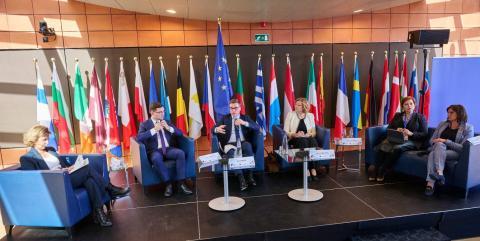
Le 26 mars 2025, le groupe des employeurs a organisé un débat avec des représentants des institutions de l’Union et de l’industrie européenne de la sécurité et de la défense.
Aux États-Unis, des responsables politiques démocrates ont récemment demandé à des électeurs de définir leurs priorités en sélectionnant une proposition parmi les deux qui leur étaient présentées. Les répondants ont à chaque fois dû choisir entre la capacité à joindre les deux bouts et un autre sujet de préoccupation.
Les discussions sur le prochain cadre financier pluriannuel (CFP) sont déjà bien engagées, avec en point de mire la proposition, très attendue, que la Commission européenne doit présenter en juillet.
À ce jour, l’emblématique prix de la société civile du CESE a été décerné à quinze reprises. Il récompense les projets qui adoptent une approche particulièrement créative et innovante face à des enjeux qui présentent un intérêt majeur pour l’UE.
À ce jour, l’emblématique prix de la société civile du CESE a été décerné à quinze reprises. Il récompense les projets qui adoptent une approche particulièrement créative et innovante face à des enjeux qui présentent un intérêt majeur pour l’UE.
Toute organisation de la société civile officiellement enregistrée dans l’Union européenne et agissant au niveau local, régional, national ou européen peut déposer sa candidature. Le prix est également ouvert aux particuliers résidant dans l’UE, ainsi qu’aux entreprises enregistrées ou opérant au sein de l’Union, pour autant que leurs projets soient strictement sans but lucratif.
Pour être admissibles, les initiatives et projets doivent tous être déployés sur le territoire de l’Union. Leur mise en œuvre doit être déjà terminée ou encore en cours à la date limite de dépôt des candidatures.
L’objectif de ce prix est de sensibiliser le public à la contribution exceptionnelle que la société civile peut apporter à la création d’une identité et d’une citoyenneté européennes ainsi qu’à la promotion des valeurs communes sur lesquelles se fonde l’intégration européenne.
Un thème différent est choisi chaque année. En 2023, les projets étaient axés sur la santé mentale. En 2022, le CESE avait exceptionnellement décerné un prix pour deux enjeux: la jeunesse et l’Ukraine. En 2021, le prix avait mis à l’honneur des projets climatiques promouvant une transition juste. En 2020, le Comité avait remplacé son prix de la société civile par un unique prix de la solidarité civile, consacré à la lutte contre la COVID-19. Parmi les autres thèmes couverts par les éditions précédentes figuraient l’égalité des sexes et l’émancipation des femmes, les identités européennes et le patrimoine culturel en Europe, ainsi que la migration.
En octobre 2024, le CESE a décidé de consacrer son quinzième prix de la société civile à la lutte contre l’émergence de clivages néfastes dans la société européenne.
Le thème de la polarisation est plus urgent que jamais. Dans un contexte marqué par la superposition de plusieurs crises dont la pandémie de COVID-19, la guerre menée par la Russie en Ukraine ainsi que l’instabilité sociale et économique généralisée, la méfiance à l’égard des institutions et des autorités publiques s’est accrue, suscitant une polarisation néfaste.
La société civile joue un rôle clé dans la lutte contre cette méfiance et dans la surveillance des foyers de radicalisation de l’opinion, en ligne et hors ligne, dans l’amélioration de la cohésion sociale et dans la sauvegarde des idéaux démocratiques. Au côté des pouvoirs publics et de la société civile, elle peut contribuer à protéger la démocratie libérale des tendances autoritaires.
C’est la raison pour laquelle le Comité a décidé de décerner son dernier prix de la société civile à des initiatives à but non lucratif qui interviennent efficacement pour mettre en place des actions de prévention, des dispositifs d’alerte en amont et, si nécessaire, des mesures de désescalade afin de veiller à ce que les valeurs démocratiques soient protégées, que les clivages ne deviennent pas néfastes, et que les rhétoriques partisanes n’aboutissent pas à des actes de violence.
La responsabilité de renforcer la cohésion pour lever les clivages qui divisent les sociétés incombe aux organisations de la société civile, qui ont la force et la motivation de protéger les espaces civiques et démocratiques. Tel est le principal message envoyé lors de la Semaine de la société civile, organisée pour la deuxième année par le Comité économique et social européen (CESE) afin d’examiner la tendance alarmante à la polarisation généralisée des sociétés de l’UE.
La responsabilité de renforcer la cohésion pour lever les clivages qui divisent les sociétés incombe aux organisations de la société civile, qui ont la force et la motivation de protéger les espaces civiques et démocratiques. Tel est le principal message envoyé lors de la Semaine de la société civile, organisée pour la deuxième année par le Comité économique et social européen (CESE) afin d’examiner la tendance alarmante à la polarisation généralisée des sociétés de l’UE.
Plus de 800 participants, notamment des représentants d’organisations de la société civile (OSC), d’ONG et d’organisations de jeunesse, ainsi que d’autres acteurs concernés et des journalistes, se sont réunis au CESE du 17 au 20 mars à l’occasion de la Semaine de la société civile, où ils ont pu procéder à des échanges de vues et débattre des moyens de renforcer la cohésion et la participation dans des sociétés marquées par les clivages.
Durant la Semaine de la société civile, quatorze séances ont été organisées par des membres du Groupe de liaison du CESE et des partenaires de la Journée de l’initiative citoyenne européenne (ICE), y compris la cérémonie de remise du prix de la société civile du CESE. Les participants ont élaboré un arsenal complet de mesures réalisables et de demandes clés pour des sociétés plus cohésives, notamment:
renforcer la cohésion par l’éducation et la culture;
fournir des logements abordables et durables;
renforcer la participation publique grâce à l’ICE;
assurer une transition juste et inclusive et une croissance verte et bleue;
construire une stratégie européenne forte relative à la société civile;
renforcer le soutien et le financement des organisations de la société civile;
faire participer les jeunes à l’élaboration d’une Europe plus forte et plus résiliente;
stimuler l’innovation et la technologie au service du bien commun.
Lors de la séance de clôture, Oliver RÖPKE, président du CESE, a déclaré: «Alors que cette deuxième édition de la Semaine de la société civile touche à sa fin, je suis profondément inspiré par l’énergie, la résilience et l’engagement des acteurs de la société civile de toute l’Europe. Cette semaine, nous avons pu montrer que lorsqu’elle se réunit, la société civile est capable d’apporter des solutions qui renforcent notre démocratie, favorisent la cohésion sociale et participent à la construction d’une Europe véritablement au service de ses citoyens.»
Henna VIRKKUNEN, vice-présidente exécutive de la Commission européenne chargée de la souveraineté technologique, de la sécurité et de la démocratie, a mis en évidence le rôle crucial que jouent les OSC pour guider les sociétés dans le respect des valeurs fondamentales européennes.
Victor NEGRESCU, vice-président du Parlement européen, a lancé un appel pressant à l’action, demandant aux OSC de déployer leur force pour réagir aux discours agressifs: «Nous avons besoin d’une société civile robuste et d’un véritable partenariat entre elle et les décideurs afin de pouvoir bâtir ensemble une société cohésive ayant un impact réel sur la vie des citoyens.»
Les représentants des OSC ont souligné que les sociétés civiles n’étaient pas que des prestataires de services, mais bien un rouage essentiel des systèmes démocratiques et participatifs. Nataša VUČKOVIĆ, secrétaire générale de la Fondation du Centre pour la démocratie en Serbie, a fait part de son optimisme quant à la contribution essentielle que peut apporter la société civile pour lutter contre les causes profondes et la propagation des discours antidémocratiques et anti-européens, tant au sein de l’Union que dans les pays candidats. Nous pouvons y parvenir en analysant attentivement l’Union européenne et en faisant en sorte que les avantages qu’elle offre profitent à tous les citoyens dans leur quotidien. (at)
Les propositions omnibus pourraient constituer une première étape importante vers la simplification réglementaire. Nous saluons l’initiative de la Commission, une avancée concrète qui devrait être suivie d’autres mesures similaires. Toutefois, il est essentiel que ce processus respecte les normes élevées en matière environnementale, sociale et de droits de l’homme.
Ministère du Développement économique et de la Technologie, Varsovie (Pologne)
Varsovie
Poland
Depuis quelques années, nos entreprises évoluent dans un environnement mondial moins stable, moins prévisible et moins sûr. Or, l’intégration économique mondiale n’a jamais été aussi poussée. Ce paradoxe apparaît de manière particulièrement évidente dans les interactions complexes entre l’UE, les États-Unis et la Chine. La réunion extraordinaire du groupe des employeurs à Varsovie sera l’occasion de réfléchir à des actions concrètes pour donner corps à cette vision, dans le but d’améliorer la compétitivité et la résilience et de renforcer ainsi l’autonomie stratégique ouverte de l’UE.
Dans son avis d’initiative, le Comité économique et social européen (CESE) insiste sur le fait que la suppression progressive des subventions aux combustibles fossiles est une étape nécessaire dans la transition écologique de l’Europe. L’idée est de réduire l’incidence du système énergétique sur l’environnement, tout en préservant la compétitivité et en atténuant la crise du coût de la vie. Il est toutefois important que ce processus soit équitable, réaliste et adapté aux besoins propres à certains secteurs tels que l’agriculture.