
European Economic
and Social Committee
Reform the European Semester for the effective participation of organised civil society, asks EESC
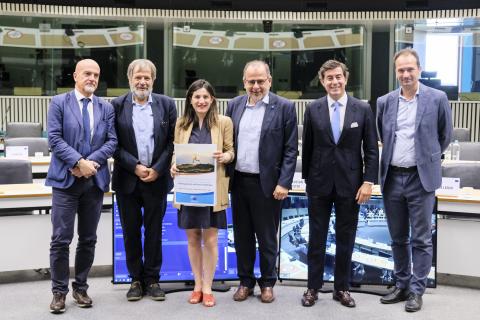
A resilient, sustainable and inclusive Europe is only possible if organised civil society is systematically involved in both national recovery plans and the Commission's new REPowerEU strategy. During its annual conference in June, the European Semester Group (ESG) renewed its call for a regulation or directive to ensure civil society participation, and proposed a permanent and common investment financing mechanism to enhance crisis preparedness and response capacity.
The conference of 2 June followed the recent adoption of a new Committee resolution on the involvement of organised civil society in the implementation and monitoring of national recovery and resilience plans (NRRPs). Member States must submit these plans to benefit from the Recovery and Resilience Facility (RRF), the EU's largest ever financial support programme. The RRF Regulation makes it clear that organised civil society should be involved in the implementation, monitoring, and adjustment of the NRRPs, however in practice this is rarely the case.
The conference picked up where the resolution left off and gathered speakers from EU institutions, organised civil society, Member States and research institutes to hold a discussion on the reform and future role of the European Semester, which will be overseeing the implementation of the NRRPs.
EESC President, Christa Schweng, opened by stating that our reflection on the EU's economic governance framework must consider both current and future challenges. The Europe of tomorrow must be based on a prosperity-oriented, inclusive, and green and digital economic model. Organised civil society has a crucial role to play in achieving this.
Elisa Ferreira, Commissioner for Cohesion and Reforms, continued: as we think about future crises and making Europe more resilient, we need to think not in terms of one master tool, but instead in terms of many tools and a well-stocked toolbox. In other words: we need diversification
.
A permanent EU instrument for crisis preparedness and response?
To succeed in the recovery and the green and digital transitions and to gain strategic autonomy, the EU will need massive public and private investments in the years to come. The NRRPs could serve as a basis for moving towards these common goals. In the first debate of the day, the panellists discussed whether these recovery plans should be made structural and permanent to ensure common investment in key areas. The renewed approach will be influenced by the current energy situation. Europe needs energy independence. Let us use this opportunity to transform our system,
stated Javier Doz Orrit, President of the European Semester Group. Moderator and ECO section President, Stefano Palmieri, insisted on the need to ensure a genuine structural transformation of the system
.
Reforming EU economic governance
The European Semester still plays a key role as the framework surveying and coordinating fiscal, macroeconomic and structural policies across the economic and monetary union. However, with the multiple new challenges facing the EU since its introduction in 2010, it needs to be updated, strengthened, and opened to European organised civil society,
explained ESG Vice-President Gonçalo Lobo Xavier. Continuing on this idea, Brikena Xhomaqi, co-chair of the EESC Liaison Group, insisted that recovery will succeed only if European organised civil society is systematically involved
. Joining the debate, MEP Dragoș Pîslaru commented that instead of trying to outlaw bad policies, the new Semester should be a visible voice of reason that supports an informed debate for sound policies
.
What’s next?
Luca Jahier, Vice-President of the European Semester Group, closed the conference by acknowledging the importance of the RRF and the NRRPs in ensuring the EU's energy autonomy and accelerating its clean energy transition. With these tools, we have perhaps done much more in these last 2 years than in the last 20 years,
he said. What is needed now is to ensure the effective and qualitative participation of organised civil society in the economic governance of the EU, invest more, and further accelerate the transition
.
Work organisation
Downloads
-
Reform the European Semester for the effective participation of organised civil society, asks EESC
Recommended for you
Tetyana Ogarkova: "The day of victory will come but it will not bring normality back"
Agenda
On 24 February 2022, the lives of millions of Ukrainians were turned upside down. Now, when we say the word "victory", we expect that day to be the way things used to be. A normal day, a day of peace…
Lutte contre la précarité énergétique: garantir un approvisionnement énergétique abordable devrait figurer au premier rang des priorités politiques des pays de l’UE
News
Alors que le nombre de ménages qui sont dans l’incapacité de chauffer leur logement va vraisemblablement augmenter dans l’Union, avec une inflation annuelle de l’énergie qui dépasse 40 %, il y a…
Les zones rurales ont le potentiel pour produire davantage de résultats
News
Si l’attrait de la vie à la campagne s’est accru ces toutes dernières années, de nombreuses zones rurales de l’Union restent confrontées à un certain nombre de problèmes qui dissuadent les personnes…
Pour lutter contre le sans-abrisme, il faut une approche globale et une action collective
News
Le 7 octobre dernier, le Comité économique et social européen (CESE) a tenu une conférence sur le sans-abrisme et les moyens d’éradiquer ce phénomène d’ici à 2030, en appliquant le principe du…
Un rôle actif pour la société civile organisée est essentiel à la résilience de l’Union européenne
News
Le CESE a tenu un débat en session plénière sur l’importance croissante de la société civile organisée et des villes pour mettre l’Europe en capacité de faire face aux chocs asymétriques et aux…