
European Economic
and Social Committee
President Mallia's speech at the EESC's Kick-off event on the Conference on the Future of Europe
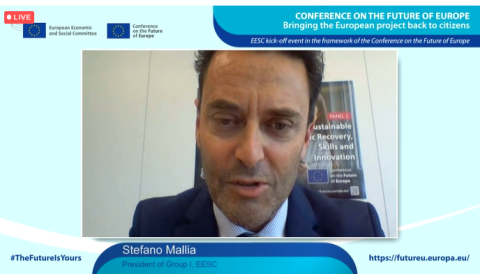
Dear Mr Oettinger,
Dear Ms Bollow,
Distinguished guests,
Dear friends,
It is a great pleasure to be here with you today to kick-off the EESC's activities of the Conference on the Future of Europe, one month after its official launch in Strasbourg.
Today's event is indeed a timely one. As we emerge from the pandemic, we are all invited to actively play a leading role in co-shaping a new vision for the EU and indeed a re-shaping of what our new normal should or could look like.
We all have our own visions and ideas when we think about the future of Europe. For me and for the Employers' Group, this would be a prospering Europe that successfully recovers from the COVID-19 crisis, and leads the world in the green and digital transitions. It’s a future that can offer companies of all sizes the chance to become more productive,competitive, generate growth and create more jobs. It is also one where we can afford to offer each European Citizen a good quality of life.
I believe that now, more than ever, we need to be creative and courageous to reassess and adapt to the fast-paced, complex and unpredictable global environment.
But where do we start?
Investing in skills fit for the future
First and foremost, I believe that we must invest in people and in skills that make it possible for us to build the future we want. If our European industries are to lead in the digital future, Europe’s workforce needs the skills to get the job done.
The fact that we are connected to this virtual event today means we enjoy a certain level of digital competence. It’s something we take for granted and it’s easy to forget that just two years ago, nearly half of the EU population (42%) was unable to perform basic tasks such as connect to the wi-fi network or use websites.
But Europe still lacks skilled ICT specialists to fill the growing number of job vacancies in all sectors of the economy because 90% of all jobs are projected to require some level of digital skills.
It is more than clear that to succeed in this evolving dynamic a number of key ingredients are needed :
- First, our national education and training systems should be rapidly modernised, paying particular attention to solid competencies in the so-called STEM, science, technology, engineering and mathematics but also cross-cutting skills such as logical reasoning, critical thinking, creativity and entrepreneurial skills through new and creative ways of teaching and learning.
- Second, we need to enhance further the culture of life-long learning that will help employers to easily recruit a skilled workforce and, at the same time, ensure workers’ continued employability and career development.
- Third, we need to reinforce links between businesses and education providers, promoting and expanding access to dual-learning systems, such as those taking place in vocation education and training (VET) and apprenticeships.
- Fourth, we should make full use of the financial resources, particularly those available through the Recovery and Resilience Facility. Through the ‘Reskill and Upskill’ flagship, Member States can tap part of the 671 billion euros in financial support to foster digital skills for our citizens. And this comes on top of the EU’s multiannual budget, which includes funding under the European Social Fund Plus that supports programmes to build basic digital literacy.
Let me conclude by saying that the Conference on the Future of Europe offers us the unique occasion to engage in a constructive discussion and to rally around a common vision, just as previous generations did.
The EU was built with common values and a common vision of peace and prosperity. But these values and vision were deep-rooted in concrete economic foundations.
Today, as we consider our future – and as we move from coal and steel to a carbon-free and digital economy, the same holds true. If we want the EU to deliver prosperity and enhance the well-being of our societies, we need to look back and start from our foundations.
And here I am thinking of the Single Market, which is – as we all know - one of our greatest assets with millions of consumers and an economy worth 15.9 trillion euros, meaning more than China and almost as much as the US. And the Single Market is one of the strongest tools to make the most of Europe’s scale and build strong and competitive industries for the future.
This is why, as employers we believe that the completion of the Single Market too has to be a top priority for the EU today.
The Conference on the future of Europe is the moment where we must deliver meaningful action to our citizens and this initiative will only make sense if at the end of it all we can deliver a Europe that makes it possible for each and every one of us to achieve a better quality of life.
Work organisation
Recommended for you
Tetyana Ogarkova: "The day of victory will come but it will not bring normality back"
Agenda
On 24 February 2022, the lives of millions of Ukrainians were turned upside down. Now, when we say the word "victory", we expect that day to be the way things used to be. A normal day, a day of peace…
Lutte contre la précarité énergétique: garantir un approvisionnement énergétique abordable devrait figurer au premier rang des priorités politiques des pays de l’UE
News
Alors que le nombre de ménages qui sont dans l’incapacité de chauffer leur logement va vraisemblablement augmenter dans l’Union, avec une inflation annuelle de l’énergie qui dépasse 40 %, il y a…
Les zones rurales ont le potentiel pour produire davantage de résultats
News
Si l’attrait de la vie à la campagne s’est accru ces toutes dernières années, de nombreuses zones rurales de l’Union restent confrontées à un certain nombre de problèmes qui dissuadent les personnes…
Pour lutter contre le sans-abrisme, il faut une approche globale et une action collective
News
Le 7 octobre dernier, le Comité économique et social européen (CESE) a tenu une conférence sur le sans-abrisme et les moyens d’éradiquer ce phénomène d’ici à 2030, en appliquant le principe du…
Un rôle actif pour la société civile organisée est essentiel à la résilience de l’Union européenne
News
Le CESE a tenu un débat en session plénière sur l’importance croissante de la société civile organisée et des villes pour mettre l’Europe en capacité de faire face aux chocs asymétriques et aux…