
European Economic
and Social Committee
From Principles to Partnership: EESC Advances Global Finance Reform at FFD4 in Seville
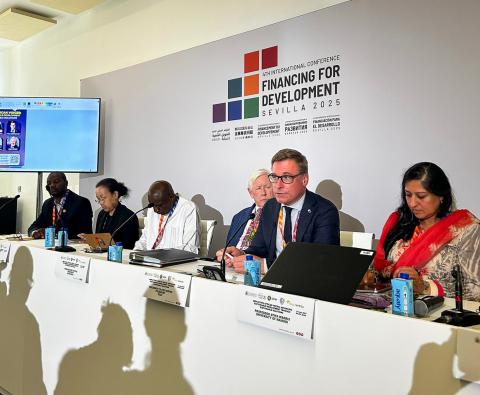
From 30 June to 2 July 2025, the European Economic and Social Committee (EESC) brought civil society priorities to the forefront at the Fourth International Conference on Financing for Development (FFD4) in Seville, calling for a fairer and more inclusive global financial system. Leading the EESC delegation, President Oliver Röpke took part in a series of high-level engagements and public events, reaffirming the Committee’s commitment to climate justice, accountable financing, and meaningful civil society participation in global decision-making.
During the event President Röpke signed a Joint Presidential Declaration with the African Union’s Economic, Social and Cultural Council (AU ECOSOCC), in the presence of Bob Rae, President of the UN Economic and Social Council (ECOSOC). The declaration shared civil society priorities for climate justice, equitable access to finance, and the structural transformation of global economic governance.
A Strong Institutional Presence at FFD4
President Röpke’s programme began with participation in the FFD4 high-level opening session, where he joined global leaders in setting the tone for a reimagined financial framework for development.
That same day, he participated in a panel at the FEPS Europe side event on “New Strategic Partnerships for Development,” alongside global leaders such as, Aminata Touré and Fernando Sampedro, to call for inclusive, locally driven and trust-based approaches.
“We must move beyond top-down models and rethink the rules, not just the tools, of global finance,” President Röpke told the audience. “Development finance must be built on trust, shaped by local priorities, and co-created with civil society.”

President Röpke also held several bilateral meetings with Mahmoud Mohieldin, UN Special Envoy on Financing the 2030 Agenda, and Jeffrey D. Sachs, President of SDSN and Columbia University Professor, to discuss sustainable financing, debt relief, and civil society’s role in the SDG agenda.
He later spoke at the “Amplifying African Voices” side event, where he reiterated the need for financial fairness, effective debt restructuring, and the formal inclusion of community voices in all levels of decision-making.
“Civil society is not a stakeholder to be consulted at the end, it must be a partner from the start. This is the principle we brought to Seville and the foundation we are building with our African counterparts”, said President Röpke.
Downloads
-
Joint Presidential Declaration EESC - AU ECOSOCC
Recommended for you
Tetyana Ogarkova: "The day of victory will come but it will not bring normality back"
Agenda
On 24 February 2022, the lives of millions of Ukrainians were turned upside down. Now, when we say the word "victory", we expect that day to be the way things used to be. A normal day, a day of peace…
Lutte contre la précarité énergétique: garantir un approvisionnement énergétique abordable devrait figurer au premier rang des priorités politiques des pays de l’UE
News
Alors que le nombre de ménages qui sont dans l’incapacité de chauffer leur logement va vraisemblablement augmenter dans l’Union, avec une inflation annuelle de l’énergie qui dépasse 40 %, il y a…
Les zones rurales ont le potentiel pour produire davantage de résultats
News
Si l’attrait de la vie à la campagne s’est accru ces toutes dernières années, de nombreuses zones rurales de l’Union restent confrontées à un certain nombre de problèmes qui dissuadent les personnes…
Pour lutter contre le sans-abrisme, il faut une approche globale et une action collective
News
Le 7 octobre dernier, le Comité économique et social européen (CESE) a tenu une conférence sur le sans-abrisme et les moyens d’éradiquer ce phénomène d’ici à 2030, en appliquant le principe du…
Un rôle actif pour la société civile organisée est essentiel à la résilience de l’Union européenne
News
Le CESE a tenu un débat en session plénière sur l’importance croissante de la société civile organisée et des villes pour mettre l’Europe en capacité de faire face aux chocs asymétriques et aux…