
European Economic
and Social Committee
Civil Society Organisations’ Group calls for turning up the volume for civil society
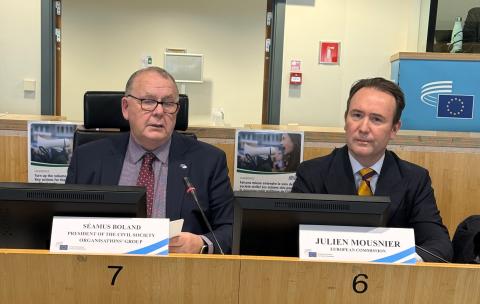
The European Economic and Social Committee (EESC) must be involved from the outset in the European Commission’s initiatives to step up engagement with civil society. The EESC’s upcoming study on Mapping civil dialogue practises in the EU institutions and its 2025 Civil Society Week (17-20 March) can provide valuable input, according to the EESC’s Civil Society Organisations’ Group.
Following the start of the EU’s new political cycle, and the announcement of an EU strategy to support, protect and empower civil society for the third quarter of 2025 in the Commission Work Programme[1], the Civil Society Organisations’ Group held a conference to highlight key actions needed for the 2024-2029 term. The event on 3 March was attended by around 100 representatives from national and European civil society organisations (CSOs) and citizens.
Séamus Boland, the President of the Civil Society Organisations’ Group, said that CSOs have a role to play in ensuring that policy-making is informed and responsive to people’s needs. He reiterated the Group’s and the Committee’s call for the EESC to be involved in the Civil Society Platform planned by the Commission. ‘The EESC, with its experience and the platform it provides, must be involved from the outset in the European Commission’s initiatives to step up engagement with civil society. The EESC must take part in the governance and be a key part of the initiative on the creation of a Civil Society Platform.’
Mr Boland argued that structured, regular, transparent and inclusive civil dialogue should be built on existing structures and bring together all relevant stakeholders. Consequently, the European institutions should create a working group on civil dialogue, facilitated by the EESC. ‘A working group on civil dialogue could create a blueprint for a more enabling environment for civil society organisations in the policy-shaping process.’ This could be a first step towards more structured civil dialogue and tackle the following questions: who is consulted, on which topics, along which timelines, with what outcomes?
The proposed working group could furthermore draw on the EESC’s upcoming study of existing dialogue practices, entitled Mapping civil dialogue practises in the EU institutions[2]. The preliminary findings of the study were presented in the framework of the event by Berta Mizsei from the Centre for European Policy Studies (CEPS).
The conference also highlighted that the financial health of CSOs is a precondition for dialogue and connecting policy-makers with the needs of people. Their financial stability and independence must be guaranteed.
The next opportunity to keep the topic of establishing a genuine civil dialogue on the agenda and continue the discussion will be Civil Society Week, held by the EESC on 17-20 March 2025, on the theme of Strengthening cohesion and participation in polarised societies.
The Group’s demands build on its work to strengthen civil society and democracy, including an Open Letter for open, transparent and regular dialogue with civil society in all policy areas, which the Group initiated together with Civil Society Europe. They are also in line with the EESC’s recent work, including the opinion SOC/782 Strengthening civil dialogue and participatory democracy in the EU: a path forward and the EESC resolution Contribution to the 2025 European Commission’s work programme.
[1] European Commission, Factsheet 2025 Work Programme, https://commission.europa.eu/document/download/537a45af-ad64-494c-a165-6410b10657b0_en?filename=CWP_2025_explained_en.pdf
[2] The study was commissioned by the EESC at the request of the Civil Society Organisations’ Group. Results are expected to be available as of July 2025. The study undertakes a comprehensive mapping of civil dialogue practices within the EU institutions: which processes of involving CSOs are currently being organised and using which kind of methodology? Knowledge on existing practices should inform and support the work towards more structured civil dialogue in the new legislative cycle.
Work organisation
Downloads
-
News - Civil Society Organisations’ Group calls for turning up the volume for civil society
Recommended for you
Tetyana Ogarkova: "The day of victory will come but it will not bring normality back"
Agenda
On 24 February 2022, the lives of millions of Ukrainians were turned upside down. Now, when we say the word "victory", we expect that day to be the way things used to be. A normal day, a day of peace…
Lutte contre la précarité énergétique: garantir un approvisionnement énergétique abordable devrait figurer au premier rang des priorités politiques des pays de l’UE
News
Alors que le nombre de ménages qui sont dans l’incapacité de chauffer leur logement va vraisemblablement augmenter dans l’Union, avec une inflation annuelle de l’énergie qui dépasse 40 %, il y a…
Les zones rurales ont le potentiel pour produire davantage de résultats
News
Si l’attrait de la vie à la campagne s’est accru ces toutes dernières années, de nombreuses zones rurales de l’Union restent confrontées à un certain nombre de problèmes qui dissuadent les personnes…
Pour lutter contre le sans-abrisme, il faut une approche globale et une action collective
News
Le 7 octobre dernier, le Comité économique et social européen (CESE) a tenu une conférence sur le sans-abrisme et les moyens d’éradiquer ce phénomène d’ici à 2030, en appliquant le principe du…
Un rôle actif pour la société civile organisée est essentiel à la résilience de l’Union européenne
News
Le CESE a tenu un débat en session plénière sur l’importance croissante de la société civile organisée et des villes pour mettre l’Europe en capacité de faire face aux chocs asymétriques et aux…