
European Economic
and Social Committee
EESC President Röpke Meets European Commission President Ursula von der Leyen
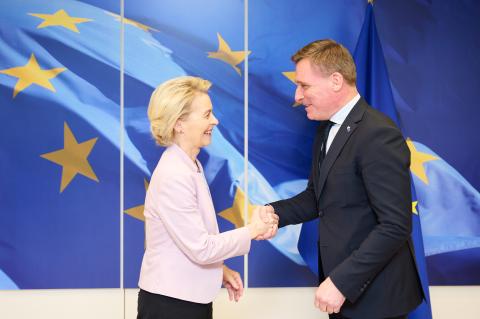
EESC President Oliver Röpke met today with European Commission President Ursula von der Leyen at the European Commission headquarters in Brussels. The meeting marked their first official bilateral discussion since President von der Leyen’s reappointment.
EC President von der Leyen and EESC President Röpke agreed that in times of geopolitical uncertainty, challenges to multilateralism and growing threats from disinformation and foreign interference, unity among the leaders of the EU institutions is of paramount importance.
During the meeting, President Röpke outlined key priorities for his mandate, emphasizing the EESC's commitment to participatory democracy, youth engagement, and civil society collaboration. He also presented the institutional reforms undertaken by the EESC under his leadership and discussed strengthening cooperation between the two institutions.
A central topic was the EESC’s Enlargement Candidate Members (ECM) initiative, which aims to involve civil society representatives from EU accession countries in the Committee’s advisory work. This initiative has proven to be a success story, and is being praised by EESC Members, Enlargement Candidate Members and social partners and civil society organisations across the EU and the candidate countries as a concrete example of gradual EU integration.
President Röpke highlighted the EESC’s strong commitment to engaging young people, particularly through the pioneering implementation of the Youth Test. This initiative ensures that youth perspectives are integrated into policy discussions by fostering direct collaboration between young people and EESC members. The Youth Test has become a model of meaningful youth engagement, with over 100 youth organisations expressing interest in participating in 2024.
The discussion also covered the EESC’s increasing international role, including its participation in major global events such as the G20 Social Summit, the UN High Level Political Forum and the UN Conference on the Status of Women.
Lastly, President Röpke extended an invitation to President von der Leyen to address an upcoming EESC Plenary Session, offering a platform for engaging with organised civil society on the Commission’s priorities for the new mandate.
This meeting reaffirmed the strong institutional relationship between the EESC and the European Commission, paving the way for even deeper cooperation in promoting democratic participation, civil society engagement, and youth empowerment across the EU.
Recommended for you
Tetyana Ogarkova: "The day of victory will come but it will not bring normality back"
Agenda
On 24 February 2022, the lives of millions of Ukrainians were turned upside down. Now, when we say the word "victory", we expect that day to be the way things used to be. A normal day, a day of peace…
Lutte contre la précarité énergétique: garantir un approvisionnement énergétique abordable devrait figurer au premier rang des priorités politiques des pays de l’UE
News
Alors que le nombre de ménages qui sont dans l’incapacité de chauffer leur logement va vraisemblablement augmenter dans l’Union, avec une inflation annuelle de l’énergie qui dépasse 40 %, il y a…
Les zones rurales ont le potentiel pour produire davantage de résultats
News
Si l’attrait de la vie à la campagne s’est accru ces toutes dernières années, de nombreuses zones rurales de l’Union restent confrontées à un certain nombre de problèmes qui dissuadent les personnes…
Pour lutter contre le sans-abrisme, il faut une approche globale et une action collective
News
Le 7 octobre dernier, le Comité économique et social européen (CESE) a tenu une conférence sur le sans-abrisme et les moyens d’éradiquer ce phénomène d’ici à 2030, en appliquant le principe du…
Un rôle actif pour la société civile organisée est essentiel à la résilience de l’Union européenne
News
Le CESE a tenu un débat en session plénière sur l’importance croissante de la société civile organisée et des villes pour mettre l’Europe en capacité de faire face aux chocs asymétriques et aux…