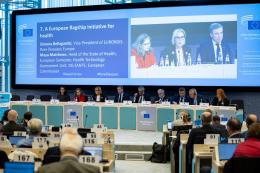
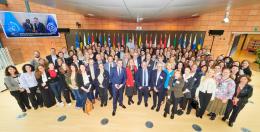
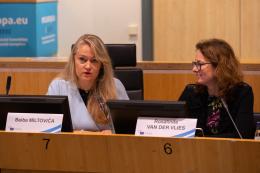
Lors de la conférence de haut niveau qu’il a organisée à Budapest, le CESE a pressé la nouvelle Commission européenne et les États membres de l’Union européenne de concevoir un cadre politique complet, assorti d’objectifs communs et mesurables, afin d’améliorer la prise en charge des maladies rares et d’accroître encore la coopération au niveau européen.
The 9th European Migration Forum, organised by the European Economic and Social Committee (EESC) and the European Commission’s Directorate-General for Migration and Home Affairs, focuses on how civil society can play a key role in the forthcoming implementation of the Pact on Migration and Asylum, while highlighting the direct work of civil society organisations on the ground.
La prochaine Commission doit être la commission de l’élargissement. La question n’est pas de savoir si l’élargissement doit avoir lieu, mais plutôt de trouver la bonne façon de le mettre en œuvre. Cette réflexion était au cœur du forum de haut niveau sur l’élargissement organisé par le Comité économique et social européen (CESE), auquel ont participé M. Oliver Röpke, président du CESE, M. Nicolas Schmit, commissaire à l’emploi et aux droits sociaux, ainsi que des ministres issus des États membres de l’UE comme des pays candidats à l’adhésion.
The European Economic and Social Committee (EESC) calls for a European flagship initiative for health, aiming to build a cross-cutting health architecture within the European Union. It also calls on the European Commission to publish an Action Plan on Rare Diseases with clearly achievable targets.
Journalists are under increasing pressure from governments and private interests that curb media freedom. On top of more familiar obstacles, they are now battling the challenges of generative AI, which, despite the many benefits it could bring, threatens to undermine the economic foundations of the profession.
Une conférence sur la gestion des déchets radioactifs organisée par le Comité économique et social européen (CESE) et la Commission européenne a souligné l’importance de tenir compte des points de vue de la société civile organisée tout en évaluant soigneusement les dernières évolutions scientifiques.
Civil society organisations, individuals and private companies can now enter their non-profit projects for the EESC’s prize dedicated to combating the harmful polarisation of European society
On 23 September, the European Commission announced the winners of the third edition of the EU Organic Awards. The European Economic and Social Committee (EESC) proudly welcomed the winners of three key categories: Best organic food processing SME, Best organic food retailer, and Best organic restaurant/food fervice.
Le Comité économique et social européen (CESE) et le Conseil économique, social et culturel (ECOSOCC) de l’Union africaine ont présenté ce jour une déclaration conjointe lors du Sommet de l’avenir organisé par les Nations unies à New York, laquelle met en avant le rôle crucial que joue la société civile pour remédier aux problèmes d’ordre mondial et faire progresser le développement durable.
In its effort to lead global climate action, the European Union should set an ambitious target for 2040, aiming to reduce net greenhouse gas emissions by 90%, in line with its broader goal of achieving climate neutrality by 2050. This target, endorsed by the European Economic and Social Committee (EESC) at its September plenary session, aligns with the scientific consensus on the need to limit global warming to 1.5°C.