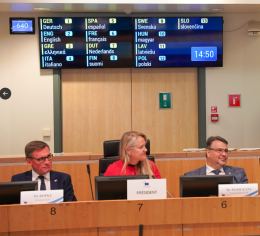
The EESC is the first EU body to offer concrete recommendations on using digital tools to improve law-making – an area still plagued by complexity and opacity. With 18 000 pages of binding legislation added each year and annual administrative costs reaching €150 billion, AI could be a gamechanger in making EU laws more accessible to Europeans.
Lors de sa session plénière de juin, le CESE a adopté un avis exhortant l’Europe à diversifier son système énergétique et à innover dans ce domaine afin de garantir la stabilité et de concrétiser la décarbonation.
The European Economic and Social Committee (EESC) has adopted a new opinion urging the EU to place reindustrialisation at the heart of its response to the cost-of-living crisis. This is part of a broader EESC strategy aimed at tackling Europe’s ongoing cost-of-living crisis through a series of sectoral and umbrella opinions. The Committee argues that a stronger industrial base is key for securing quality jobs, boosting innovation and strengthening Europe’s economic resilience.
Le 25 juin 2025, le Comité économique et social européen (CESE) a organisé une manifestation dans le cadre de la Semaine européenne de la diplomatie publique, lancée pour la première fois par le Service européen pour l’action extérieure (SEAE). Les participants ont mis en évidence une dimension fondamentale de l’action européenne: la contribution de la société civile à la diplomatie publique dans des domaines allant du commerce international à l’eau, en passant par l’élargissement. La société civile est en effet susceptible d’apporter une valeur ajoutée lorsque des questions politiques ou d’autres problèmes restreignent la portée de la diplomatie officielle.
Lors d’une conférence qui s’est tenue au Comité économique et social européen (CESE), les participants ont débattu des défis auxquels est confronté le secteur de la construction dans l’Union européenne. Ils ont insisté sur le fait que les futures mesures devaient viser à renforcer les compétences de la main-d’œuvre, à réduire les coûts de construction, à améliorer la protection des travailleurs et enfin à garantir une concurrence loyale.
At its June 2025 plenary session, the European Economic and Social Committee (EESC) adopted a forward-looking opinion on the future of the EU Strategy on the Rights of Persons with Disabilities, calling for a more ambitious and binding approach for the 2025–2030 period.
The European Economic and Social Committee (EESC) has called on the EU to scale up regenerative agriculture, saying it can help rebuild soil health, restore biodiversity, and protect food production from extreme weather events resulting from climate change.
At its June plenary session, the European Economic and Social Committee (EESC) adopted two opinions calling for bold EU steps to protect public health by boosting cybersecurity in hospitals and securing supplies of critical medicines. These challenges demand concrete investment, smarter cooperation, and a rights-based approach that puts people’s well-being first.
The European Economic and Social Committee (EESC) has adopted an opinion supporting the European Commission’s ambition to simplify tax reporting obligations across the EU, reduce administrative burdens, especially for SMEs, and improve the effective use of tax information by authorities. The EESC stresses that simplification must avoid creating loopholes or unfair tax shifts, while also calling for harmonised rules, clearer guidance and enhanced digitalisation.