EU enlargement is a key priority for the European Economic and Social Committee (EESC). The Committee considers enlargement to be a geostrategic investment in a strong, stable, secure and united Europe, grounded in shared democratic values.
Débat public au sein de la section ECO sur «Le cadre financier pluriannuel après 2027: évaluation des progrès et des défis à relever». Cet événement permettra de faire le point sur l'évolution des négociations depuis la présentation par la Commission de ses propositions pour le prochain cadre financier pluriannuel et d'aborder les défis en suspens.
Le débat du Comité économique et social européen sur « Des régions fortes pour une Europe sûre : résilience et croissance des régions de la frontière orientale de l’Union européenne » se concentrera sur l’importance stratégique du renforcement de la résilience et de la promotion d’une croissance durable dans les régions frontalières orientales de l’Union européenne.
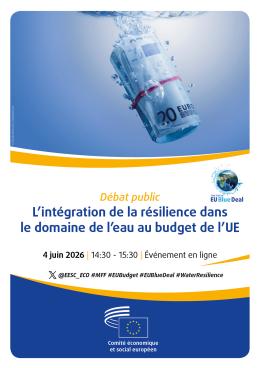
L'intégration de la résilience dans le domaine de l'eau au budget de l'UE est un sujet d’actualité pour garantir l’avenir de l’eau en Europe. Découvrez comment des investissements européens plus judicieux peuvent renforcer la résilience, la durabilité et la préparation en matière d’eau, et comment définir les priorités de financement des programmes de demain dans le cadre du prochain cadre financier pluriannuel de l’UE.
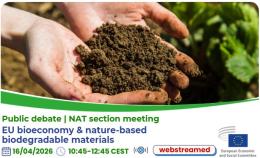
The debate will explore how the EU can strengthen its bioeconomy strategy and scale up the use of nature-based biodegradable materials to advance circularity, resource efficiency, and sustainability.
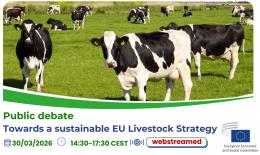
On 30 March 2026, the EESC Permanent Group on Sustainable Food Systems (PG) will hold a public debate “Towards a sustainable EU Livestock Strategy”, with the aim to contribute to the European Commission’s upcoming EU Livestock Strategy.
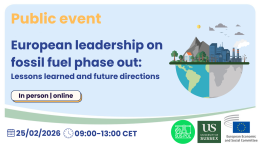
On 25 February 2026, the University of Sussex and the EESC will host an event and workshop on European leadership on fossil fuel phase out: Lessons learned and future directions.
It is taking place at a critical moment - following the outcomes of COP30, amid growing calls for concrete roadmaps to accelerate the transition away from fossil fuels, and ahead of the world’s first summit on a just transition away from fossil fuels in 2026 - the event will examine how EU leadership, experience, and policy tools can help accelerate action within Europe and beyond.
Débat public au sein de la section ECO sur les Derniers rebondissements sur la voie du prochain cadre financier pluriannuel dans le cadre de l'avis ECO/682 Cadre financier pluriannuel 2028-2034.
L'objectif du débat publique dans le cadre de l'avis ECO/675 est de souligner l’importance d’aligner les stratégies macro-régionales avec les plans nationaux de partenariat régional (PNPR) afin de renforcer la cohésion et la coopération transfrontalière.