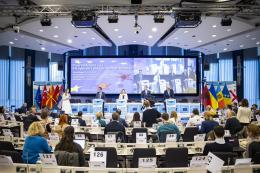
Luísa Santos, the new Chair, welcomed the EU DAG to its 10th meeting, putting forward some actions and proposals to give more visibility to future meetings and improve cooperation with UK DAG. In the light of this approach, EU DAG members discussed the impact of recent developments in EU-UK relations as well as the priorities for the TCA review.
L’édition 2024 de la journée annuelle de l’initiative citoyenne européenne (ICE) du CESE aura lieu dans le cadre de la première semaine de la société civile 2024
Débat public avec Karl-Heinz Lambertz, membre du groupe de spécialistes de haut niveau sur l'avenir de la politique de cohésion et ancien président du Comité des régions (CdR)
Event type
Debate
Location
Evénement en ligne
Belgium
Présentation du rapport du groupe de haut niveau sur l'avenir de la politique de cohésion par Karl-Heinz Lambertz, membre du groupe de spécialistes de haut niveau sur l'avenir de la politique de cohésion et ancien président du Comité des régions (CdR)
The EESC's Permanent Group on Sustainable Food Systems will discuss "How sustainable food systems can contribute in achieving food security and nutrition, in line with SDG2 on Zero Hunger".
In the context of the upcoming European elections in June 2024, the high-level discussion at the NAT section meeting on 26 February will contribute to set the agenda of the new Commission. Building on previous EESC opinions and events on "The sustainable economy we need" and "Beyond GDP measures", the debate will feed into the own-initiative opinion on A Blueprint for a European Green and Social Deal, based on a wellbeing economy.
"Meet the champions of excellence" est un événement phare de l'Année européenne des compétences, organisé conjointement par le Comité économique et social européen (CESE) et la Commission européenne.
Aujourd'hui, la disponibilité, l'accessibilité et la durabilité d'un logement décent sont des préoccupations de plus en plus importantes pour les Européens, en particulier pour les groupes les plus vulnérables. De nombreux citoyens et ménages de l'UE sont confrontés à des coûts de logement excessifs, le logement étant leur principale dépense de consommation et une charge excessive, au détriment d'autres besoins fondamentaux. Pourtant, l'accès à un logement abordable et décent est à la fois un besoin social et un droit social, et l'un des 20 principes essentiels du pilier européen des droits sociaux. Il est pourtant constamment remis en question par les différentes crises auxquelles l'Union européenne a été confrontée ces dernières années.
585e session plénière du CESE, avec les invités suivants: Maroš Šefčovič, VP exécutif de la Commission européenne chargé du pacte vert pour l’Europe, des relations interinstitutionnelles et de la prospective; Dubravka Šuica, VP de la Commission européenne chargée de la démocratie et de la démographie et Tatiana Molcean, sous-secrétaire générale des Nations unies et secrétaire exécutive de la Commission économique des Nations unies pour l’Europe (CEE-ONU); Edi Rama, premier ministre d’Albanie, et Milojko Spajić, premier ministre du Monténegro. Web streaming.
The Commission is proposing a new growth plan for the Western Balkans based on four pillars, aimed at:
Enhancing economic integration with the European Union’s single market, subject to the Western Balkans aligning with single market rules and opening the relevant sectors and areas to all their neighbours at the same time, in line with the Common Regional Market;
Boosting economic integration within the Western Balkans through the Common Regional Market, based on EU rules and standards;
Accelerating fundamental reforms, including on the fundamentals cluster, supporting the Western Balkans' path towards EU membership, improving sustainable economic growth including through attracting foreign investments and strengthening regional stability;
Increasing financial assistance to support the reforms through a Reform and Growth Facility for the Western Balkans, a new instrument worth EUR 6 billion in non-repayable support and loan support, with payment conditioned on the Western Balkans’ partners fulfilling fundamental reforms, and in particular specific socio-economic reforms.
This hearing will focus on:
Presentation of the Commission's proposal and view of the Regional Cooperation Council and
Views from organised civil society and international organisations