Le bénévolat joue un rôle essentiel dans la construction de sociétés résilientes et inclusives, mieux préparées aux défis actuels et futurs. Cette audition publique réunira des acteurs institutionnels, des organisations de la société civile, des partenaires sociaux et des experts afin de réfléchir au rôle que peut jouer le bénévolat dans le cadre d’une approche globale de la préparation (préconisée par la Commission européenne). Les discussions alimenteront l’Avis du CESE (SOC/864) relatif à ce sujet.
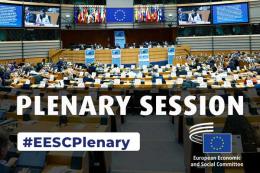
The agenda and all information regarding this plenary session will be available 8 days prior to the event. You will be able to follow the debates by web streaming. Web streaming
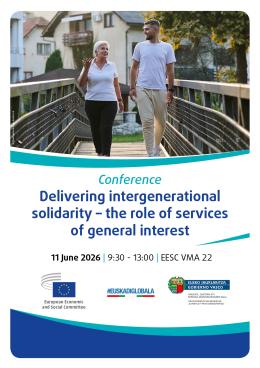
This conference will serve as a platform to showcase the societal and political significance of public services in promoting intergenerational solidarity, providing concrete action points for policymakers and practitioners. The aim is to broaden the debate and to serve as a constructive contribution to the development and refinement of the Intergenerational Fairness Strategy announced by the European Commission, to be adopted in the second quarter of 2026.
Reset and Recharge: All-island contributions to a resilient EU-UK relationship
Event type
Conference
Location
Europe House - 5 Balfe Street, Dublin, Ireland
Dublin
Ireland
The EU-UK Follow-Up Committee of the European Economic and Social Committee (EESC) is pleased to announce that the Annual All-Island Stakeholder Forum will be held in Dublin on 10th June 2026. This forum is the second of its kind, the first having been held in Dundalk last year.
This year’s forum is titled: ‘Reset and Recharge: All-island contributions to a resilient EU-UK relationship’. It is organised in collaboration with an Advisory Group of representative organisations from the three ‘pillars’ of the EESC – workers, employers and civil society organisations – from both jurisdictions.*
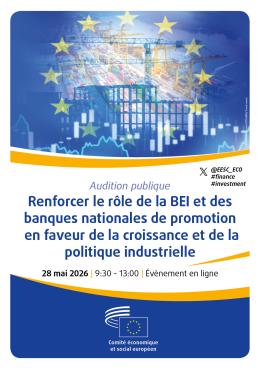
Cette audition publique réunira des décideurs politiques et des parties prenantes de la société civile afin de discuter de la manière dont les banques publiques peuvent mieux soutenir la politique industrielle de l’UE, l’innovation, l’expansion des entreprises de l’UE et, en fin de compte, la croissance économique.
European Economic and Social Committee - 99 rue Belliard
1040 Brussels
Belgium
Save the date! 🇪🇺
On Saturday 9 May 2026, the European Economic and Social Committee (EESC) opens its doors to you in celebration of Europe Day! This special occasion marks the anniversary of the Schuman Declaration, a defining moment that laid out the foundations of European unity and cooperation.
Cette audition publique réunira des décideurs politiques et des parties prenantes de la société civile pour discuter des initiatives existantes, du rôle que la société civile devrait jouer et des mesures politiques nécessaires pour exploiter leur potentiel à cet égard.
The agenda and all information regarding this plenary session will be available 8 days prior to the event. You will be able to follow the debates by web streaming. Web streaming
This public hearing will feed into the works on the own-initiative opinion which aims to clearly define social farming as an innovation in agriculture, highlighting its social impacts and to identify barriers to its development - such as legislative frameworks, recognition of services, financing, insurance, quality and safety, capacities and competences.