considers that the EU has a timely opportunity to accelerate the transition towards a circular bioeconomy, combining resource efficiency, sustainable biomass use and industrial competitiveness, building on upcoming legislative initiatives such as the Circular Economy Act and the EU Bioeconomy Strategy;
stresses that efficient use of resources requires applying the waste hierarchy and lifecycle thinking, prioritising prevention, reuse and material efficiency, while recognising both technical and biological circular pathways to achieve the best environmental outcomes;
highlights the potential of nature-based biodegradable materials to reduce pollution, support regional economies and strengthen EU competitiveness, while calling for greater regulatory coherence—particularly in the implementation of packaging legislation—to avoid barriers and enable innovation.
highlights that Europe faces increasing pressure as a resource-constrained and import-dependent continent, and stresses the need to strengthen the European Green Deal and Sustainable Development Goals, ensuring coherence with circular economy, climate and biodiversity objectives to support a sustainable and competitive bioeconomy within planetary boundaries;
recalls that EU leadership in the bioeconomy requires clear, strict and enforceable principles on the sourcing and use of biomass, applied across supply chains and equally to domestic and imported materials, while addressing unfair competition from underpriced fossil-based resources;
reminds that the bioeconomy must fully respect the waste hierarchy by prioritising the reduction of resource use, ensuring that biomass is used efficiently and sustainably, and avoiding short-term applications that do not contribute to circularity.
As part of European Youth Week 2026, the European Economic and Social Committee (EESC) highlighted its long-standing commitment to meaningful youth participation through direct engagement with young people and a range of concrete policy tools designed to strengthen their influence on decision making.
As part of European Youth Week 2026, the European Economic and Social Committee (EESC) highlighted its long-standing commitment to meaningful youth participation through direct engagement with young people and a range of concrete policy tools designed to strengthen their influence on decision making.
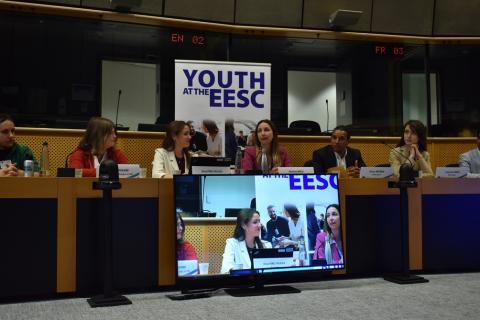
A key moment of the EESC’s contribution was the interactive breakout session 'Meaningful youth participation in action!', held on 24 April as part of the official programme. The roundtable brought together more than 40 young participants to reflect on how youth engagement can move beyond consultation and lead to tangible impact at local, national and European levels.
The discussion highlighted concrete tools and pathways developed by the EESC to support youth engagement, including the EESC Youth Test, which integrates youth perspectives into EU legislative processes, and the Youth Delegate to COP initiative, enabling young people to contribute directly to international climate negotiations. Youth organisations are also actively involved in the EESC’s work through platforms such as Your Europe, Your Say!, the Liaison Group, the European Circular Economy Stakeholder Platform, and Fundamental Rights and Rule of Law country visits, as well as through cooperation with youth organisations from EU candidate countries.
Young leaders and experts already shaping policy shared their experiences during the session, including President of the EESC Youth Group Nicoletta Merlo, former EESC Youth Delegate to COP Sophia Wiegand and youth participation experts Bruno António and Françeska Muço. Discussions focused on access to decision-making spaces, the barriers young people continue to face, and the difference between meaningful and tokenistic participation. Participants underlined that genuine involvement requires early engagement, clear roles, long-term support and visible follow-up.
Taking place from 24 April to 1 May under the theme 'Solidarity and Fairness', European Youth Week 2026 offered an opportunity to reaffirm that youth participation at the EESC is a core, long-term institutional priority.