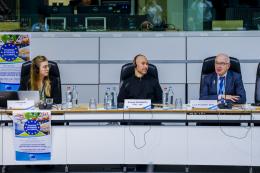
The European Economic and Social Committee (EESC) held a debate on Gender Equality and Women's and Girls' empowerment in the context of Food Security and Nutrition. In light of the climate crisis, and in the context of the recent COP27, the EESC has identified the intersection between gender and climate change as a top priority for the EU. The debate is an important contribution to the ongoing EESC initiative on gender equality.
The EESC held a conference on the future of European strategic autonomy. The event was organised jointly by three Committee bodies; the Digital Transition and Single Market Observatory, the Labour Market Observatory and the Sustainable Development Observatory. Policy-makers, experts from organised civil society and academia, as well as youth representatives, gathered to discuss how to overcome current and future obstacles to a self-sufficient EU in times of great geopolitical tensions and multiple crises.
The EU-Serbia Joint Consultative Committee (JCC) held its 14th meeting on 29 November 2022 in Belgrade, to discuss the state of play in the accession process and reform policies in the country. The participants from Serbia and the EU Institutions, as well as from civil society organisations pointed out concerns and challenges that still need further improvement. The joint declarationof the EU-Serbia JCC was adopted unanimously.
After nine months of war in Ukraine, the EU institutions and the Member States are still striving to overcome the challenges of the migration crisis caused by Ukrainians fleeing the war on a massive scale. Civil society organisations (CSOs), NGOs and national stakeholders are also seeking practices to ensure the protection and integration of Ukrainian refugees, paying special attention to children and people with disabilities, with winter and war fatigue making these efforts harder.
Per motivi economici, fisiologici e socioculturali, le donne rischiano di trovarsi in condizioni di povertà energetica più facilmente degli uomini. Alla luce delle recenti allarmanti statistiche, dal dibattito tematico organizzato dal Comitato economico e sociale europeo (CESE) è emersa un'esortazione all'UE affinché adotti politiche in cui il genere sia considerato un fattore specifico.
XV Connecting EU Seminar
24-25 November 2022
Hotel Dubrovnik| Ljudevita Gaja 1, Zagreb
The European Economic and Social Committee (EESC), in partnership with the Economic and Social Council of Croatia (GSV), is organising its annual Civil Society Communication seminar, #ConnectingEU2022, on 24-25 November 2022, on: Geopolitical turmoil at Europe's door: the perspective of civil society
Il Comitato economico e sociale europeo (CESE) sottolinea che i trasporti pubblici sono essenziali per garantire l'accesso e la continuità dei servizi di base. La pandemia di COVID-19 ha cambiato il comportamento dei cittadini sul piano della mobilità, e l'UE deve dotarsi di una strategia specifica per migliorare la mobilità e renderla realmente rispettosa dell'ambiente e delle persone.
The European Economic and Social Committee (EESC) has held a debate on women's representation and participation in the workforce. The event gathered insights, success stories and best practices from our CCMI members and delegates. The conclusions drawn will make an important contribution to the EESC's ongoing initiative on gender equality.
A coordinated and systematic approach to skills training is needed to ensure that all Europeans can face the challenges of the green and digital transitions, the European Economic and Social Committee(EESC) and the European Centre for the Development of Vocational Training (Cedefop) emphasised at their fourth Policy Learning Forum on 16 November.
The EESC held a debate on gender-based investments in the Member States' national Recovery and Resilience Plans (RRPs). Following on from the European Gender Equality Week, the event gathered policy-makers, experts from organised civil society and academia to discuss, among other things, how EU countries can improve the impact of the measures proposed in their RRPs on gender equality during implementation and monitoring.