
European Economic
and Social Committee
Peace calls for more arms
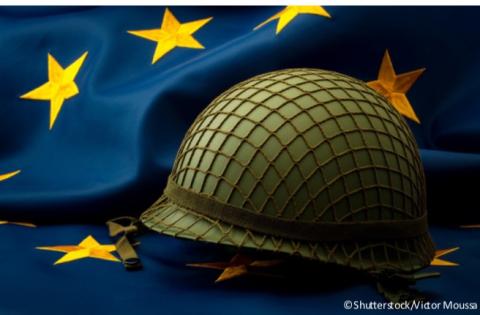
The peaceful coexistence of democratic states has never ceased to be our philosophy. The emphasis on peace is the most outstanding achievement of nearly 80 years of this great project which we call the Union. Aversion to military action and the ability to resolve conflicts through negotiation and compromise have become the new DNA of Europeans. It is something we are proud of, but also something that has made us lose our vigilance. We naively believed that armed aggression had been eliminated from our chemosphere once and for all.
On 22 February 2022, we were abruptly reminded of the urgency of our situation. It is one thing to acknowledge our past mistakes, but it is another to take decisive action to prevent their recurrence. We are now beginning to draw practical conclusions from these painful experiences. One such crucial measure is the ambitious new programme, the European Defence Industry Programme. This project aims to establish a framework for a common European arms industry, a vital step in ending years of neglect and ensuring our collective security.
The truth is that we are sailing into uncharted waters, and we must move very carefully so that somewhere along the way, we do not lose things that have always been most important to us, values that lay at the foundation of the European Union. Any spending on arms programmes should result from a deliberate financial architecture so that it will not force us to abandon other programmes vital to our prosperity and the European community. This will be critical in building broad support for a universal arms programme.
This is one of the reasons why, after a lengthy discussion, we have decided to open our opinion with an axiological recommendation to the European Commission so that, before we get bogged down in the technical details of the armaments plans, we give ourselves some time to communicate to the European people the reasons why we had to decide to devote so much time and energy to armaments programmes. Explaining that standard security guarantees are critical to building peace and a secure framework for our democratic prosperity. Hence, the European Defence Industrial and Technological Base (EDTIB) is now essential for all our endeavours, peace, and achieving our dreams.
This realisation has led us to advocate for an increase in the budget for developing strategic cooperation for the arms industry, which currently stands at €1.5 billion. We understand the challenges posed by the current geopolitical environment and difficult economic conditions, but we believe that the potential benefits of this programme far outweigh these challenges. We have no other choice but to act now and create a stable framework for broad international cooperation on joint arms programmes, joint procurement and the development of new technologies. This programme will be available to all member countries, including Ukraine, whose experience would be invaluable in creating new modern weapons.
Our programmes should not be limited to traditional arms companies. We believe in the importance of inclusivity, reaching out to medium-sized companies and ensuring that all member countries, including Ukraine, have a role to play in this initiative. This is not just for economic reasons, where the military industry could be a vital element for the revitalisation of the EU industry, but also for strategic reasons, to ensure the critical elements of our safety are scattered all over Europe. Moreover, this inclusivity is crucial for psychological reasons, to give everyone a sense of purpose and a role in building a new framework for peace.
At the same time, we must remember not to let business objectives overshadow the initiative's primary goal of strengthening the EU's defence resilience, and we must not exclude our long-standing allies from the programme. While building our own EU defence resources, we should work closely with other countries, especially within NATO, to expand the broader resilience of democratic states worldwide.
 Tomasz Wróblewski
Rapporteur of the opinion CCMI/203 “European defence industry programme”
Member of the EESC Employers’ Group
Work organisation
Recommended for you
Tetyana Ogarkova: "The day of victory will come but it will not bring normality back"
Agenda
On 24 February 2022, the lives of millions of Ukrainians were turned upside down. Now, when we say the word "victory", we expect that day to be the way things used to be. A normal day, a day of peace…
Lutte contre la précarité énergétique: garantir un approvisionnement énergétique abordable devrait figurer au premier rang des priorités politiques des pays de l’UE
News
Alors que le nombre de ménages qui sont dans l’incapacité de chauffer leur logement va vraisemblablement augmenter dans l’Union, avec une inflation annuelle de l’énergie qui dépasse 40 %, il y a…
Les zones rurales ont le potentiel pour produire davantage de résultats
News
Si l’attrait de la vie à la campagne s’est accru ces toutes dernières années, de nombreuses zones rurales de l’Union restent confrontées à un certain nombre de problèmes qui dissuadent les personnes…
Pour lutter contre le sans-abrisme, il faut une approche globale et une action collective
News
Le 7 octobre dernier, le Comité économique et social européen (CESE) a tenu une conférence sur le sans-abrisme et les moyens d’éradiquer ce phénomène d’ici à 2030, en appliquant le principe du…
Un rôle actif pour la société civile organisée est essentiel à la résilience de l’Union européenne
News
Le CESE a tenu un débat en session plénière sur l’importance croissante de la société civile organisée et des villes pour mettre l’Europe en capacité de faire face aux chocs asymétriques et aux…