
European Economic
and Social Committee
Social Pillar implementation: the EU must have adequate minimum incomes
The Commission has presented a recommendation on adequate minimum incomes today. Against a terrible perspective of more than 90 million people in Europe at risk of poverty or social exclusion, with widening gaps in coverage of social protection systems highlighted by the pandemic, and now with a massive inflation crisis growing, it is more necessary than ever.
Turning the European Pillar of Social Rights into a reality for working people is a fundamental priority, and making sure support arrives where and when is needed is key. The goal of poverty eradication needs a comprehensive income support set of schemes.
'Ministers must agree on a clear roadmap and concrete measures to ensure adequate coverage and levels of protection' said Oliver Röpke, EESC Workers' Group President, 'and within this, they must also consider the importance of setting minimum common standards for unemployment schemes, given their predominant role as transfers in the EU, as well as the full implementation of the decent minimum wages directive'.
The European Economic and Social Committee adopted in 2019 an opinion supporting the introduction of a decent minimum income guaranteed at EU level based on Article 153(1)(c), based on past exercises by the EESC on minimum income and poverty indicators and a comprehensive study commissioned by the Workers' Group on minimum income schemes.
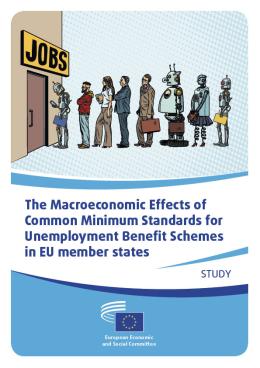
The role of unemployment insurance schemes must also not be overlooked, and setting common standards at EU level would offer significant macroeconomic effects in terms of crisis alleviation, growth, and fight against poverty, as seen in the study commissioned by the Workers' Group.
The EESC adopted in 2018 an opinion already exploring the use of common standards for unemployment within the framework of the Social Pillar.
In this own-initiative opinion the EESC emphasized that setting EU-wide targets for unemployment benefits would improve the functioning of the single market and labour markets in general, as well as playing an important role as automatic stabilisers.
'It is unacceptable that in some countries workers receive only three months of unemployment compensation, even after decades of contributing to the system' said Oliver Röpke, rapporteur for this opinion.
Such an EU scheme should be part of the new initiative of the Commission. It would complement national efforts, respecting national competences. As an integral part of the European Pillar of Social Rights (EPSR), these minimum standards should be integrated into the European semester. If the benchmarking process does not yield sufficient progress, we will need binding measures, such as an EU directive.
Work organisation
Related content
Recommended for you
Tetyana Ogarkova: "The day of victory will come but it will not bring normality back"
Agenda
On 24 February 2022, the lives of millions of Ukrainians were turned upside down. Now, when we say the word "victory", we expect that day to be the way things used to be. A normal day, a day of peace…
Lutte contre la précarité énergétique: garantir un approvisionnement énergétique abordable devrait figurer au premier rang des priorités politiques des pays de l’UE
News
Alors que le nombre de ménages qui sont dans l’incapacité de chauffer leur logement va vraisemblablement augmenter dans l’Union, avec une inflation annuelle de l’énergie qui dépasse 40 %, il y a…
Les zones rurales ont le potentiel pour produire davantage de résultats
News
Si l’attrait de la vie à la campagne s’est accru ces toutes dernières années, de nombreuses zones rurales de l’Union restent confrontées à un certain nombre de problèmes qui dissuadent les personnes…
Pour lutter contre le sans-abrisme, il faut une approche globale et une action collective
News
Le 7 octobre dernier, le Comité économique et social européen (CESE) a tenu une conférence sur le sans-abrisme et les moyens d’éradiquer ce phénomène d’ici à 2030, en appliquant le principe du…
Un rôle actif pour la société civile organisée est essentiel à la résilience de l’Union européenne
News
Le CESE a tenu un débat en session plénière sur l’importance croissante de la société civile organisée et des villes pour mettre l’Europe en capacité de faire face aux chocs asymétriques et aux…