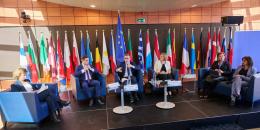
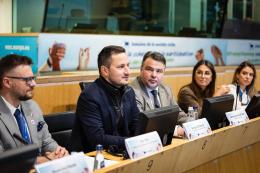
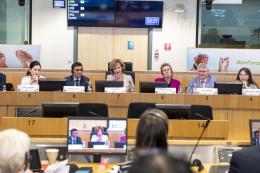
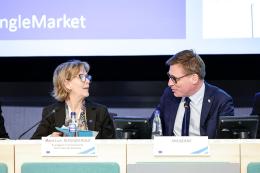
La responsabilité de renforcer la cohésion pour lever les clivages qui divisent les sociétés incombe aux organisations de la société civile, qui ont la force et la motivation de protéger les espaces civiques et démocratiques. Tel est le principal message envoyé lors de la Semaine de la société civile, organisée pour la deuxième année par le Comité économique et social européen (CESE) afin d’examiner la tendance alarmante à la polarisation généralisée des sociétés de l’UE.
L’initiative citoyenne européenne s’est avérée être un outil efficace pour intensifier la participation des citoyens à la vie politique de l’Union, mais il est nécessaire de la renforcer, pour parer au risque qu’elle ne s’éloigne des préoccupations des citoyens européens ordinaires.
Plus de 800 participants issus d’organisations de citoyens et de parties prenantes de toute l’Europe, y compris des organisations de jeunesse, des ONG et des journalistes, participent à la Semaine de la société civile du Comité économique et social européen, organisée du 17 au 20 mars 2025. La séance d’ouverture a mis en évidence la nécessité de protéger l’espace civique grâce à l’action juridique, en réaffirmant le rôle clé que joue la société civile: demander des comptes aux décideurs, construire des ponts, soutenir la résilience sociale et faire entendre des voix trop souvent ignorées.
Les organisations de la société civile (OSC) sont attaquées en Europe et en Amérique. L’UE doit agir maintenant pour les défendre et sauvegarder la démocratie. Lors de son débat plénier sur la Journée internationale des ONG, le Comité économique et social européen a envoyé un message clair: les OSC sont en première ligne pour ce qui est de défendre la démocratie. Des coupes budgétaires menacent leur survie, et l’UE doit prendre des mesures immédiates pour les protéger et les soutenir.
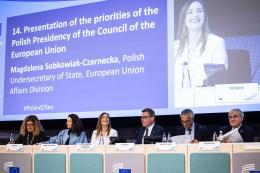
Lors de sa session plénière de février, le Comité économique et social européen (CESE) a organisé un débat sur les priorités politiques de l’actuelle présidence du Conseil de l’Union européenne, qui a débuté en janvier et se poursuivra jusqu’en juin 2025.
Despite progress in gender equality, millions of women across Europe still face violence, discrimination and barriers to equal opportunities. From under-representation in leadership to the alarming rise in gender-based violence, urgent action is needed. The European Economic and Social Committee (EESC) High-Level Forum on Women’s Rights brought together leading voices to address these pressing issues and outline key priorities ahead of the upcoming UN Commission on the Status of Women session.
Expanding across borders in the EU means navigating a maze of conflicting VAT rules and paperwork, driving up costs. Small and medium-sized enterprises (SMEs), in particular, face disproportionate compliance burdens, making it harder to scale up and compete. To cut red tape and boost competitiveness, the EESC calls for urgent reforms in two opinions adopted during its February plenary, building on the Letta and Draghi reports. Proposals include harmonised financial regulations, AI-driven reporting and a coordinated industrial policy.
This year, the European Economic and Social Committee (EESC) is awarding its flagship Civil Society Prize to non-profit projects dedicated to combating the harmful polarisation of European society.
Artificial Intelligence is transforming the world of work at an unprecedented pace, bringing both opportunities and challenges for workers, businesses and policymakers. On 3 February, the European Economic and Social Committee (EESC) and the International Labour Organization (ILO) held a joint high-level conference entitled ‘Social Justice in the Digital Era: AI’s Impact on work and society’, gathering over 300 experts, policymakers and social partners and civil society representatives to discuss how AI can contribute to inclusive labour markets, decent work and social justice.