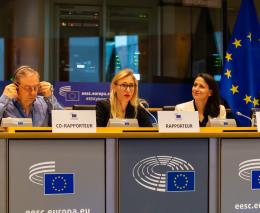
In a bid to lead in climate action, the European Commission has recommended a target to reduce net greenhouse gas emissions by 90% by 2040. The European Economic and Social Committee (EESC) supported this move during its May plenary by adopting an opinion on EU climate target for 2040. The opinion outlines steps to achieve climate neutrality by 2050, aligning with scientific consensus to limit global warming to 1.5 degrees Celsius.
The European Economic and Social Committee (EESC) has given a cautious green light to Europe’s revamped defence strategy in three opinions, all emphasising the need for a long-term, strategic approach. However, concerns linger about its financial viability and public buy-in.
Face à la progression alarmante du nombre de cancers et de décès liés à cette pathologie partout dans l’Union, le Comité économique et social européen (CESE) demande qu’une attention particulière soit accordée aux mesures qui s’imposent dans la prévention de cette maladie, sachant qu’environ 40 % des cas de cancer sont considérés comme évitables.
L’Union européenne se doit de réduire ses dépendances stratégiques dans des secteurs sensibles comme la santé et les technologies critiques, pour qu’un nombre croissant de patients, sur tout son territoire, aient la possibilité de bénéficier de la médecine nucléaire pour le diagnostic et le traitement des cancers.
À un mois à peine des élections européennes, le Comité économique et social européen (CESE) met en garde les autorités européennes quant à la nécessité urgente de lutter contre la désinformation afin de préserver la démocratie. Un journalisme indépendant et de qualité, évoluant au sein d’un système pluraliste et florissant, demeure le premier rempart contre les campagnes malveillantes et les fausses informations.
On 9 May, President Röpke celebrated Europe Day in Madrid at an event on "The future of the EU social agenda". Organised by the Spanish Minister of Labour and Social Economy, Yolanda Díaz, the event gathered many prominent speakers. In his intervention, President Röpke underlined that social dialogue is a cornerstone of our European social model and democratic values.
À la demande de la Commission européenne, le CESE a adopté un avis sur la nouvelle facilité pour les réformes et la croissance pour les Balkans occidentaux. Le plan de croissance aidera les Balkans occidentaux à accélérer la coopération économique régionale. C’est la première fois que l’Union européenne se concentre sur le développement économique et la convergence socio-économique dans la région.
Selon le Comité économique et social européen (CESE), renforcer les liens entre les jeunes et les organisations de jeunesse de l’Union européenne et du Royaume-Uni aura des effets positifs concrets sur une génération d’Européens touchée de manière disproportionnée par les conséquences du Brexit.
Stakeholders want systematic consultation as a driver of growth-led approaches
Strengthening national ownership requires both the close involvement of national parliaments, regional and local authorities, the social partners and civil society, and clearer provisions in EU and national procedures. Together, this will ensure that the new EU economic governance framework and the future European Semester are implemented as effectively as possible. It will also guarantee transparent and inclusive policy making.