Gender inequality remains one of the most pressing issues that our societies continue to face. The question of gender equality in the media sector is shaped by broader political, social and technological developments that influence how women participate in and are represented across media landscapes.
The 14th edition of European Citizens’ Initiative Day – ECI Day 2026 – will take place as part of the EESC’s Civil Society Week, held from 2 to 5 March under the title People, Democracy, Resilience – Our Future!
On 26 February 2026, the EESC in cooperation with Sustainable Development Solutions Network, will host an online event featuring the launch of the Europe Sustainable Development Report 2026 which tracks annually since 2019 the performance of all EU member states and partner countries on the SDGs and is co-designed with civil society.
The 10th Meeting of the EU-Brazil Civil Society Round Table took place in Brussels on 25-26 February 2026. Hosted by the European Economic and Social Committee, the dialogue was co-chaired by the EESC President, Mr Séamus Boland and Ms Raimunda Monteiro, Deputy Executive Secretary of the CDESS.
The meeting will bring together civil society representatives from both regions to advance dialogue, strengthen cooperation, and identify practical avenues for joint action.
« Politique de cohésion 2028–2034 : un nouveau fonds, un nouveau cadre, un nouveau rôle pour la société civile ? » réunit les institutions de l'UE, les partenaires sociaux et les représentants de la société civile afin de réfléchir à l'avenir de la politique de cohésion dans le prochain Cadre financier pluriannuel. L'audition explore les propositions de réforme du financement et de la gouvernance de la cohésion, évalue les implications du nouveau cadre à travers les Plans de partenariat nationaux et régionaux et examine comment les organisations de la société civile peuvent jouer un rôle plus important dans la conception, la mise en œuvre et le suivi de la politique de cohésion. La discussion vise à identifier comment la politique de cohésion peut continuer à promouvoir la cohésion territoriale, sociale et économique tout en répondant aux nouveaux défis et transitions auxquels l'Union européenne est confrontée.
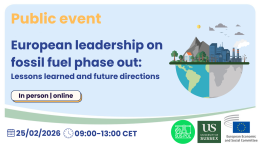
On 25 February 2026, the University of Sussex and the EESC will host an event and workshop on European leadership on fossil fuel phase out: Lessons learned and future directions.
It is taking place at a critical moment - following the outcomes of COP30, amid growing calls for concrete roadmaps to accelerate the transition away from fossil fuels, and ahead of the world’s first summit on a just transition away from fossil fuels in 2026 - the event will examine how EU leadership, experience, and policy tools can help accelerate action within Europe and beyond.
The afternoon session of the Latin America Follow-up Committee meeting to be held on 24 February 2026 will be dedicated to the Gran Chaco. Organised in collaboration with the multi-actor platform Redes Chaco, the network implementing the EU-supported Impacto Verde initiative, this dialogue will spotlight the challenges and opportunities linking the American Gran Chaco to the EU-Latin America agenda.
Meet of the EU-Japan and South East Asia Follow-up Committee
Location
Brussels
Belgium
The EESC EU-Japan & South-East Asia Follow-up Committee meets on 12 February 2026 to discuss various aspects of EU-Japan & South-East Asia relations. Main topics on the programme:
Initial discussion on the priorities for the Follow-up Committee during the new term
EU relations with the Southeast Asian countries and follow-up on the EESC's information report on the situation of the civil society organisations in the ASEAN countries
Cette audition publique visera à présenter et à débattre de la proposition de la Commission européenne relative à une Boussole culturelle pour l’Europe, un nouveau cadre stratégique destiné à placer la culture au cœur des politiques de l’UE. L’événement réunira des acteurs institutionnels clés, des organisations de la société civile, des partenaires sociaux et des experts afin de réfléchir aux priorités de la Boussole et de contribuer à l’élaboration de l’avis du CESE (SOC/853).