Economic and Social Council of Spain,
c/ Huertas, 73
Madrid
Spain
The 20th meeting of the EU-China Round Table took place in Madrid, Spain on 9 and 10 June 2025.
The EU-China Civil Society Round Table was established in 2007 following a decision taken by the 9th EU-China Summit in Helsinki. The delegations from the EESC and its Chinese counterpart, the China Economic and Social Council, meet regularly to discuss topics relating to economic and social issues relevant to both parties.
By elaborating reports, discussing them and exchanging ideas, the representatives of the European Economic and Social Committee and the China Economic and Social Council contribute to the development of the overall EU-China relationship, from a civil society perspective.
Le CESE organise une audition publique sur les compétences et l’éducation des européens en matière financière. Il réunira des institutions, de l’industrie et des parties prenantes de la société civile, afin de discuter sur des actions politiques souhaitables, ainsi que partager des bonnes pratiques autour de l’UE.
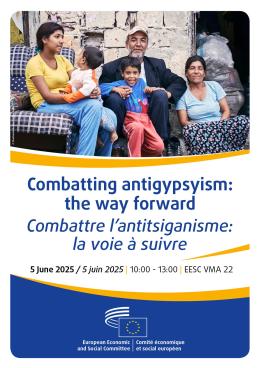
Les enquêtes continuent de faire état de taux élevés de discrimination subis par les membres de la communauté rom en raison de leur origine. Une longue histoire de discrimination et de perceptions négatives à l’égard de la communauté rom renforce les pratiques préjudiciables et les sentiments anti-tsiganes, qui se manifestent dans divers contextes. Axée sur différents domaines politiques, cette audition se penchera sur l’antitsiganisme institutionnel et discutera des moyens de le combattre efficacement.
Dans un contexte comme celui que traverse l'Europe, marqué par de multiples crises, il est opportun de promouvoir une réflexion sur les biens publics européens et sur les priorités politiques fondamentales capables d'assurer la croissance durable de l'UE et le bien-être de ses citoyens. Cette réflexion prend d'autant plus d'importance dans la perspective des négociations à venir sur le prochain cadre financier pluriannuel européen pour la période post-2027.
Rue Van Maerlant/Van Maerlantstraat 2, 1040 Bruxelles/Brussel
Bruxelles
Belgium
Les inégalités persistantes sur le marché du travail en Europe touchent les femmes, les jeunes et les groupes vulnérables, y compris les personnes handicapées. L’entrepreneuriat recèle un potentiel considérable pour remédier à ces disparités en responsabilisant les individus, en favorisant l’innovation et en générant une croissance économique qui profite à la société dans son ensemble. Cette audition réunira des experts et des parties prenantes afin de recenser les défis communs, de partager les bonnes pratiques et de proposer des solutions stratégiques pour favoriser l’égalité et l’inclusion sociale grâce à l’entrepreneuriat.
Teatro Thalia, Estrada das Laranjeiras 205, Lisboa 1600-134
Lisbon
Portugal
This conference in Lisbon is the fourth event on disinformation being hosted by the European Economic and Social Committee (EESC) as part of its ongoing project aiming to fight disinformation with the help of civil society.
On 21 May 2025 the EESC will hold an online event on the link between trade policy and sustainability, with a particular focus on agri-food systems. Through panel discussions, EESC members, representatives of the European Commission and of civil society will exchange views on the role of reciprocity in achieving a fair green transition.
Le CESE estime qu'il est important de créer un système fiscal performant, propice à la prospérité, au service des citoyens et des entreprises et favorisant la compétitivité. Les différents actes législatifs récents ont enrichi le cadre fiscal existant. Lors de cette audition, le CESE examinera les moyens de simplifier le cadre fiscal complexe de l'UE.
The EESC will hold an online event on Tuesday 20 May 2025 to discuss the EU wine policy package in which the Commission proposed to amend the relevant wine regulations to introduce targeted measures to help the sector manage production potential, adapt to changing consumer preferences and exploit new market opportunities.