Newsletter Info

EESC info

European Economic and Social Committee A bridge between Europe and organised civil society

MARCH 2024 | EN

GENERATE NEWSLETTER PDF

Available Languages:

  • BG
  • CS
  • DA
  • DE
  • EL
  • EN
  • ES
  • ET
  • FI
  • FR
  • HR
  • HU
  • IT
  • LT
  • LV
  • MT
  • NL
  • PL
  • PT
  • RO
  • SK
  • SL
  • SV
Editorial
The voice of the civil society cannot be ignored ahead of European elections

Editorial

Dear readers,

In this issue, I want to draw your attention to Civil Society Week, the flagship event organised and hosted by the EESC at the beginning of March.

Read more in all languages

Dear readers,

In this issue, I want to draw your attention to Civil Society Week, the flagship event organised and hosted by the EESC at the beginning of March.

With less than 100 days until the European elections, Civil Society Week provided a unique opportunity for the EESC to bring together people from all walks of life to discuss what matters to them and the European future they want. Over 800 representatives from civil society organisations and youth groups brainstormed throughout the week to outline their key messages and expectations for the next EU leaders. The message, which I am committed to conveying, is clear – people want to see more democracy and youth participation, less fake news and an economy that works for everyone. Europe cannot afford to ignore the voice of civil society, the true watchdog of our democracies.

The insights gained from Civil Society Week will feed into an EESC Resolution on the European Elections. You can find early insights from Civil Society Week on the EESC website.

Our preparation for the elections also involves strengthening relations with the European Parliament. On 27 February, I signed a Memorandum of Understanding with the European Parliament's President Roberta Metsola to deepen the cooperation between the two institutions promoting European elections, boosting voter turnout – especially among non-voters and first-time voters – and combating information manipulation. The EESC will fully mobilise its extensive network, spanning across the EU and representing employers, workers and civil society organisations, so they can fully play their role. The agreement is a crucial step in generating momentum leading up to the 2024 European elections.

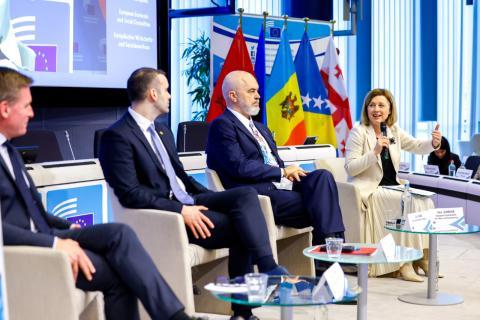
At the EESC, we aim to empower civil society organisations not only in the European Union but also abroad. In February, we officially launched our Enlargement Candidate Members (ECM) initiative, marking a turning point in the EESC's history. The initiative to involve representatives from candidate countries in EESC work was warmly welcomed by European Commission Vice-President Věra Jourová, the Prime Minister of Montenegro, Milojko Spajić, and the Prime Minister of Albania, Edi Rama, who attended the inauguration. A total of 131 Enlargement Candidate Members were selected to comprise the pool of civil society experts who will participate in the Committee's work in the coming months. Our common goal is for all candidate countries to progressively move closer to the EU and become increasingly integrated with the EU as the negotiations advance.

A vibrant civil society and strong social dialogue are indispensable for well-functioning democracies. Welcoming candidate countries is a positive and logical step forward for democracy in Europe.

Oliver Röpke

EESC President

Diary Dates

25 March 2024

Strengthening civil society and participatory democracy in the EU: the way forward

18 April 2024

Citizens can defeat disinformation 2024

24-25 April 2024

EESC plenary session

To the point

Our guest writer is EESC member and rapporteur of the opinion on the Defence of Democracy package, Christian Moos. He listed for us the reasons why the EESC does not back the Commission’s proposal on the package which caused quite a stir when it was finally published last December.

Read more in all languages

Our guest writer is EESC member and rapporteur of the opinion on the Defence of Democracy package, Christian Moos. He listed for us the reasons why the EESC does not back the Commission’s proposal on the package which caused quite a stir when it was finally published last December.

Defence of Democracy package: Commission should withdraw the directive

By Christian Moos

Concerns about malign influence from hostile states like Russia are completely justified. There have been multiple examples of favourable loans for far-right parties, supervisory board positions for political has-beens, lucrative contracts for dubious entrepreneurs and the funding of alleged NGOs.

Read more in all languages

By Christian Moos

Concerns about malign influence from hostile states like Russia are completely justified. There have been multiple examples of favourable loans for far-right parties, supervisory board positions for political has-beens, lucrative contracts for dubious entrepreneurs and the funding of alleged NGOs.

Therefore, we do indeed need to be very vigilant in view of the European elections. However, despite making some good recommendations to Member States, the Defence of Democracy package comes far too late. Firstly, the Commission launched the package late. Then, in early summer 2023, it postponed it by more than half a year because the criticism of the legislative proposal that the package was supposed to include was very loud and, above all, unanimous.

However, the package published in December confirmed the worst fears. The proposed directive would stigmatise NGOs that receive funds from governments from non-EU countries, such as the US. The proposal alone serves as a justification for authoritarian governments that use foreign agent laws to try to silence any democratic opposition.

Beyond that, the directive’s definitions are vague and there are enormous loopholes for Moscow’s actual agents. Representatives of organised civil society are wondering why the Commission is not establishing a general transparency register that covers all interest representatives and would be compatible with existing laws at national level and create a clear and secure legal basis for all stakeholders.

The Commission should withdraw this draft directive and take a more comprehensive approach to its successor in 2025 that does not play into the hands of the enemies of democracy.

One question to…

For our column One question to…, we have asked Florian Marin, EESC member and rapporteur of the EESC opinion EU forests – new EU Framework for Forest Monitoring and Strategic Plans, to share with us the EESC's demands for the framework, given the importance of forests to achieving the EU climate and sustainability targets.

Read more in all languages

For our column One question to…, we have asked Florian Marin, EESC member and rapporteur of the EESC opinion EU forests – new EU Framework for Forest Monitoring and Strategic Plans, to share with us the EESC's demands for the framework, given the importance of forests to achieving the EU climate and sustainability targets.

The new EU framework for forest monitoring should be sustainable and participatory

By Florian Marin

The European Economic and Social Committee is proposing that the new EU framework for forest monitoring should be sustainable, cost-effective and operationally feasible. It should also be timely, safe and secure, dynamic, inclusive and participatory in order to allow close cooperation between science and practice alongside better planning and evidence-based policy-making.

Read more in all languages

By Florian Marin

The European Economic and Social Committee is proposing that the new EU framework for forest monitoring should be sustainable, cost-effective and operationally feasible. It should also be timely, safe and secure, dynamic, inclusive and participatory in order to allow close cooperation between science and practice alongside better planning and evidence-based policy-making.

It is crucial to ensure complementarity and prevent duplication of data already covered by existing legislation such as climate and air policies, biodiversity regulations and the common agriculture policy.

When it comes to climate change, there is a need for long-term data alongside data on rural development, circular economy and science. It is important to ensure interoperability and the same granularity, technology and frequency especially when supplementary data are being collected in all EU Member States. Reducing the administrative burden and avoiding excessive red tape, such as multiple data collection and reporting, should be an ongoing concern. The same level of importance should be attached to economic, social and environmental forest data.

The importance of respecting private property rights and data ownership, particularly within the framework of the subsidiarity principle, cannot be overstated. Above all, it is public interest that should prevail in the forest data infrastructure.

Each EU Member State that benefits from forests should have a long-term forest plan which complements other forest and wood strategies, assuring a perfect match with SDGs. Taking into account the multilateral values of forests, social and economic aspects should be included in the structure of forest plans alongside the partnership principle and the involvement of civil society in the development and implementation of long-term forest plans.

The role of the Standing Forestry Committee should be strengthened and should include relevant actors from civil society.

The surprise guest

Our surprise guest is Bruno Kaufmann, Ambassador of the European Citizens' Initiative, a unique tool ideally allowing EU citizens to propose new EU laws. He gives the reasons why the ECI is of tremendous importance and why one day, if it succeeds, it may be seen as one of the most amazing democratic achievements since the breakthrough of universal and equal suffrage in the 20th century.

Read more in all languages

Our surprise guest is Bruno Kaufmann, Ambassador of the European Citizens' Initiative, a unique tool ideally allowing EU citizens to propose new EU laws. He gives the reasons why the ECI is of tremendous importance and why one day, if it succeeds, it may be seen as one of the most amazing democratic achievements since the breakthrough of universal and equal suffrage in the 20th century.

Bruno Kaufmann is a Swedish political scientist and a journalist who has authored publications in more than 40 languages on modern direct and representative democracy. He is the Global Democracy Correspondent at SWI swissinfo.ch, the international service of the Swiss Broadcasting Company and covers Northern European Affairs for the Swiss public service radio and TV. Bruno is co-founder and board member of democracy support organisations like the Initiative and Referendum Institute, Democracy International and the Global Forum on Modern Direct Democracy. He is Director of International Cooperation at the Swiss Democracy Foundation.

Bruno Kaufmann: Why the European Citizens Initiative is much more decisive than we may think

There is much to complain about when it comes to the state of democracy at large, and the European Citizens' Initiative (ECI) in particular.

Read more in all languages

There is much to complain about when it comes to the state of democracy at large, and the European Citizens' Initiative (ECI) in particular.

According to the most recent ‘World Democracy Report’ presented by ‘Varieties of Democracy’ on 7 March, the percentage of humans living in democracies has declined to where we stood almost 40 years ago. And while this year, more people across the world than ever are eligible to vote in elections, a large number of countries hosting those elections are becoming more autocratic.

Complaints were also heard at the first ever Civil Society Week held by the European Economic and Social Committee in early March. These complaints concerned the European Citizens' Initiative, the first cross-border direct democratic tool in the world. “Too complicated”, “too unattractive,” “there is little trust,” “inefficient” and “little known” were just a few of the less than flattering reviews given by stakeholders from civil society, the media, academia and administration of the ECI.

I found these very critical assessments to be discouragingly correct - but also too cautious and moderate in their critique. Democracy deserves world domination. To achieve that, we, as citizens and eligible voters on this planet right now, are obliged to reach for more than what we currently have. 

This means doing more than playing defence against fear, today’s dictators and their cowardly cliques. We need to take much bigger steps forward. The further development of the European Citizens’ Initiative would be such a step.

Because what do we have here in the ECI? Three things. A right, an instrument and a tool that has never existed at any other time in history or in any other place in the world. It is complex and comprehensively designed, digital, directly democratic, transnational, has a supportive infrastructure and is well-used. 

Since 2012, the ECI has been created, introduced, practiced and improved, making it living proof that the democratic space can be expanded and consolidated even under the most difficult circumstances.

Next year, at the tender age of 13, the pampered child will hopefully become a stubborn teenager who can show Europe and the world what it is capable of. And we need this fresh, wild strength to decisively revitalize the encrusted mentalities of the nation states and the bureaucratized structures of the European Union. 

Let’s be clear - we do not need the constant and restless reinvention of democratic forms of living together, which often go by the name of innovation. Instead, we need to devote ourselves to the ECI, to make sure it comes of age at 16, or at the very least 18, at the end of this decade.  

What does this mean? By 2028 or 2030, two important changes need to happen. First, the agenda-setting powers of the ECI need to be made equal with those of the European Parliament. In other words, Europeans should be able to propose legislation and other government actions just as elected members of the European Parliament can.

Second, EU citizens should, by the end of this decade, be able to initiate not just legislation, but Europe-wide popular votes on substantive issues - often simply called referendums. The pan-European referendum is not a new idea, but it is an idea whose time is now ripe, thanks to the birth and early life of the ECI.

If this sort of future can be constructed around the ECI, people will look back at this tool, and at this time, as the one which produced one of the most amazing democratic achievements since the breakthrough for universal and equal suffrage in the 20th century.

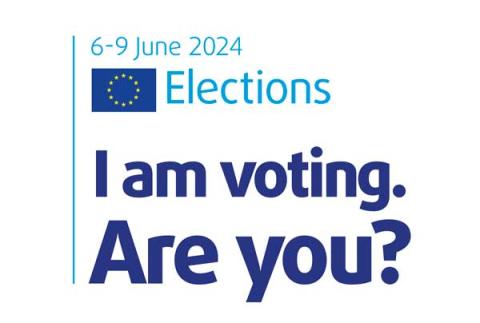
European elections - 6-9 June 2024: I'm voting. Are you?

In our new column I'm voting. Are you? which will run until June 2024, we present the views of our guest speakers on how and why to participate in the European elections. In this issue, our guest is Konstantina Manoli, a 19-year old student  from Greece who took part in this year's Your Europe Your Say.

Read more in all languages

In our new column I'm voting. Are you? which will run until June 2024, we present the views of our guest speakers on how and why to participate in the European elections. In this issue, our guest is Konstantina Manoli, a 19-year old student  from Greece who took part in this year's Your Europe Your Say. 

Held for the first time during Civil Society Week, the EESC's flagship youth event brought together more than 100 young people from across the EU, candidate countries and the UK for fervent debates on democracy and Europe's future.

Konstantina Manoli studies foreign languages, translation and interpreting at the Ionian University in Greece. She is a dedicated linguist with a passion for political discussions and global affairs.

Empowering Tomorrow: Young voters have a vital role in shaping democracy

By Konstantina Manoli

We cannot deny that the exercise of voting rights serves as a powerful tool for voicing opinions and influencing policies. As a matter of fact, throughout the elections in general, we all choose our voice, the people who we, personally, consider to be the best suited to represent us, our beliefs and our value systems. However, most of the time the majority of people and especially us, young people, tend to overlook the power of voting.

Read more in all languages

By Konstantina Manoli

We cannot deny that the exercise of voting rights serves as a powerful tool for voicing opinions and influencing policies. As a matter of fact, throughout the elections in general, we all choose our voice, the people who we, personally, consider to be the best suited to represent us, our beliefs and our value systems. However, most of the time the majority of people and especially us, young people, tend to overlook the power of voting.

We passionately declare our desire to change the world, to create a better future for all of us and for the next generations. However, somewhere in the middle of this process, when we feel that our opinions, our values and our ideals do not matter anymore or that we have no power, we give up.

Indeed, as a young woman from Greece, I know exactly how this feels. I'm familiar with the frustration of having our voices go unheard, witnessing the infringement of our rights and experiencing the sense of helplessness that arises when it seems like there's nothing more we can do. Sometimes, despite our best efforts, things don't unfold as planned. It is in these moments, surrounded by the echoes of our efforts, that we often forget a fundamental truth - our vote is our own power! As Barack Obama once said: 'There is no such thing as a vote that doesn't matter'.

Regrettably, I don't think this is solely my experience or exclusive to being Greek, young, or a woman. The truth is that many individuals share this sentiment regardless of their age, ethnicity, gender, religion, or their personal circumstances.

Voting is our collective voice in shaping the future we desire. Taking matters into our own hands ensures that our dreams and values resonate in the decisions that shape our society. We have to act, we need to because our vote is a key, unlocking the door to a future where the echoes of empowered youth resonate.

And remember the wise words of John Lewis, 'If not us, then who? If not now, then when?'

EESC News

Enlargement: Representatives from EU candidate countries will now join the work of the EESC

On 15 February, the European Economic and Social Committee (EESC) officially launched its initiative to welcome civil society representatives from EU candidate countries. A total of 131 'enlargement candidate members' (ECM) were selected to make up the pool of civil society experts who will be participating in the Committee's work, thus making the EESC the first institution to open its doors to EU candidate countries.

Read more in all languages

On 15 February, the European Economic and Social Committee (EESC) officially launched its initiative to welcome civil society representatives from EU candidate countries. A total of 131 'enlargement candidate members' (ECM) were selected to make up the pool of civil society experts who will be participating in the Committee's work, thus making the EESC the first institution to open its doors to EU candidate countries.

This initiative is EESC President Oliver Röpke's political priority. It sets new standards for involving candidate countries in EU activities, facilitating their progressive and tangible integration into the EU.

The initiative was inaugurated at the EESC plenary session, where it received a warm welcome from Věra Jourová, European Commission Vice-President, Milojko Spajić, Prime Minister of Montenegro, and Edi Rama, Prime Minister of Albania. They were joined by civil society representatives from nine EU candidate countries (Albania, Bosnia and Herzegovina, Georgia, Moldova, Montenegro, North Macedonia, Serbia, Türkiye and Ukraine) and by other ECMs online, all participating in an EESC plenary debate for the first time.

On this landmark occasion, President Röpke stressed: 'We cannot keep candidate countries in the waiting room any longer. This is why the EESC has decided to open its doors to candidate countries and involve their representatives – the enlargement candidate members – in our work'.

Prime Minister Spajić said: 'We highly value these aspects of gradual integration. We do not see this as a substitute for membership, but a way of preparing both the countries of the Western Balkan Region (in line with a merit-based 'regatta' approach) and the EU for integration'.

Prime Minister Rama stated: "I strongly believe that what is happening here should also happen in the EU Parliament, it should happen in the European Commission and it should happen in the European Council. This is the only way to soothe all spirits and inject a very concrete energy'.

Věra Jourová, European Commission Vice-President for Values and Transparency, said: "Enlargement is our mutual interest. It remains a geo-strategic investment for the Union. This is why we support the launch of today's initiative and all others that help our partner countries succeed with reform efforts that lead to a better economy and stronger democracy'.

The full list of ECMs selected for the pool is available here. (at)

Civil Society Week: European civil society sets agenda for next EU leaders

From 4 to 7 March, the European Economic and Social Committee (EESC) hosted the first-ever Civil Society Week, where over 800 representatives from civil society organisations and youth groups gathered to discuss the upcoming elections and the future of the EU. The takeaways will be incorporated into an EESC resolution in July, which will outline what civil society expects from the incoming leadership of the European Parliament and the Commission.

Read more in all languages

From 4 to 7 March, the European Economic and Social Committee (EESC) hosted the first-ever Civil Society Week, where over 800 representatives from civil society organisations and youth groups gathered to discuss the upcoming elections and the future of the EU. The takeaways will be incorporated into an EESC resolution in July, which will outline what civil society expects from the incoming leadership of the European Parliament and the Commission.

With its five major initiatives – including Civil Society Days, European Citizens' Initiative Day, Your Europe, Your Say! (YEYS), the Civil Society Prize, and the Journalists' Seminar – Civil Society Week aims to:

  • empower citizens to engage with the EU and exercise their democratic rights;
  • identify and address threats to democratic values, such as disinformation and voter apathy; and
  • gather recommendations from civil society to feed into future EU plans.

The first insights into the messages formulated by civil society organisations for the new EU leaders focused notably on responsive governance, inclusive policies and a sustainable future for all Europeans.

Combating misinformation

Ahead of the European elections, youth representatives and journalists raised concerns about the rampant spread of misinformation and deepening online polarisation, stressing the need for robust legal frameworks. Civil society calls for collaboration among governments, schools and tech firms to promote digital literacy, fostering a knowledge-rich and inclusive online environment.

An economy that works for people and the planet

Civil society urged for a shift from growth-centric models to holistic approaches that prioritise well-being, prosperity and environmental limits. In line with this, youth organisations advocated for a corporate sustainability directive and proposed special taxes on environmentally harmful goods.

Participants also emphasised the EU's role in the digital transformation, urging ethical AI leadership and citizen education. These measures aim to ensure responsible economic growth and to empower citizens in navigating the evolving technological landscape.

Empowering youth

Civil society insisted that young people must be empowered to shape the future of Europe. They advocated for a 'youth test' on all EU policies to assess their impact on younger generations. In particular, youth groups proposed youth quotas for European Parliament elections to enhance representation.

Strengthening democracy

Participants called for a more resilient and inclusive democracy, emphasising structured civil dialogue at all government levels. This dialogue, coupled with capacity building, aims to strengthen civil society in EU candidate countries, fostering a safe and enabling environment for civil society to thrive in Europe.

Moving beyond the suggestion box

The week exposed the strengths and weaknesses of the European Citizens' Initiative (ECI). While acknowledging its successes, frustrations emerged over insufficient responsiveness from EU institutions. Calls were made for ECIs to elicit substantive responses, fostering stronger partnerships and empowering citizen participation through shared best practices.

Looking ahead

These recommendations will feed into an upcoming EESC resolution setting out civil society's expectations for the next European Parliament and Commission. (gb)

Ireland’s Third Age Foundation wins EESC Civil Society Prize for mental health

The EESC Civil Society Prize honours non-profit projects implemented by individuals, civil society organisations and companies. A different theme is chosen each year, covering an important area of the EESC’s work. The winner of the 14th Civil Society Prize, dedicated to mental health, is Ireland’s Third Age Foundation and its social engagement network AgeWell, which battles loneliness in old age.

Read more in all languages

The EESC Civil Society Prize honours non-profit projects implemented by individuals, civil society organisations and companies. A different theme is chosen each year, covering an important area of the EESC’s work. The winner of the 14th Civil Society Prize, dedicated to mental health, is Ireland’s Third Age Foundation and its social engagement network AgeWell, which battles loneliness in old age.

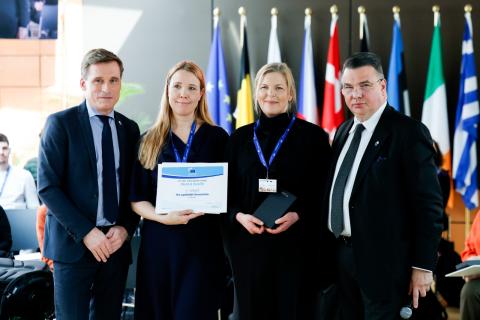
On 7 March, the European Economic and Social Committee (EESC) rewarded five non-profit organisations for their outstanding contribution to fighting mental health disorders, which have increased dramatically in the EU.

The EUR 50 000 prize was shared among the five winning projects.

The Irish charity Third Age Foundation took home the first prize of EUR 14 000.

The four runners-up each received EUR 9 000 and were ranked as follows:

  • 2nd place: Pro Lapinlahti association, FINLAND, for its community centre Lapinlahden Lähde
  • 3rd place: Integra, SLOVAKIA, for its ‘Crazy? So what!’ initiative
  • 4th place: Lilinkoti Foundation, FINLAND, for its The World of Recovery games
  • 5th place: Animenta organisation, ITALY, for its project Telling Stories for Good

FIRST PRIZE WINNER

With its social engagement network AgeWell, the Irish charity Third Age Foundation helps older people who are isolated, frail and vulnerable. Their unique service is community-based, where people over 50 support at-risk and in-need older people. Using a combination of in-house visits and a smartphone-based mental health questionnaire, AgeWell thus offers companionship and emotional support and identifies health risks at an early stage.

OTHER WINNING PROJECTS

The second place went to the Finnish Pro Lapinlahti association and its community centre Lapinlahden Lähde or ‘The Spring of Lapinlahti’. The centre, built through the renovation of Helsinki’s Lapinlahti Hospital, organises various workshops and events related to mental health literacy, boasting 50 000 visitors each year. Declared a diagnosis‑free zone, it allows everyone to be who they are without being labelled, offering empowerment instead of paternalism.

Placed third is the Slovak organisation Integra, with its ‘Crazy? So what!’ initiative, which breaks down stereotypes by promoting a compassionate understanding of mental health among young people. It provides first-hand insight into what it is like to have poor mental health and into the road to recovery.

The winner of the fourth prize, the Finnish Lilinkoti Foundation, is on a mission to support mental health with its innovative and creative games called The World of Recovery. The games promote mental health recovery through goals that inspire a healthy self-image, personal autonomy and an active and meaningful life. While the first is a non-violent mobile game, the second is an award-winning table top role-play game. They target mental health and people in recovery from substance abuse, along with professionals, and are free to use.

The project Telling Stories for Good secured fifth place for Italy's non-profit organisation Animenta. With the project, Animenta is rewriting stereotypical narratives on eating disorders, which affect more than four million people in Italy alone, two million of whom are adolescents. Its prevention and awareness-raising programmes are carried out by volunteer professionals online and in schools across Italy.

The EESC launched this year’s prize in July 2023. By dedicating it to mental health, it wanted to recognise the crucial role played by civil society in mental health treatment and prevention. The winners were chosen from over 100 applications from 23 Member States.

Past topics of the prize include youth and help for Ukraine, climate action, gender equality and empowering women and migration. In 2020, the EESC replaced its Civil Society Prize with a one-off Civil Solidarity Prize dedicated to the fight against COVID-19. (ll)

ECI Day 2024: raising the bar on citizen engagement

The 2024 ECI Day served as a powerful reminder of both the potential and the limitations of the European Citizens' Initiative (ECI). While celebrating the successes of past initiatives in raising awareness and sparking public debates, the discussions also laid bare the frustrations regarding the need for better responsiveness and follow-up from the EU institutions.

Read more in all languages

The 2024 ECI Day served as a powerful reminder of both the potential and the limitations of the European Citizens' Initiative (ECI). While celebrating the successes of past initiatives in raising awareness and sparking public debates, the discussions also laid bare the frustrations regarding the need for better responsiveness and follow-up from the EU institutions.

Key takeaways from the ECI day:

  • Beyond the Suggestion Box.  Successful ECIs should automatically result in substantive action from the Commission, including concrete responses and, where appropriate, legislative proposals. This would ensure their direct influence on EU law, fostering a more meaningful dialogue between citizens and institutions.
  • Stronger partnerships. Collaboration is key. Amplifying citizen voices requires strategic collaboration between organizers, civil society, media outlets and public partners.
  • Continuous improvement. The ECI framework is constantly evolving. By harnessing best practices and fostering knowledge-sharing among stakeholders, we can strengthen the ECI process and empower even more citizens to participate actively.

The ECI enables citizens to ask the EU to take action and propose a new law on a particular issue. When an initiative has reached 1 million signatures, the Commission decides what action to take. (gb)

YEYS 2024: Youth priorities for the next EU legislative term

More than 100 young people from the EU, candidate countries and the UK gathered for Your Europe, Your Say! (YEYS), the EESC's annual top youth event. They shared their visions and recommendations for the future of the European Union. With the EU elections approaching, YEYS 2024 prioritises combatting disengagement and promoting youth participation.

Read more in all languages

More than 100 young people from the EU, candidate countries and the UK gathered for Your Europe, Your Say! (YEYS), the EESC's annual top youth event. They shared their visions and recommendations for the future of the European Union. With the EU elections approaching, YEYS 2024 prioritises combatting disengagement and promoting youth participation.

Key recommendations:

  1. Introduce a youth quota for European Parliament elections.
  2. Enact a directive mandating human rights and environmental considerations in supply chains and corporate operations.
  3. Establish a legal framework for social media to combat polarisation and disinformation.
  4. Develop a standardised strategy on sexual and reproductive rights.
  5. Implement special taxation guidelines for climate-harming goods, with proceeds funding climate-friendly initiatives.

These proposals will be handed over to the EU institutions and policymakers and contribute to the output of Civil Society Week and to an EESC resolution on the upcoming European elections.(gb)

EESC calls for a strategy on civil dialogue

In a debate with Commission Vice-President and Commissioner for Democracy and Demography Dubravka Šuica, the EESC called for a strategy on civil dialogue as a first step towards strengthening the role of civil society and increasing citizen participation in EU policy-making.

Read more in all languages

In a debate with Commission Vice-President and Commissioner for Democracy and Demography Dubravka Šuica, the EESC called for a strategy on civil dialogue as a first step towards strengthening the role of civil society and increasing citizen participation in EU policy-making.

The European Economic and Social Committee (EESC) put forward its demands in the opinion Strengthening civil dialogue and participatory democracy in the EU: a path forward, adopted shortly after the debate held at the EESC's plenary session on 15 February.

It stressed the urgent need to step up the implementation of Article 11 of the Treaty of the EU (TEU), under which the institutions have a joint responsibility to ensure that organised civil society is actively involved in formulating EU laws.

This should be done as a follow-up to the Conference on the Future of Europe (CoFoE), a landmark initiative and major democratic exercise, which included a series of citizen-led debates on matters that directly affect them in their lives.

'We can all agree that citizens' voices must be heard beyond the ballot box. We, in the EU institutions and bodies, must all become better at involving civil society in meaningful dialogue beyond mere information and consultation,' said EESC President Oliver Röpke.

Building a more transparent, inclusive and democratic EU requires increased civic engagement and a strong partnership between the EU institutions and national governing bodies. 'Our collective efforts will ensure that the EU remains a beacon of hope and a model of participatory democracy for the world,' Commissioner Šuica stressed.

Pietro Barbieri, rapporteur of the opinion, stated: 'With this opinion, the EESC is inviting the European institutions to take a concrete step forward: to adopt a strategy for civil dialogue, giving life to an action plan and an interinstitutional agreement that involves every level of the EU. The EESC's commitment is a sign of an urgent need that cannot be renounced or postponed.'

Miranda Ulens, co-rapporteur, added: 'We already have good practices for social dialogue. The proposals we make will ensure that the voices of other legitimate and representative organisations can be heard too. Let's create a real, democratic Europe for its citizens! #TogetherStrong!' (ll)

Meet the Champions of Excellence: EESC and European Commission put spotlight on vocational training to address labour shortages

On 23 February, the European Economic and Social Committee (EESC) and the European Commission held a flagship event for the European Year of Skills, bringing together over 400 young people from all EU Member States to shine the spotlight on the skills needed for current and future jobs.

Read more in all languages

On 23 February, the European Economic and Social Committee (EESC) and the European Commission held a flagship event for the European Year of Skills, bringing together over 400 young people from all EU Member States to shine the spotlight on the skills needed for current and future jobs.

The Meet the Champions of Excellence event featured 35 young EU champions from recent WorldSkills and EuroSkills competitions and from Abylimpics (a skills Olympics for people with disabilities), where competitors had participated in more than 20 different disciplines, such as mobile robotics, ICT, mechanics, graphic design, automotive technologies and construction.

The champions shared inspiring stories of their learning and career paths. Young audiences were able to observe and learn about traditional and new skills during specific demonstrations in areas such as floristry, car painting, robotics and virtual reality, which included talks on robot system integration, a demining robot for Ukraine and mechanical engineering computer aided design (CAD).

The aim was to promote the benefits and opportunities offered by vocational education and training (VET), especially against the backdrop of the green and digital transitions and the future world of work. VET is also relevant in the current context of labour and skill shortages and skill mismatches in the EU, where more than three quarters of companies report difficulties finding workers with the necessary skills.

EESC President Oliver Röpke said: 'Skills are a key ingredient for empowering young people to thrive in both their personal lives and their careers. With the digital and green transitions ongoing, we have the power, through skills, not only to adapt but also to sculpt the jobs of tomorrow'.

Nicolas Schmit, Commissioner for Jobs and Social Rights, said: 'Vocational training offers so many opportunities in today's labour market. I am convinced that VET has the potential to help us address the skill mismatches and labour shortages that are holding back Europe's industries'.

The event showed that VET is an excellent choice, offering strong career prospects and quicker job opportunities for young people and also for adults looking to change jobs or simply upgrade their existing skill set. Yet it often remains a second choice for many prospective students. In 2021, just over half of all students enrolled in medium-level education in the EU were in programmes with a vocational orientation.

In 2022, almost 80% of recent VET graduates managed to get a job, with the EU aiming to reach a target of 82% by 2025. (ll)

European Democracy Passport updated

Trying to change the education system? Having a problem with poisoned food products? Want to move lorries from road to rail? Or having problems registering your company across borders? EU citizens have many rights and also face hard choices – but they need to know where and how they can make a difference and what their options are.

Read more in all languages

Trying to change the education system? Having a problem with poisoned food products? Want to move lorries from road to rail? Or having problems registering your company across borders? EU citizens have many rights and also face hard choices – but they need to know where and how they can make a difference and what their options are.

Our popular European Democracy Passport has the answers, and it has just been updated! The Passport provides factsheets, background information, pathfinders and navigators for all aspects of modern European democracy, including a toolkit of participation resources and a detailed manual on the European Citizens' Initiative (ECI).

The new version is already available in several languages and we will be adding more in the next couple of weeks. (cw)

News from the Groups

Time for a large-scale European defence industrial programme

by Antonello Pezzini, delegate of the EESC Consultative Committee on Industrial Change and former member of the EESC Employers’ Group

Read more in all languages

by Antonello Pezzini, delegate of the EESC Consultative Committee on Industrial Change and former member of the EESC Employers’ Group

Last January, the European Commissioner for Internal Market, Thierry Breton reiterated the need to consolidate an internal defence market to ensure our security. ‘We started with munitions for Ukraine’, he stated. ‘We now need to broaden this approach to include a large-scale European defence industrial programme capable of supporting the expansion of the European industrial base and developing the infrastructure needed to protect contested areas’.

The EESC has had the opportunity to reiterate on numerous occasions the need to support the launch of a European Defence Industrial Development Programme (EDIDP) aimed at creating an interoperable and integrated common defence system.

This objective is all the more urgent given the current geopolitical situation, which urges us to strengthen Europe’s strategic autonomy in defence and develop a solid common industrial and technological base.

The EDIDP should be framed by a common strategic vision for the defence industry that can move towards the effective integration of European manufacturers and users, involving at least three Member States.

There is an emerging and growing need for structured dialogue at European level, in synergy and coordination with NATO, and a council of defence ministers that can provide ongoing political leadership and a forum for consultation and the adoption of genuinely European decisions.

The statutory provisions must ensure: a balance between large and small countries; that 20 % of participating businesses are smaller businesses; training for skilled staff and new job profiles; and retraining for staff whose skills have become redundant or obsolete.

Now is the time to expand and strengthen this approach to include a large-scale European defence industrial programme, capable of supporting the expansion of the European industrial base, by developing ‘dual-use’ items. These are items, including software and technology, which can be used for both civil and military purposes and include items that can be used for the design, development, production or use of chemical or biological weapons and their means of delivery.

Read the full article by Antonello Pezzini in the EESC Employers' Group Newsletter: https://europa.eu/!yKMPTk

From farm to pitchfork?

There will be no green deal without a social deal

by the EESC Workers' Group

Read more in all languages

There will be no green deal without a social deal

by the EESC Workers' Group

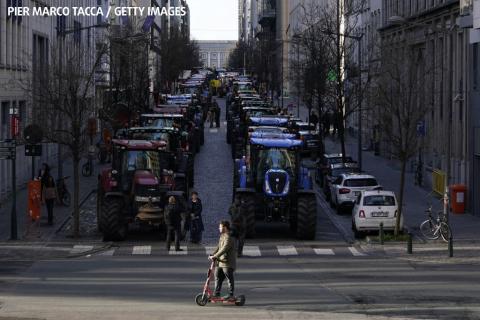
On 26 February, farmers and their tractors blocked the streets of Brussels in protest, for the second time in a few weeks. In stark contrast with the usual array of suits and well-trimmed haircuts, the streets of the European district were taken over by trucks, tractors, hay and piles of burning tyres. The complex reasons behind the farmers' protest range from the CAP and environmental policies to completely unrelated issues.

The truth is, the European countryside is in a difficult situation, and has been for a long time. The Workers’ Group and the EESC as a whole have repeatedly warned that there would be no green deal without a social deal. And while it could be tempting to dismiss this as another by-product of Brussels jargon, it would be a grave mistake. The countryside is facing real problems. They include intermediaries paying producers a pittance but charging outrageous consumer prices; insufficient aid for undertaking environmental reforms; and (non-fair) free trade, harsh working conditions and climate change.

The response of the European Commission, which hastily ditched pesticide requirements, is even more worrying than the lack of proper consultation and engagement with social partners and the inaction at social policy level. As with environmental measures, abandoning these measures might buy our politicians a little time, but it will also push us beyond the point of no return with the environment.

On top of this, with the elections coming, the far right is trying to capitalise on the discontent and, to some extent, is succeeding in steering the protest against the SDGs, the Green Deal and Agenda 2030.

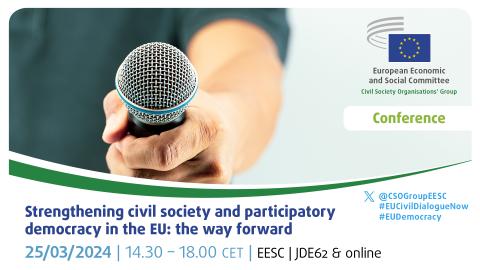
Conference on Strengthening civil society and participatory democracy in the EU: the way forward

by the EESC Civil Society Organisations' Group

On 25 March from 14.30 to 18.00 CET, the EESC's Civil Society Organisations' Group will hold a conference in Brussels to explore how the EU as a whole and Member States individually can work towards effective sustainable civil dialogue and participatory democracy

Read more in all languages

by the EESC Civil Society Organisations' Group

On 25 March from 14.30 to 18.00 CET, the EESC's Civil Society Organisations' Group will hold a conference in Brussels to explore how the EU as a whole and Member States individually can work towards effective sustainable civil dialogue and participatory democracy.

Guest speakers will include:

  • Pedro Silva Pereira, Vice-President of the European Parliament, replacing European Parliament President Roberta Metsola for contact with civil society organisations representing citizens, and
  • His Excellency Willem van de Voorde, Belgian Ambassador and Permanent Representative of Belgium to the EU.

During the conference, the following two recent initiatives will be presented:

  • the EESC opinion on Strengthening civil dialogue and participatory democracy in the EU: a path forward (SOC/782), drawn up at the request of the Belgian presidency of the Council of the EU and adopted at the EESC plenary session on 15 February;
  • an open letter, which received the support of 156 signatories from 26 EU Member States and was initiated by the Civil Society Organisations' Group and Civil Society Europe. The letter calls on the main EU institutions to take concrete measures to implement open, transparent and regular dialogue with civil society organisations in all policy areas.

The conference will bring together institutional stakeholders and a wider audience to reflect on ways to implement the measures proposed by these and other initiatives.

The conference is open to the public. Prior registration is required for active participation on site or remotely. The event will be streamed.

For further information, the draft programme, registration and streaming, please visit the event website.

Civil Society Prize Special

Brochure on the 14th Civil Society Prize: Find out more about many candidates!

To shine a light on civil society’s efforts towards curbing the silent epidemic of mental health disorders in the EU, the EESC has published a brochure which features a number of entries submitted for the Civil Society Prize on mental health. You can read the brochure here.

Read more in all languages

To shine a light on civil society’s efforts towards curbing the silent epidemic of mental health disorders in the EU, the EESC has published a brochure which features a number of entries submitted for the Civil Society Prize on mental health. You can read the brochure here.

Did you know? Facts and figures on mental health

Facts and figures about mental health in the EU do not paint a rosy picture but rather raise a call for action. The EESC advocates stronger measures to promote mental health at national and EU levels. It has also called for binding legislation to prevent psychosocial risks in the workplace. With the Civil Society Prize on mental health, it pays tribute to the continuing efforts of civil society to improve the wellbeing of Europeans.

Read more in all languages

Facts and figures about mental health in the EU do not paint a rosy picture but rather raise a call for action. The EESC advocates stronger measures to promote mental health at national and EU levels. It has also called for binding legislation to prevent psychosocial risks in the workplace. With the Civil Society Prize on mental health, it pays tribute to the continuing efforts of civil society to improve the wellbeing of Europeans.

  1. The EESC decided to dedicate its flagship Civil Society Prize to mental health after reports that, in the aftermath of the COVID-19 pandemic, mental health disorders such as anxiety and depression spiked across Europe. According to the OECD, the share of young people with symptoms of anxiety more than doubled in several European countries. The pandemic also lowered the age of onset for eating disorders, particularly among adolescents. Even before COVID-19 hit, mental health problems affected at least 84 million people – around one in six – across the EU.
  2. Around 4% of annual deaths in the EU are attributed to mental health and behavioural disorders. Poor mental health also has a huge economic impact, as the direct and indirect costs account for roughly 4% of GDP. More than a third of these costs stem from lower employment rates and falling productivity at work.
  3. In 2020, 44.6% of the employed population aged 15-64 across the EU reported facing risk factors for their mental wellbeing at work according to Eurostat. Work overload or time pressure was the most commonly mentioned risk factor for mental wellbeing at work, reported by nearly a fifth of employed people in the EU.
  4. Mental wellbeing has risen to the top of the political agenda in the EU. As a result, the Commission adopted a comprehensive approach to mental health in June 2023. Supported by EUR 1.23 billion in EU funding, this new approach aims to promote mental health in all EU policies, with a focus on three guiding principles: adequate and effective prevention; access to high-quality and affordable mental healthcare and treatment; and reintegration into society after recovery. Mental health is also a political priority for the EESC and is at the core of its work.
  5. The EESC received as many as 105 applications from across the EU, covering a wide range of topics – from projects preventing psychosocial risks in the workplace or tackling issues such as substance abuse and cyberaddiction to combatting stigma around mental health and promoting community-led assistance. The EESC hopes that by honouring and showcasing these vital non-state efforts in supporting mental health it can also inspire others to do the same. (sg)

Safeguarding mental health in old age: the power of social contact

Through its social engagement network AgeWell, the Irish charity Third Age Foundation is battling loneliness in old age. Its AgeWell Companions, themselves over 50, visit older people in their homes once a week, offering companionship but also monitoring the client's health and well-being with the help of a phone-based app questionnaire. The Third Age Foundation's Alison Branigan told us that to date, more than 500 people received the support in Ireland's Co. Meath, with some describing the service as a "lifeline" or even as "light at the end of a dark long tunnel."

Read more in all languages

Through its social engagement network AgeWell, the Irish charity Third Age Foundation is battling loneliness in old age. Its AgeWell Companions, themselves over 50, visit older people in their homes once a week, offering companionship but also monitoring the client's health and well-being with the help of a phone-based app questionnaire. The Third Age Foundation's Alison Branigan told us that to date, more than 500 people received the support in Ireland's Co. Meath, with some describing the service as a "lifeline" or even as "light at the end of a dark long tunnel."

What prompted you to start your project?

AgeWell was introduced in Co. Meath to support its growing older population, who had specific social, emotional, psychological, and physical care needs. Our health service is under immense pressure, our population is growing and ageing, and there are long waiting lists for services including home support. AgeWell provides a timely and practical response that compliments and enhances our existing health service by supporting older people who are isolated, lonely, frail, housebound, and at-risk to help them live better for longer in the place of their choosing, by providing them with social connections and ongoing health and well-being monitoring, and by identifying and reacting to emerging issues before they escalate into something more serious. AgeWell also fits well with the ethos of our organisation Third Age, which supports older people directly through innovative services and programmes, and creates unique volunteering opportunities where older people can support their peers and other community groups. 

How was your project received? Did you have any feedback from the people you helped?  (Can you give an example if you have any)

To date AgeWell has supported over 500 older people in Co. Meath. Many really appreciate the companionship aspect of the programme: they have built a special trust with their AgeWell Companions, which helps us to understand their needs and fears and thus enables us to better support them.

Comments from our clients include: “the service is a lifeline”, “I didn’t know I needed the support until I had it”, “I’m so grateful for the service and my companion, she brightens up my week”, “I was very lonely, I didn’t see anyone from one day to the next, I really look forward to my visits”. One client who found himself in a very dark place and admitted he had contemplated suicide several times said that “AgeWell came at the right time - it helped me to see light at the end of a long dark tunnel”; he also said “everyone should have access to this service”.

Our volunteer companions who are also older people have this to say: “I just love being a volunteer”, “It’s so nice to feel you are making a difference”, and “I’ve learned a lot about people and myself doing this job”.

Statistically we can prove that AgeWell improves well-being and social, emotional and informational support, reduces isolation and loneliness, improves self-rated health, and increases physical activity levels.

Other feedback includes peace of mind expressed by the family members of our clients, and recognition of our work from healthcare providers who continually refer clients directly to us.

What advice would you give to other organisations in terms of achieving results with such activities and programmes?

Know your audience, involve your participants in the process, and listen to their suggestions and their needs. Believe in what you know and what you can achieve, be brave, be creative, persevere: if your idea is good enough, you will find a way. Be open to working with others, and if you can get buy-in from the state or health service in terms of funding and/or support/promotion, that can add hugely to the programme's credibility, its impact and its success.

What is, in your opinion, the main trigger for worsening mental health in old age, apart from physiological factors? Can we, as a society, improve the mental health of older people?

Loneliness and isolation have always been factors that contribute to worsening mental health in old age; while this can be an issue in rural Ireland it is just as prevalent in bustling towns and cities. In recent years the effects of the pandemic, forced isolation, cocooning, and shielding, and the loss of social contact, access to activities and freedom have created an epidemic of fear, anxiety, depression, and mental health issues. Domestic and world events, including the rising cost of living, war and conflict, have also played a part. As people age their social circles can decrease, illness can affect their ability to get out and about, they may become housebound, or experience a loss of independence; all of these can affect esteem, self-worth, mood, and outlook. It is important that older people are not forgotten just because they may not be visible: we need to remember the importance of community, community interventions and the power of social contact and social prescribing initiatives. 

Lapinlahden Lähde: leave stigma and discrimination at the gate

In 2013, the Lapinlahti hospital, Finland's first psychiatric hospital and the symbol of mental health care in the country with a 170-year history, stood empty and forgotten. Then a group of mental health activists rolled up their sleeves with a vision of transforming the dilapidated place of heritage into an open centre for mental health, culture and the arts. Siru Valleala, a representative of the association Pro Lapinlahti  which runs the centre, told us that Lapinlahden Lähde is now first and foremost an inclusive place where stigma and prejudice are left at the gate and where everyone feels welcome.

Read more in all languages

In 2013, the Lapinlahti hospital, Finland's first psychiatric hospital and the symbol of mental health care in the country with a 170-year history, stood empty and forgotten. Then a group of mental health activists rolled up their sleeves with a vision of transforming the dilapidated place of heritage into an open centre for mental health, culture and the arts. Siru Valleala, a representative of the association Pro Lapinlahti which runs the centre, told us that Lapinlahden Lähde is now first and foremost an inclusive place where stigma and prejudice are left at the gate and where everyone feels welcome.

What prompted you to start your project?

In 2013, the Lapinlahti Hospital, Finland's first psychiatric hospital, built in 1841, stood empty. The City of Helsinki had no plans for its future. Full of heritage and surrounded by beautiful parkland, the historic site was forgotten and dilapidated. Concerned about this tragic situation, a group of mental health activists started sharing their vision and dreams for the place - to transform the Lapinlahti hospital and parkland into an open centre for mental health, culture and the arts.

That was the beginning of what is today known as Lapinlahden Lähde – “the spring of Lapinlahti”.  Activities build on the area’s historical and architectural significance in the heart of Lapinlahti Bay, inspired by 170 years of mental health work. The focus was shifted from treating illness to promoting wellbeing for all walks of life. Lapinlahden Lähde is now a living example of the ongoing anti-stigma work and a paradigm shift towards promoting the positive.

In the past, Lapinlahti had been the flagship of psychiatry and a place where mental health care was constantly being developed. Instead, now the mental health activists who had worked for the Pro Lapinlahti Mental Health Association that was founded in 1988 – when Lapinlahti was still an active hospital – wanted to create an innovative centre for promoting mental health, using all the knowledge available in the 21st century, a place that embodies the concrete paradigm shift from treating mental illness to promoting mental wellbeing.

How was your project received? Did you have any feedback from the people you helped?  Do you have an example to give us?

In the beginning it was a challenge getting people to come through the gates. The area had been closed to the public for 170 years while it was used as a psychiatric hospital, and despite interest and curiosity it was difficult to convince people that they were welcome to come and have a look round. Slowly but surely, people joined in the activities and events and enthusiastically helped to develop them further, volunteering and sharing ideas. Artists and performers brought their art exhibitions and cultural events to Lapinlahden Lähde and today we have more than 400 events a year, and 50–60 yearly art exhibitions. Lapinlahti has become an open living room for everyone in Helsinki, promoting mental wellbeing and reducing loneliness and social exclusion every single day of the year.

”When I got involved with this initiative I felt it was absolutely lovely that I could be here, helping to breathe new life into this place ... the air blows all the heavy things away.” (Cresswell-Smith et al 2022)

Lapinlahti hospital is today viewed as a very safe and inclusive place. A place where you always feel welcome, regardless of what kind of day you are having or what kind of life situation you find yourself in. There is meaning in Lapinlahti’s past as a psychiatric hospital. It gives you permission to be vulnerable and there is an openness about mental health difficulties which is absolutely unique. We build on a strong sense of community and everyone can safely explore their own strengths. Stigma and discrimination are left at the gate, and we at Lapinlahden Lähde pride ourselves on including everyone.

Lapinlahti's operations have been developed in cooperation with the owner, the City of Helsinki, and this development work has been a prerequisite for the entire operation. Far-reaching political decisions are currently being taken on the future ownership of the area, and we hope that the success of the current operations will be fully taken into account.

How will you use this specific funding to provide further help in the community? Are you already planning new projects?

We will continue to develop our activities so that even more people can take part and benefit from them. We have recently launched an exciting project for people recovering from mental health disorders which aims to increase access and even rights to cultural activities. More specifically, helping people to find their own way to achieve cultural expression, to figure out what works for them in terms of mental wellbeing culture and the arts. This is what we will use the generous prize money awarded here for.

In your opinion, what kind of collective action is needed to reduce the stigma that often accompanies mental health problems? Can art have a role in empowering people with mental health problems?      

We need to provide activities where people with different experiences and backgrounds can meet. Building activities not based on health status or life circumstances creates unique human encounters and forges meaningful connections between people from different backgrounds. Exploring mental health through different means such as the arts has increased awareness and understanding. Art has an exceptional way of bringing people together and offers new ways to deal with even painful issues. Art channels expression and builds opportunities for people to be seen and heard. The power of being heard can change a person's life and their perception of themselves.

Sometimes it's enough to have someone to talk to

The Slovak project Crazy? So what?, run by the organisation Integra, brings together young students and people who have experienced mental health problems. During one full day of teaching, students learn first hand what it is like to overcome a mental health crisis and how to get help . Integra's director Jana Hurova told us that the project helps break down the stigma about people struggling with mental health and gives young people a precious spark of hope.

Read more in all languages

The Slovak project Crazy? So what?, run by the organisation Integra, brings together young students and people who have experienced mental health problems. During one full day of teaching, students learn first hand what it is like to overcome a mental health crisis and how to get help . Integra's director Jana Hurova told us that the project helps break down the stigma about people struggling with mental health and gives young people a precious spark of hope.

What prompted you to start your project?

For many years, our organisation has been supporting people with mental health problems. As a result of being ill, they have lost their jobs, homes, friends, sometimes their families too. Their whole world has been turned upside down. We set up Slovakia’s first community mental health services almost 30 years ago. Its aim was to ensure that that these people, after being treated in a psychiatric hospital, could receive support and get back to the regular lives they had before they were ill. We supported the emergence of patient organisations in Slovakia and carried out a number of programmes to destigmatise mental illness. There are people with severe mental health problems in our care, especially schizophrenia, many of whom have already managed to integrate and find meaning in their lives.

With all of our activities being carried out in a non-traditional way from the very beginning, working in partnership with our clients to best identify their needs, we applied a similar approach to the Crazy? So what! programme. Many of our clients have found a sense of purpose by meeting young people and, by drawing on their personal experience, talking about what they lacked at their age and what later triggered their mental health problems.

We see a growing need to highlight the importance of mental health. Knowing how to manage a personal crisis is a great strength.

We started the Crazy? So what! programme in Slovakia back in 2005, together with partners from Germany and Czechia. However, it is only recently that we have managed to put the programme on a more stable footing and to expand it. We have trained as coaches, we train up new teams and we visit new schools.

How has your project been received? Did you have any feedback from the people you helped?  (Can you give an example if you have any)

It always makes a strong impression on young people when they are able to meet those who have overcome a mental health crisis and who they can ask about anything. It shows them that if they do have problems themselves, help is always available. The fact that it involves one full day of teaching, and that communication is on an equal basis, means that participants always come away with a positive impression.

People with personal experience of mental health problems can give young people the courage to do something about their own problems. In almost every class, there are students experiencing problems. Giving them a spark of hope is priceless. People with personal experience tell their own story as a way of feeling better themselves. They themselves decide how much to let the pupils into their lives. In this way, they feel that they are valuable and that people understand them.

We received many comments such as students saying they don't normally get the chance to meet people with mental health problems or that we should learn to accept such people and not condemn them for being different.

We also received feedback from people with personal experience of mental health problems who are involved in the programme. One person told us:

‘The programme gives me the courage to walk tall. I want to live at last! Talking to students is tough but rewarding. They are very open, and have hardly any fear of social contact. The most wonderful thing for me is that they show there is far more that unites us than divides us, that the image of “crazy people” is not true. It is great that I can help people to finally talk openly about mental health problems, so that no one has to be ashamed or to hide. ’

What drives us forward are young people. After each of these days, they talk about how important the Crazy? So what! programme is for them and that it should continue so that every young person in Slovakia can learn about how valuable their own mental health is.

Are you already planning new projects?

We would like there to be scope for all young people to receive this form of education so that we can further expand the programme to other regions of Slovakia. It has already been carried out in Germany (where it was first set up), Slovakia, Czechia and Austria. This year we also trained up the first teams in Ukraine.

In your opinion, how important is it to openly talk about one's mental health problems? What message are you sending with your project?

We want to spread the message that having mental health problems is not a source of shame. What is shameful, however, is not doing anything to promote our own health. Because there is no health without mental health.

The main idea behind the Crazy? So what! programme is to highlight in good time the importance of mental health, and, at the same time, to foster understanding of people with mental health problems.

We have found it is much better to prevent than to treat. And it is more effective too. We offer courage and motivation and are optimistic. Help is always available. Sometimes it is enough to have someone to talk to. Fighting for your dreams is never easy, but it is worth it.

The untapped potential of games to improve mental health

Feeling that there was still room for innovation and new approaches to mental health, the Finnish Lilinkoti Foundation developed The World of Recovery (TWoR) games – one played online and the other around a table. Both are role-playing games that require players to step into the shoes of a given character. Set in a futuristic world of hope, they promote the player’s journey to recovery, targeting those recovering from mental health and substance abuse problems, but also professionals. Lilinkoti’s representatives Reetta Sedergren and Venla Leimu told us that games have a huge potential to improve mental health, however, this potential remains largely untapped. 

Read more in all languages

Feeling there was still room for innovation and new approaches to mental health, the Finnish Lilinkoti Foundation developed The World of Recovery (TWoR) games – one played online and the other around a table. Both are role-playing games that require players to step into the shoes of a given character. Set in a futuristic world of hope, they promote the player’s journey to recovery, targeting those recovering from mental health and substance abuse problems, but also professionals. Lilinkoti’s representatives Reetta Sedergren and Venla Leimu told us that games have a huge potential to improve mental health, however, this potential remains largely untapped. 

What prompted you to start your project? 

Some years ago, we at Lilinkoti foundation felt there was plenty of space for innovation and new approaches in the field of mental health recovery. Spread of recovery orientation was a huge step forward for the field, but modern, innovative tools to implement it were somewhat lacking. Our organisation had worked with people recovering from mental health problems for decades, and we had a dream: what if there was a modern tool to boost mental health – a digital game you play as a character? 

How was your project received? Did you have any feedback from the people you helped?   

The World of Recovery games were co-developed with people recovering from mental health problems and with professionals, so the feedback was constant throughout the game design process, guiding it towards the end result. 

We received overwhelmingly positive anonymous and personal feedback from the players of both games. For example, more than 90% of responders said that the mobile game boosted their well-being and helped them to get active, while the role-playing game helped them with their social skills.  

Perhaps the best feedback was the laughter and the conversations about feelings, challenges and strengths, and the way that these games brought the players together, regardless of their roles and background. 

What advice would you give to other organisations in terms of achieving results with such activities and programmes? 

There are many benefits to being on the frontlines of innovation. It is truly inspiring and you are doing something new. Embrace it, don’t try to fit into any box. Follow your instinct, be curious to listen to everybody’s opinions. More than anything, involve people who are recovering and experts by experience in the design process. If you are making games, be prepared to tackle lots of prejudices from professionals. It is common in the field of mental health that games in general are considered addictive or harmful. Don’t be discouraged! Be bold, be creative and dare to dream. 

What is the potential of computer and video games for improving mental health? In your opinion, should they be used more in the treatment of mental health issues? 

The potential of computer and video games – and specifically role-playing games – for improving mental health is huge. As an alarming number of people suffer from mental health issues, we need new, versatile ways to improve mental health. It is a shame that the potential of games has not been explored further. This is not for lack of interest but for lack of sufficient funding. There is no fast and easy way to develop good games to improve mental health. We need more funding, more co-developed projects and more mental health and game industry professionals working towards this goal. And we need research, lots of research. 

Breaking the stigma around eating disorders with storytelling

Over 55 million worldwide, many of them adolescents, suffer from eating disorders, impacting their mental and physical health. Stigma prevents many from seeking help. The project Telling Stories for Good, run by Italian organisation Animenta, aims to dismantle stereotypes, promote early recognition and provide support. Since 2021, they have reached over 10,000 pupils in Italy. We talked to Animenta's president and founder Aurora Caporossi.

Read more in all languages

Over 55 million worldwide, many of them adolescents, suffer from eating disorders, impacting their mental and physical health. Stigma prevents many from seeking help. The project Telling Stories for Good, run by Italian organisation Animenta, aims to dismantle stereotypes, promote early recognition and provide support. Since 2021, they have reached over 10,000 pupils in Italy. We talked to Animenta's president and founder Aurora Caporossi.

What prompted you to start your project?

Animenta was born of the need to give a voice to all people suffering from an eating disorder, but also to those who live next door. The association aims to ensure that people receive proper access to treatment for eating disorders, because it is possible for people to heal from an eating disorder if they are given the opportunity to heal themselves.

How has your project been received? Have you had any feedback from the people you helped?  Do you have an example you can give us?

"Animenta is the place where I felt welcomed, I realised that I also suffered from an eating disorder even though I was not underweight." This is a message that came several months ago from our community which allowed us to understand the importance and impact of our work. Animenta was received with curiosity, but also with the hope that we could bring about change.

How will you use this specific funding to provide further help in the community? Are you already planning new projects?

We would like to invest more and more in the projects we carry out in schools to broaden our impact. Likewise, funds will be used to start self-help groups for those suffering from an eating disorder. Animenta's projects include Animenta Camps, which are six-day experiences in nature for people to rediscover their relationship with themselves, their bodies and food.

What advice would you give to other organisations in terms of achieving results with these kinds of activities and programmes?

Start with stories to learn about what the community you are addressing is experiencing. Ask for feedback, and give out questionnaires to understand what they need. But most of all put your face out there to tell the story of your struggle and the change you want to bring about. At the same time, it is crucial to network with others to create an efficient and effective support system.

In your opinion, are eating disorders today properly recognised as a serious mental health issue? Do people affected receive appropriate support and what should be done to improve this?

Today there is more talk about eating disorders, so we can say that there is more information. However, they are diseases that have a deep social stigma and very stereotypical representation. Some people, even today, believe that eating disorders are a lack of willpower or a whim. In reality, eating disorders are a complex psychiatric illness that needs proper treatment, which at the moment is not always available because there are not enough treatment centres and many people cannot access the treatment pathway.

Editors

Ewa Haczyk-Plumley (editor-in-chief)
Laura Lui (ll)

Contributors to this issue

Daniela Vincenti (dv)
Ewa Haczyk-Plumley (ehp)
Agata Berdys (ab)
Giorgia Battiato (gb)
Jasmin Kloetzing (jk)
Katerina Serifi (ks)
Katharina Radler (kr)
Laura Lui (ll)
Marco Pezzani (mp)
Margarita Gavanas (mg)
Margarida Reis (mr)
Millie Tsoumani (mt)
Pablo Ribera Paya (prp)
Simran Grewal (sg)
Thomas Kersten (tk)

Coordination

Agata Berdys (ab)
Giorgia Battiato (gb)


Address

European Economic and Social Committee
Jacques Delors Building,
99 Rue Belliard,
B-1040 Brussels, Belgium
Tel. (+32 2) 546.94.76
Email: eescinfo@eesc.europa.eu

EESC info is published nine times a year during EESC plenary sessions. EESC info is available in 24 languages
EESC info is not an official record of the EESC’s proceedings; for this, please refer to the Official Journal of the European Union or to the Committee’s other publications.
Reproduction permitted if EESC info is mentioned as the source and a link  is sent to the editor.
 

March 2024
03/2024

Follow us

  • Facebook
  • Twitter
  • LinkedIn
  • Instagram