Newsletter Info

EESC info

European Economic and Social Committee A bridge between Europe and organised civil society

FEBRUARY 2024 | EN

GENERATE NEWSLETTER PDF

Available Languages:

  • BG
  • CS
  • DA
  • DE
  • EL
  • EN
  • ES
  • ET
  • FI
  • FR
  • HR
  • HU
  • IT
  • LT
  • LV
  • MT
  • NL
  • PL
  • PT
  • RO
  • SK
  • SL
  • SV
Editorial
Let's build EU future together – Join us for the EESC inaugural Civil Society Week

Editorial

Dear readers,

The upcoming European elections are crucial for the EU as it fights Eurosceptic and far-right alarmism. They will shape the EU's political landscape and define an active and inclusive role for citizens and civil society organisations.

Read more in all languages

The upcoming European elections are crucial for the EU as it fights Eurosceptic and far-right alarmism. They will shape the EU's political landscape and define an active and inclusive role for citizens and civil society organisations.

Against this backdrop, the EESC, the home of organised civil society, is holding its first Civil Society Week: Rise Up for Democracy! on 4-7 March 2024.

This event will bring together people of all ages and backgrounds, including young people, journalists from all EU Member States, representatives from civil society organisations, stakeholders and EU institutions, who will engage in lively discussions, highlighting civil society's contribution to the social, political and economic issues that affect our everyday lives.

As democracy starts with participation, this new EESC flagship event will combine five major initiatives:

  • Civil Society Days, where people will voice their expectations on crucial issues for our democracies;
  • European Citizens' Initiative (ECI), the annual high-level "rendezvous" for future ECI organisers, setting their next legislative target;
  • Your Europe, Your Say! (YEYS!), a unique youth event bringing the EU closer to young people from across EU Member States and beyond, including young representatives from the EU candidate countries and the UK;
  • Civil Society Prize, which this year rewards creative and innovative non-profit projects for their support to people with mental health conditions;
  • and, last but not least, the Journalists' seminar, with journalists from all EU Member States, who will experience the Committee in action first-hand and report back to their countries.

Our Civil Society Week will be a timely platform for organised civil society and citizens to express their views on key issues for Europe's new legislative term. Most importantly, it will encourage voter participation and a pro-European attitude.

The input generated by the Civil Society Week and its participants will feed into a resolution setting out civil society's main messages for a more democratic Europe with a view to the European elections. 

I invite you to join forces with us in this important endeavour: please contribute to our discussions and encourage citizens and associations to take part in the European elections. Don't miss this opportunity! The EU needs its citizens to speak up and be present.

Laurenţiu Plosceanu

Vice-President for Communication

Diary Dates

20 February 2024

Conference on "Housing crisis in Europe - the way forward?"

23 February 2024

Meet the Champions of Excellence

4-7 March 2024

Civil Society Week

8 March 2024

Rare Diseases in the EU: Joint Action shaping the future of ERNs

14 March 2024

Effective legal protection and access to justice

20-21 March 2024

EESC plenary session

To the point

Our guest writer is EESC member Pietro Vittorio Barbieri who shared his views on the importance of civil dialogue and ensuring that it has a proper place on the European agenda.

Read more in all languages

Our guest writer is EESC member Pietro Vittorio Barbieri who shared his views on the importance of civil dialogue and ensuring that it has a proper place on the European agenda.

Civil dialogue: It's high time to implement Article 11 of the TEU

By Pietro Vittorio Barbieri

The adoption of an opinion on civil dialogue cannot be the end of the process. It's certainly a fundamental step towards progress, given that it was drafted at the request of the Belgian presidency and it might therefore be added to the European Union's agenda.

Read more in all languages

By Pietro Vittorio Barbieri

The adoption of an opinion on civil dialogue cannot be the end of the process. It's certainly a fundamental step towards progress, given that it was drafted at the request of the Belgian presidency and it might therefore be added to the European Union's agenda.

Rather than describing the opinion, it would be more useful to understand the process. Civil dialogue is first and foremost a place where people can discuss their agendas and objectives, where institutional and non-institutional stakeholders meet on an equal footing.

However, representative democracy must be safeguarded from illiberal attempts to undermine it. Various forms of populism are deep cause for concern as they are eroding the space for civic participation. This is why it is both vital and urgent to implement Article 11 of the TEU. When this article was first written, it was clear that liberal democracy requires the participation of intermediary bodies, such as the social partners and civil society organisations. These bodies convey people's views -  entrepreneurs running big companies or SMEs, workers, professionals, consumers, minorities such as migrants, people with disabilities and Roma, and everyone involved in European and international human rights associations. "Freedom, democracy, human rights and the rule of law are among the fundamental values ​​upon which the European Union is founded. They are enshrined in the EU Treaties and lie at the heart of the EU's identity. Yet these values ​​have come under great pressure in recent years. Europe has faced unprecedented crises, which amplified social and economic inequalities and called into question EU citizens' trust in democratic institutions," said EESC President Oliver Röpke in his inauguration speech. Civil dialogue is key to responding to these challenges and as the new president pointed out when speaking about the EESC as an EU institution, the doors of EU institutions must always be open to hear what people want to say.

The debate in the study group which prepared this opinion was a good example of civil dialogue, where the participants listen to each other and negotiate on the wording, contents and objectives.

We agreed on some demands which would be presented to the European institutions with a view to strengthening civil dialogue. The goal was to reach an interinstitutional agreement, a basis for a strategy and an action plan.

This is progress, a step forward like the many others the EESC has accomplished since 1999 by means of internal discussions between the entities it represents. However, this step must now be implemented and supported and inch its way along the road to adoption by the European Union.

One question to…

For our column "One question to…", we have asked EESC member and rapporteur of the EESC opinion "Long-term competitiveness of the EU: looking beyond 2030" Emilie Prouzet what is needed to secure long-term competitiveness in the EU. The opinion is planned for adoption at the March plenary session. 

Read more in all languages

For our column "One question to…", we have asked EESC member and rapporteur of the EESC opinion "Long-term competitiveness of the EU: looking beyond 2030" Emilie Prouzet what is needed to secure long-term competitiveness in the EU. The opinion is planned for adoption at the March plenary session. 

Emilie Prouzet: Long-term competitiveness, mapping factors and actors to chart a way forward

In the last year, competitiveness has moved up the ladder of EU priorities in European politics and no one can ignore its importance for the EU’s future.

Read more in all languages

In the last year, competitiveness has moved up the ladder of EU priorities in European politics and no one can ignore its importance for the EU’s future.

Competitiveness was a key theme of the Commission President Ursula von der Leyen’s annual State of the Union speech to the European Parliament in September last year. Von der Leyen pledged to do what is necessary to defend Europe’s competitive advantage.

European companies are struggling to recruit skilled labour, regulation of key sectors is stricter than in the other competing countries, namely the United States and China, investment in research and development is lower, and physical and digital infrastructure inhibits trade and economic growth. These challenges are well known and have been documented in multiple studies.

Von der Leyen has also tasked Mario Draghi, former head of the European Central Bank, to make concrete proposals on how EU competitiveness can be improved. This is welcome. However, good suggestions will not be enough, there must also be the political will and ability to implement them.

The EU has set itself the goal to strengthen its resilience and influence in the world, but is losing the competitiveness needed to achieve this goal. The EU’s share of the world economy is predicted to steadily decrease from nearly 15% to only 9% by 2050.

Therefore, it is imperative to improve the EU’s productivity and competitiveness. To that end, the EU must adopt a competitiveness agenda, which, in line with the principles of the single market and the social market economy, is forward-looking, well-defined and coordinated, and promotes the prosperity of businesses and workers, improving their ability to innovate, invest and trade and compete in the global marketplace for the common good and drive our transition to climate neutrality. This is essential not only to ensure future prosperity, innovation, investment, trade and growth, but also to create quality jobs and raise living standards.

This is why EU companies have clear expectations from this new momentum and demand to re-position competitiveness within a broader economic and societal long-term framework.

The EESC has been working on identifying the factors and actors that influence long-term competitiveness and productivity and which must be considered in an integrated vision.  We have worked on the competitiveness ecosystems with the ambition to explain to the Commission which indicators they should further enhance or complement.

Thus, a country-based approach in assessing the issues and how to solve them seems to be a crucial angle which the Commission has not dealt with sufficiently throughout its two communications on long-term competitiveness.

More generally, the Commission has drawn up a list of 17 performance factors to be assessed annually on the 9 dimensions of competitiveness it identifies. But it is also necessary for the Member States to fully respect them and for the Commission to have the proper enforcement means to oblige them to do so. That’s what we're asking for.

On the indicators, the following top the list:

  1. Access to finance, at a reasonable cost but without penalising future generations.
  2. On public services and critical infrastructure, we need to invest and better measure these investments. We propose six evaluation parameters in this respect.
  3. On research and innovation:  increasing cooperation, whether public/private, regional or global, is vital.
  4. On data networks and energy, security, price and climate neutrality are the key words.
  5. In terms of circularity, the role of the EU doesn’t need to be demonstrated anymore, but we need to pay attention to balance competition between operators.
  6. The EU’s legislative framework on digitalisation is a precursor: connectivity, AI, data, etc. In this framework, we must take up the challenge to balance the human aspects with the promises of digital technology.
  7. Education and training must be able to respond to demographic and sociological challenges.
  8. And finally, in terms of strategic autonomy and trade, our dependencies are our weaknesses. Businesses need to reorganise themselves and the EU needs to provide an enabling framework to meet this challenge. 

Finally, on the single market, we firmly reiterate the need for Member States to follow the rules of the acquis communautaire and the principles of the Treaties. No more barriers and real control. The political will of EU governments to implement what they negotiate in Brussels and the capacity of the Commission to work in interdepartmental services and not in silos, which contributes to more inconsistencies. That’s what we need.

We will never say it enough.

And in this context, let us rely on Brussels for the results of the competitiveness checks and use regional industrial clusters at the national level. Tools exist, let’s use them.

The surprise guest

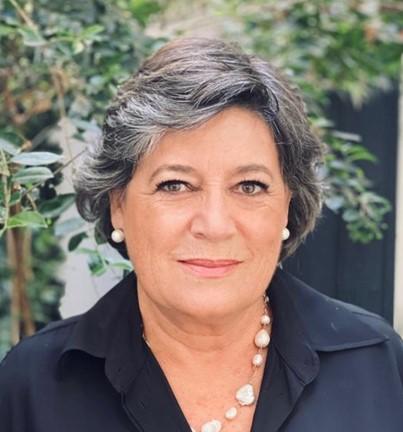
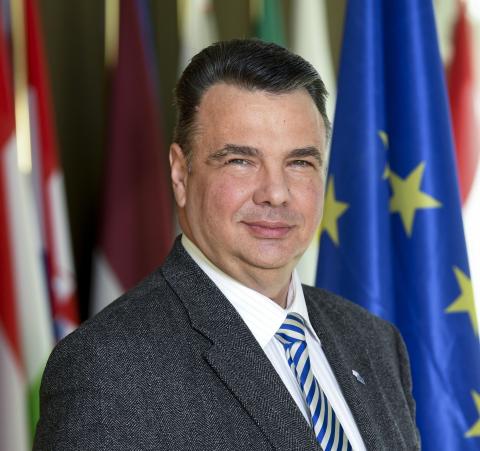
Our surprise guest is Ana Gomes, Portuguese diplomat and politician, member of the Portuguese Socialist Party. She writes about the danger of populism, the rise of far-right parties and the need to fight this.

Read more in all languages

Our surprise guest is Ana Gomes, Portuguese diplomat and politician, member of the Portuguese Socialist Party. She writes about the danger of populism, the rise of far-right parties and the need to fight this.

A career diplomat since 1980, Ana Gomes has held numerous positions, including at the United Nations in Geneva and New York. In 1999 she was Head of the Portuguese Interests Section and then, until 2003, Ambassador in Jakarta, where she played a role in the process leading up to the independence of Timor-Leste and in the reestablishment of diplomatic relations between Portugal and Indonesia. 

A Member of the European Parliament from 2004 to 2019, she was particularly active in the European Parliament on foreign relations, human rights, security and defence, international development, gender equality and the fight against tax evasion, money laundering and the financing of terrorism.

In 2021, on behalf of the Socialists, she ran in the presidential election against the outgoing president, Marcelo Rebelo de Sousa. She managed to come second, ahead of the candidate from the extreme-right party, Chega.

Today she continues her political activism as a campaigner for human rights, integrity and transparency in public life, against corruption and organised crime. She has a weekly commentary programme on the Portuguese TV channel SIC Notícias (The opinion of Ana Gomes).

Ana Gomes: Rising above the far right in Europe – causes and the remedies needed

Europe is neglecting this tough battle and lagging behind in it. Reversing the progress of the far right is currently proving to be a difficult task. When Nazi-fascism was defeated in 1945, it was believed that extremist movements would lose their influence and space to operate. This was not the case. The democratic model has allowed the far right to survive and gain strength through people’s resentment and frustration.

Read more in all languages

Europe is neglecting this tough battle and lagging behind in it. Reversing the progress of the far right is currently proving to be a difficult task. When Nazi-fascism was defeated in 1945, it was believed that extremist movements would lose their influence and space to operate. This was not the case. The democratic model has allowed the far right to survive and gain strength through people’s resentment and frustration. The far right has benefited from eighty years of European liberal democracies’ tolerance and complacency. It pretended to play the democratic game, but it never gave up its ambition to destroy democracy from the inside, once it obtains the power to do so.

And it is close to succeeding: as part of a framework it calls ‘national sovereignty’, the far right has already gained power in government in various countries such as Orban's Hungary and Fico's Slovakia. In Poland it was in power for eight years with the PiS government (Prawo i Sprawiedliwosc/Law and Justice) until the recent elections in October.

In the European Union, the far right is also attempting to corrode democracy and bring about its implosion. Developments in information and communication technologies over the last thirty years, via digital platforms and social media, have dramatically increased the capacity of neo-Nazi and neo-fascist groups to interact, and gain visibility and power on a global scale. They use the freedom of expression of democracies to amplify and reiterate their xenophobic and racist ideologies. They coordinate strategies and mobilise challenges, in real time, to the civic order which they are a part of. The fact is that democracy provides the movements that are trying to destroy it with objective conditions that are conducive to their development and social penetration – including state financing.

The far right has found fertile ground for growth in Europe, given that the neoliberal policies and financial capitalism taken from Reaganomics caused the interruption to the progress and social well-being of the middle classes – the signpost for the building of Europe and its success. Neoliberalism has deregulated and hampered economic and social development; it has reduced real labour income in favour of capital; cut down on social support and public services; and left the housing sector in the hands of property speculation. European governments are ominously competing with each other in the sale of golden visas to kleptocrats and oligarchs from all over the place. The market crisis and fiscal dumping, which renders competition in the internal market unfair, weak support from Brussels and Frankfurt to SMEs, as well as weak employment protection and purchasing power, have increased leagues of discontent in Europe over the past fifteen years.

It is a tragic political error that is responsible for consecutive drops in people participating in European elections and the growth of the far right in the European Parliament. The resurgence of Nazi-fascist ideology is the result of the austerity model used in Europe. It has protected the financial system but has failed economic and fiscal justice and has failed to respond to the problems, wishes and expectations of citizens. It has given rise to old propaganda of supremacist and identitarian ideologies, which is always lurking in the background waiting for an opportunity for humanity to regress on the level of civilisation. This stirring up of cultural and religious hatred is present in our lives today, on our screens, on our social media, in the disinformation that is promoted every minute. Instilling fear and insecurity in citizens, evoking Islamisation, the end of white supremacy or of the Judeo-Christian identity and demonising the Roma community as being dependent on benefits, are strategies that have been used historically in the rise of authoritarian dictators or leaders.

Today, European governments are allowing them to point to the ‘danger of immigration’ in an ageing Europe that absolutely needs to import part of its workforce in order to sustain itself and grow economically. This is despite the fact that the number of refugees and migrants entering the EU today is low – in fact, it is lower than what the European population and workforce needs. Nevertheless, the xenophobic and racist rhetoric persists, in a Europe that continues to lack a safe and efficient legal framework to welcome and integrate migrants, instead of continuing to feed the trafficking mafia. Migrant workers were essential in the reconstruction of post-war Europe and in the construction of the EU. The contribution of migrants will remain crucial for Europe’s progress in the coming decades. The far right is aware of this – many of its financial backers use migrants in their industries and businesses.

But it will continue to play its games, creating fears, and manipulating consciences, as well as the complacency of weak and unstable national and European leaders when it comes to a strategic vision, our values and our principles. There can only be one response from democrats and Europeanists – fighting for our values. For democracy, for freedom, for dignity and for peace in Europe.

Ukraine, two years on

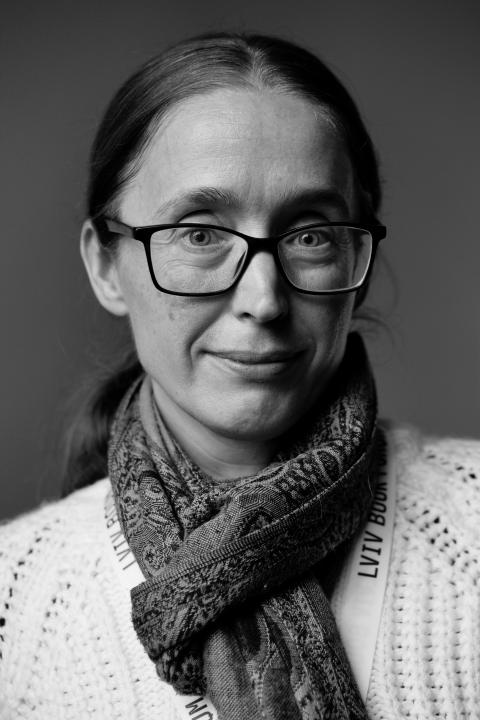
We asked Tetyana Ogarkova - a Ukrainian journalist living in Kyiv - to capture an image for us that symbolises Ukraine today, two years after Russia’s invasion on 24 February 2022. She sent us a photo that she took while travelling through the country supporting the Ukrainian troops. Here is the photo that Ms Ogarkova wants to share with our readers, and the story behind it.

Read more in all languages

We asked Tetyana Ogarkova - a Ukrainian journalist living in Kyiv - to capture an image for us that symbolises Ukraine today, two years after Russia’s invasion on 24 February 2022. She sent us a photo that she took while travelling through the country supporting the Ukrainian troops. Here is the photo that Ms Ogarkova wants to share with our readers, and the story behind it.

Tetyana Ogarkova has a PhD in literature from Paris XII Val-De-Marne University; she is a lecturer at Mohyla University in Kyiv, a journalist and Head of International Outreach at the Ukraine Crisis Media Center. She lives in Kyiv.

© Tetyana Ogarkova

Once upon a time there was a house...

A ruined house in the village of Vremivka, near Nova Novosilka, the epicentre of the Ukrainian counter-offensive in the summer of 2023.

Read more in all languages

A ruined house in the village of Vremivka, near Nova Novosilka, the epicentre of the Ukrainian counter-offensive in the summer of 2023.

These villages in the Ukrainian steppe, at the intersection of three regions (Donetsk, Dnipro and Zaporizhzhia) and a long way from the big cities, have been populated by Greeks displaced from Crimea since the 18th century. They resisted the Russian offensive in 2022 at the cost of being completely destroyed by enemy artillery. Here, in this strategic location that might be the key to liberating the shores of the Sea of Azov, Ukraine is standing its ground today, two years after Russia’s invasion.

European elections - 6-9 June 2024: I am voting. Are you?

In our new column I am voting. Are you?, which will run until June 2024, we present the views of our guest speakers on how and why to participate in the European elections. This time, our guest is Andrej Matišák, deputy head of the foreign affairs desk at Slovakia's biggest daily newspaper, Pravda.

Read more in all languages

In our new column "I am voting. Are you?" which will run until June 2024, we present the views of our guest speakers on how and why to participate in the European elections. This time, our guest is Andrej Matišák, deputy head of the foreign affairs desk at Slovakia's biggest daily newspaper, Pravda.

Slovakxit is not on the agenda. However ...

by Andrej Matišák

Welcome to Slovakia! Welcome to the land of European records.

No, I am not talking about an exceptional number of castles, exclusive spas or beautiful mountains. I mean the political records of Slovakia. And well, unfortunately, we are bottom of the class.

Slovaks voted for the first time in the European Parliament elections in 2004. Since then, my country has always had the lowest turnout. Always.

Read more in all languages

by Andrej Matišák

Welcome to Slovakia! Welcome to the land of European records.

No, I am not talking about an exceptional number of castles, exclusive spas or beautiful mountains. I mean the political records of Slovakia. And well, unfortunately, we are bottom of the class.

Slovaks voted for the first time in the European Parliament elections in 2004. Since then, my country has always had the lowest turnout. Always.

In 2014, it was only 13.05%. At the time, I was so convinced that the turnout would be below 15% that I almost considered taking out a bank loan and forming a party. Even in retrospect, I think that I had a chance of becoming an MEP.

However, on a more serious note: how do Slovaks perceive the European Union nowadays? As a piggy bank from which they can withdraw money? Certainly, but the problem is that Slovakia cannot even use EU funds effectively. We are among the worst in this area too.

The narrative that Brussels dictates everything is widespread. No doubt, it can be found everywhere. However, Slovak politicians have got it off to perfection. If anything good happens they take the credit. If anything bad happens it's "Brussels' fails again", and very few politicians resist this narrative.

However, the media can be also considered a problem. Their coverage of EU topics is often completely shallow. Journalists avoid EU affairs because they say they are boring, with the result that when they do cover them they focus primarily on problematic issues, whether real or invented.

Let me say a few words about the business sector. Entrepreneurs rarely talk publicly about the advantages of the EU. They also prefer to complain about orders and regulations from Brussels.

All these factors taken together have meant that, according to surveys, Slovaks are increasingly eurosceptic. If we add all the disinformation, including from Russia, which the current ruling politicians like to use for their purposes, we end up with an explosive cocktail of disinterest and anger.

No, Slovakxit is not on the agenda yet. But we may start to hear more about it when Slovakia eventually becomes a country that is no longer entitled to EU funds.

If we want to avoid a dark scenario, political leaders in Slovakia must finally embrace the EU as a space that is essential for the functioning of the country and behave accordingly. Unfortunately, it is already clear that a considerable part of the current Slovak political representation would rather start a fight with the EU to protect their interests no matter what.

This means that all voters who care about the EU must talk about its importance to their relatives, friends and even strangers. This may be a lot to ask and what it will lead to is unclear. However, every alternative is worse.

EESC News

Belgian EU Council Presidency asks for EESC support with its key priorities

Competitiveness, SMEs and social inclusion are at the heart of the Belgian Presidency programme. The European Economic and Social Committee (EESC) makes policy recommendations on the relationship between economic governance, long-term inclusive growth and sustainable security, as well as on the power of social economy in combating poverty and social exclusion.

Read more in all languages

Competitiveness, SMEs and social inclusion are at the heart of the Belgian Presidency programme. The European Economic and Social Committee (EESC) makes policy recommendations on the relationship between economic governance, long-term inclusive growth and sustainable security, as well as on the power of social economy in combating poverty and social exclusion.

In the first half of 2024, Belgium holds its thirteenth Presidency of the Council of the European Union, the priorities of which were discussed during two debates organised by the EESC at its plenary session in January.

EESC President Oliver Röpke commended the Presidency for including social partners in its work. Belgium's Presidency concludes the EU's institutional cycle, requiring the country to handle legislative compromises and guide the EU Council during the European Parliament campaign and elections.

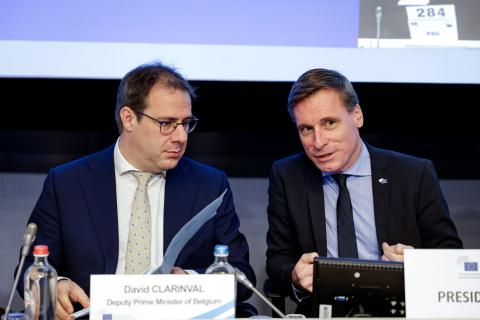
Belgian Deputy Prime Minister David Clarinval outlined the Presidency's views on common agricultural policy reform, protection for self-employed people, and EU industrial policy. In requesting 13 advisory opinions from the EESC, the Presidency aims to contribute to discussions on the 2024-29 Strategic Agenda. An interinstitutional declaration in April will focus on the future social agenda of the EU. The Presidency's priorities include a green and social transition, addressing climate and biodiversity crises. Its emphasis on fair labour mobility and sustainable social protection is at the heart of the EESC social partners' dialogue. Strengthening European competitiveness, supporting SMEs and promoting a balanced trade policy for Global Europe will be key focus areas. (tk)

Shaping the future of European agriculture: the EESC calls for resilience and sustainability

The European Economic and Social Committee (EESC) is shaping a vision for the post-2027 Common Agricultural Policy (CAP) to ensure resilience and sustainability in European agriculture. Tasked by the Belgian presidency of the Council of the EU, the EESC drafted an opinion,  adopted in January, in which it emphasised the need for a stable, long-term policy framework that supports sustainable food production, open strategic autonomy, and rural development.

Read more in all languages

The European Economic and Social Committee (EESC) is shaping a vision for the post-2027 Common Agricultural Policy (CAP) to ensure resilience and sustainability in European agriculture. Tasked by the Belgian presidency of the Council of the EU, the EESC drafted an opinion, adopted in January, in which it emphasised the need for a stable, long-term policy framework that supports sustainable food production, open strategic autonomy, and rural development.

With 94.8% of farms in the EU being family-owned, the sector faces challenges such as lower incomes, a diminishing number of farms, generational renewal difficulties, and significant labour force outflows. Despite decreasing budget allocations to the CAP (less than 25% in 2021), the EESC calls for CAP funding that is commensurate with its sustainability goals. A shift from basic income support to financial incentives for environmental and social services is recommended, allowing for flexibility for small family farms during a transition period.

Concerns about fair living standards for EU farmers, exacerbated by inflation, energy market volatility and climate change, highlight the need for CAP reforms. The EESC would like to see these challenges addressed in the post-2027 CAP which should focus on decent working conditions, promote healthier diets, reduce food waste, and regulate food markets. Counter-cyclical components and support for renewable energy production are proposed to mitigate the impact of energy price hikes and supply disruptions. Public-private partnership insurance schemes and investment in innovation and digital technologies are suggested measures to combat extreme climate conditions and empower farmers.

In preparation for the 2024 European Parliament elections, the EESC emphasises the need to shape the CAP to meet the evolving societal and agricultural needs.  It stresses the importance of stakeholder involvement, flexibility for Member States, and streamlined administrative processes in designing and adapting the strategic plans. Ultimately, the EESC envisions a CAP that strikes a balance between ensuring food security, protecting the environment and promoting the well-being of European farmers in the face of global challenges.(ks)

The EU needs to speed up competitiveness reforms

Europe is falling behind on competitiveness and needs to address the shortcomings of its single market urgently, but in a way that benefits both business and Europeans.

Read more in all languages

Europe is falling behind on competitiveness and needs to address the shortcomings of its single market urgently, but in a way that benefits both business and Europeans.

The EESC January plenary held a debate on European competitiveness and the future of the internal market. The EESC opinion at the centre of this debate was requested by the Belgian Presidency of the EU, which has pledged to use its six months to focus on competitiveness and the single market. The opinion will also help shape Enrico Letta's high-level report on the future of the single market, set to be presented to the European Council in March.

In it, the EESC stresses that the internal market needs to rise to the challenges of a very different world to the one for which it was created back in the 1990s. As a result, the EU is facing multiple pressures: maintaining a level playing field while subsidising its industries to help finance the green transition; keeping jobs in Europe while ensuring EU businesses stay competitive; and securing raw materials while upholding labour and environmental standards.

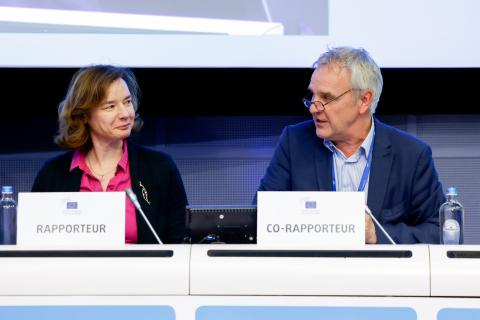
Rapporteur Sandra Parthie said: "The single market has helped make the EU one of the most powerful trading blocs in the world – but this powerful position is about to be eroded. What we propose in our opinion is to focus on the development of a European industrial policy that is not the sum of 27 national industrial policies, but rather a truly European view of our industrial potential".

Speaking at the debate, Markus Beyrer, Director General of Business Europe, said: "We have an issue with competitiveness. We are falling behind our global competitors, and the single market is one of the tools available to us to remedy this. The goal is to produce the margin we need to feed the European model as we know it, including the social aspects".

Ludovic Voet, Confederal Secretary of the European Trade Union Confederation (ETUC), stressed that the European social contract is the basis of the single market and that contract needs to be reinforced, saying: "In our competitive system, businesses have to pay fair salaries, offer good jobs and not harm the environment. Europe has to keep the momentum for a just green transition".

The EESC opinion includes a proposal to appoint a commissioner for services of general economic interest (SGEI) in the next Commission, with a five-year plan to develop secure, good-quality and sustainable SGEI. These account for 25% of EU GDP and 20% of total employment, and cover key sectors such as transport, energy, communications, access to water and sanitation. However, they are also very important in healthcare and social services. (dm)

The EU must improve its energy infrastructure connections between neighbouring Member States

Cross-border energy flows are key to supplying electricity and gas to the various EU Member States. This means energy infrastructure must be upgraded through interconnectors between neighbouring countries to increase the Union's sustainable energy capacity.

Read more in all languages

Cross-border energy flows are key to supplying electricity and gas to the various EU Member States. This means energy infrastructure must be upgraded through interconnectors between neighbouring countries to increase the Union's sustainable energy capacity.

In the opinion requested by the Belgian Presidency of the Council of the EU, adopted at its plenary on 18 January 2024, the EESC delivered a clear message on this issue.

The EU should pay particular attention to grid developments, and substantial investment must be made to stimulate the European economy and create high-quality jobs that are respectful of the environment.

"We at the EESC believe that, in order to achieve the green transition and strategic energy autonomy, it is fundamentally important to make a structural change to our energy system," said EESC president, Oliver Röpke, during the debate held in conjunction with the adoption of the opinion.

The Minister of Energy for Belgium, Tinne Van der Straeten, stressed that the clean energy transition, born out of climate necessity, was now an economic and security imperative, and that interconnection created a more flexible system that could balance geographic variations in wind and solar generation.

"Europe's ambitions for renewable energy currently exceed its plans in terms of infrastructure, so we need these trans-European infrastructures fast. And they need to be cost-efficient, secure, sustainable and flexible," she said. (mp)

EESC calls for collaboration for effective implementation of the Head Office Tax system in Europe

To bolster small business growth in the EU, the European Economic and Social Committee (EESC) backs the Commission's Head Office Tax (HOT) proposal. In its advisory opinion, the EESC advocates additional measures and emphasises the need for stronger collaboration among the Commission, Member States and representatives of micro, small and medium-sized enterprises (MSMEs) for effective implementation and awareness.

Read more in all languages

To bolster small business growth in the EU, the European Economic and Social Committee (EESC) backs the Commission's Head Office Tax (HOT) proposal. In its advisory opinion, the EESC advocates additional measures and emphasises the need for stronger collaboration among the Commission, Member States and representatives of micro, small and medium-sized enterprises (MSMEs) for effective implementation and awareness.

SMEs, constituting a staggering 99.8% of non-financial enterprises in the EU, significantly contribute to employment (66.6%) and added value (56.8%). The Commission's Head Office Tax (HOT) proposal, part of the broader SME Relief Package, aims to ease regulatory burdens and simplify tax procedures for these companies. The EESC emphasises the urgency of adopting the HOT proposal to catalyse MSME growth, targeting standalone SMEs engaged in cross-border operations. The proposed reduction aligns with the EESC's goal of fostering an environment for long-term GDP and employment growth.

While supporting the focus on standalone MSMEs initially, the EESC suggests evaluating the possibility of extending HOT to include subsidiaries in an ex-post assessment after five years, enhancing inclusivity. The EESC acknowledges HOT's complementarity with the BEFIT proposal but stresses the need for vigilance to avoid discrepancies in the legal framework. Cooperation between tax authorities in Member States is crucial for HOT's success, and the EESC calls for collaboration to ensure that it is properly implemented, urging Member States to adapt IT systems with all speed and to raise awareness among MSMEs. (tk)

Compliance with climate commitments promotes peace and security

At its January plenary session, the European Economic and Social Committee (EESC) addressed the impact of climate change and environmental degradation on peace, security and defence. The Committee stresses the urgent need to invest in setting up resilient responses to these global challenges.

Read more in all languages

At its January plenary session, the European Economic and Social Committee (EESC) addressed the impact of climate change and environmental degradation on peace, security and defence. The Committee stresses the urgent need to invest in setting up resilient responses to these global challenges.

Given that the fundamental mission of the EU project is to promote and preserve peace, Europe needs to step up its peace-building efforts.

In its opinion adopted at the plenary session, the EESC stresses that promoting peace is inextricably linked to the preservation and promotion of fundamental rights and democracy. Therefore, the Committee's position is that it is imperative to continue integrating the climate and security nexus into the EU's external policies. This should be done by creating proactive interfaces between the institutions responsible for external relations, internal EU cohesion and the Member States' security and defence services. The term "climate and security nexus" refers to the impacts of both climate change and environmental degradation on peace, security and defence.

Ozlem Yildirim, EESC member and rapporteur for the opinion said: "The EESC is also proposing specific measures to anticipate effectively, in particular by investing in resilient responses, preparing decision-making processes for the tensions to come, and above all establishing a real strategy on this issue at EU level. Prompt and effective compliance with climate commitments by all parties is also an important preventive lever!"

The European Commission's proposal takes account of the climate and security nexus. However, the EESC feels that the document falls short of establishing geographical, political and military parameters, as it fails to touch on the evolving nature of this nexus, when in fact the situation is going to deteriorate and may lead to serious tensions between the Member States. The Commission and the Member States need to have a permanent specific dialogue on the climate and security nexus. (at)

Europe's Water Opportunity: EU Blue Deal Gains Momentum ahead of EU elections

The European Economic and Social Committee's call for an EU Blue Deal is garnering support from policy-makers and civil society. This momentum is driven by a growing recognition of the urgency of addressing water scarcity, and the Blue Deal's potential to provide a comprehensive solution.

Read more in all languages

The European Economic and Social Committee's call for an EU Blue Deal is garnering support from policy-makers and civil society. This momentum is driven by a growing recognition of the urgency of addressing water scarcity, and the Blue Deal's potential to provide a comprehensive solution.

A recent event at the European Economic and Social Committee (EESC) brought together key stakeholders to discuss the Blue Deal and its potential to transform water management practices across the continent, with a focus on river basins.

"We face a water crisis of unprecedented proportions", said EESC President Oliver Röpke. Referring to the upcoming European elections in June, he noted that water is a topic that concerns every citizen. "How will EU decision-makers address the issue of water and the challenges that lie ahead? It's time to ask these questions".

MEP Pernille Weiss, echoing the calls for a comprehensive solution, advocated for a dedicated water transition fund to support businesses and communities in transitioning to sustainable water practices. UN Special Rapporteur Pedro Arrojo-Agudo stressed that water scarcity and climate change recognise no borders, and called on the EU to lead the way in developing a global solution to the water crisis.

The EESC's call for an EU Blue Deal has resonated with a wide range of stakeholders, including Compagnie Nationale du Rhône (CNR), a French public interest company that manages the Rhône River. CNR's Director of Water Resources, Eric Divet, shared the company's successful track record in sustainable water management, including efforts to restore wetlands, improve river biodiversity and adapt to climate change.

The European Commission is expected to unveil its water resilience initiative in the coming months. The EESC stands ready to collaborate with the EU institutions and stakeholders to ensure that its proposals for an EU Blue Deal are part of the priorities of the next European Commission. (gb)

Scientists and civil society call for ten decisive policy actions to avert irreversible environmental and social tipping points

The 5th Europe Sustainable Development Report (ESDR) has revealed that at the current pace, the EU is set to fail to achieve one third of the Sustainable Development Goals (SDGs) by 2030. The report, co-produced with civil society, highlights stagnation and regression in environmental and social goals across many European countries, exacerbated by crises since 2020. The SDGs cover areas such as poverty reduction, zero hunger, health, education, gender equality, climate action, and clean water.

Read more in all languages

The 5th Europe Sustainable Development Report (ESDR) has revealed that at the current pace, the EU is set to fail to achieve one third of the Sustainable Development Goals (SDGs) by 2030. The report, co-produced with civil society, highlights stagnation and regression in environmental and social goals across many European countries, exacerbated by crises since 2020. The SDGs cover areas such as poverty reduction, zero hunger, health, education, gender equality, climate action, and clean water.

To address this, ten decisive policy actions have been proposed to avert irreversible environmental and social tipping points. Urgency was emphasised during an event co-hosted by the European Economic and Social Committee's (EESC) Agriculture, Rural Development and Environment Section (NAT) and the UN Sustainable Development Solutions Network (SDSN). The report aims to guide the EU in bolstering its SDG leadership ahead of the June 2024 European elections and the September 2024 Summit of the Future convened by the UN Secretary-General.

Speakers at the event stressed the need for immediate action before 2030 to avert irreversible tipping points. Camilla Brückner of the UN/UNDP, Zakia Khattabi, Belgian Federal Minister for Climate, and Petra Petan of the European Commission, emphasised the importance of staying committed to the 2030 Agenda and the Paris Climate Agreement.

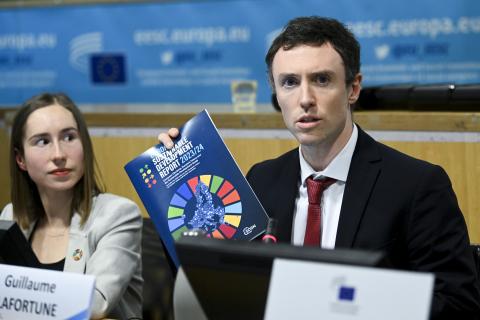
Guillaume Lafortune, Vice-President of the UN SDSN, presented the report and the ten priority actions aimed at political parties, the next European Parliament, the next European Commission, the European Council, and the Member States. The call for action, co-signed by the EESC and the SDSN, urges European leaders to work together for a green, social, and international European Deal for the Future. Peter Schmidt, president of the EESC's NAT section, stressed that the next six years were crucial for advancing the 2030 Agenda, emphasising the EESC's commitment to pushing the EU institutions towards the SDGs and meaningful civil society involvement. The call for action is positioned to guide European leaders towards a comprehensive European deal aligned with the green and social goals advocated by the EESC. (ks)

© EU/EESC

#CivSocWeek is coming on 4-7 March

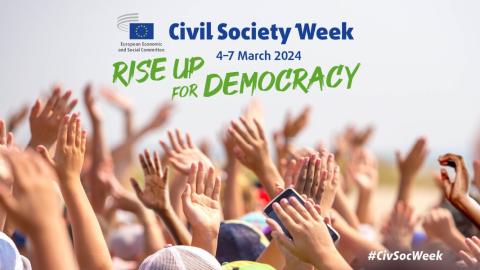
With the European elections in June 2024 laying the groundwork for Europe's future, the EESC, as civil society's institutional partner, is organising its first Civil Society Week, entitled Rise Up for Democracy!

Will you be part of it?

Read more in all languages

With the European elections in June 2024 laying the groundwork for Europe's future, the EESC, as civil society's institutional partner, is organising its first Civil Society Week, entitled Rise Up for Democracy!

Will you be part of it?

We will gather people of a range of ages and with a variety of backgrounds, including young people, journalists, and representatives of the EU institutions, to engage in a lively debate about issues that affect our daily lives and Europe's future. We will address the various threats and challenges to democratic values, as well as what civil society expects of Europe's future leaders. Our proposals will then be incorporated into the EESC's Resolution for the elections and specific policy proposals.

 #CivSocWeek will bring together five major EESC initiatives:

  • Civil Society Days – an annual flagship event highlighting the wide range of contributions from organised civil society to the building of an EU that is more in line with citizens' expectations on crucial issues for our democratic societies. This in turn seeks to encourage greater involvement by civil society in the European project at all levels.
  • European Citizens' Initiative Day - a high-level annual conference, providing a forum and platform where registered and future ECI organisers and stakeholders can exchange information and experiences and present their ECI-related activities to the public.
  • Your Europe, Your Say! (YEYS) - a youth event connecting young people with the EU - from the Member States, the candidate countries and the UK - inspiring them to exercise their democratic right to vote. Through dynamic consultation sessions, young participants will engage in debates, foster collaboration, and reach consensus.
  • Civil Society Prize - an annual prize rewarding effective, innovative and creative projects run by civil society and individuals. This year it will go to initiatives supporting mental well-being in Europe on an individual or collective basis
  • Journalists' Seminar bringing together journalists from the Member States to join the discussions on the state of democracy in the Union and the upcoming European elections and to experience first-hand the Committee in action.

Join us and be inspired by our expert-led workshops and high-level policy debates. Make your voice heard on key issues for the new legislative cycle and connect with civil society associations and changemakers from all over Europe!

Check out the #CivSocWeek webpage and spread the word!

EU Organic Awards 2024

Applications for the third EU Organic Awards can be submitted from 4 March 2024.

Read more in all languages

Applications for the third EU Organic Awards can be submitted from 4 March 2024.

The EU Organic Awards recognise excellence in the organic value chain each year. This year's award ceremony will take place on 23 September 2024: EU Organic Day.

A total of eight awards will be given across seven categories. They reward organic value chain actors for outstanding, innovative, sustainable and inspiring projects which are providing real added value for organic production and consumption. The first EU Organic Awards were held in 2022. (ks)

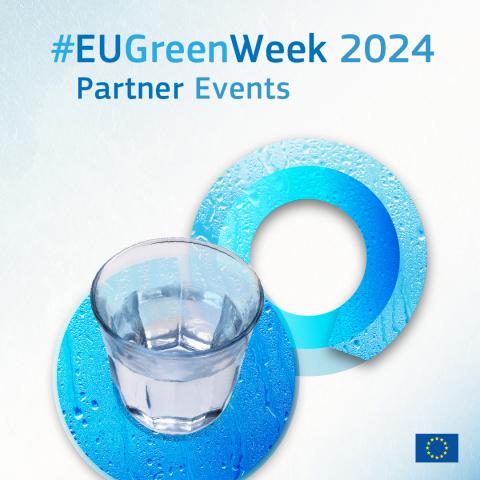
Applications open on 4 March - EU Green Week 2024 Partner Events on water resilience

Applications for partner events will be open between 4 and 17 March, with events taking place between 29 May and 1 September.

Read more in all languages

Applications for partner events will be open between 4 and 17 March, with events taking place between 29 May and 1 September.

Every year, the EU Green Week is accompanied by hundreds of partner events across Europe and beyond, organised by various institutions, NGOs, business representatives, academia, schools, and local, regional and national administrations, among many others.  

The theme of the 2024 partner events will be water resilience. The objective is to stimulate an EU-wide conversation on the present and future of the EU's water, with an emphasis on fostering awareness and promoting positive, collaborative solutions.  

All kinds of events are welcome, from workshops and public discussions to exhibitions and awareness-raising events for families. Activities can take place at local, regional, national or European level. More information and a timeline are available here. 

As the EU Blue Deal is one of the EESC's flagship initiatives, choosing this theme for the partner events presents a good occasion to communicate the proposals presented in the October 2023 EU Blue Deal Declaration, which calls for a new and ambitious water strategy for Europe, on a par with the EU Green Deal.  (gb)

News from the Groups

EU Single Market: the next generation

By the EESC Employers Group

Since the European single market was established, harmonisation and mutual recognition of standards have enabled companies to sell their products in a market of over 450 million people. It accounts for 61% of intra-EU trade by companies, and is the basis of Europe's economic prosperity, thus benefitting its citizens, consumers, workers and companies. The European Commission estimates that 25% of the EU's gross domestic product is generated by the internal market.

Read more in all languages

By the EESC Employers Group

Since the European single market was established, harmonisation and mutual recognition of standards have enabled companies to sell their products in a market of over 450 million people. It accounts for 61% of intra-EU trade by companies, and is the basis of Europe's economic prosperity, thus benefitting its citizens, consumers, workers and companies. The European Commission estimates that 25% of the EU's gross domestic product is generated by the internal market.

However, new developments, such as the digital transformation and the transition to a less carbon-intensive and more sustainable economy, require new adjustments, as do the changing needs of consumers, employees and companies and new geopolitical conditions.

The successful continuation of the single market requires improvements in several areas, including European energy and industrial policy, an energy union, a banking union, a more favourable framework for businesses large and small, and more public support for the European project, more efficient public services and improved infrastructure for IT, energy and transport.

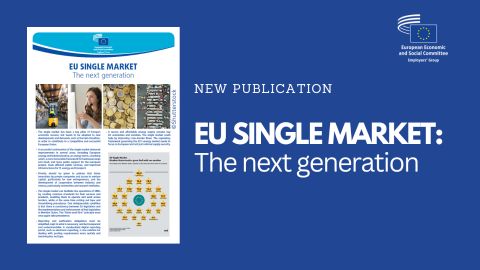
With two landmark reports by former Italian prime ministers, Enrico Letta ("Future of the Single Market") and Mario Draghi (on the future of European competitiveness) being published in the first half of 2024, the EESC's Employers Group has summarised its key messages for the successful future of the EU's internal market in its One Pager "EU Single Market: the next generation".

Read the new publication here: europa.eu/!TVmdYg

Our priorities for social progress

By the EESC Workers' Group

Political decision-making must always have the concerns and well-being of citizens and workers at its core.

Read more in all languages

By the EESC Workers' Group

Political decision-making must always have the concerns and well-being of citizens and workers at its core. They are important human factors that should be taken into account. It is the only way to ensure decent living conditions. Through policies that ensure these decent conditions for all we increase trust and widespread acceptance of current and future political measures and prevent popular disenchantment that provides a fertile ground for right-wing populism and extremism.

These concerns were the foundation of the Workers' Group priorities for 2023-2025, setting clear demands for future EU leaders to embark on a progressive agenda with a more social and human dimension at its core. After decades of crises, the costs of which have unequivocally been borne by European citizens and workers, we hope that the EU debate can again shift towards what really matters – social progress.

Our priorities outline the Workers' Group's vision of a Europe that is not only social and sustainable but that also upholds the rule of law, human rights, gender equality, solidarity and diversity. We need a Europe that prioritises tackling inequality, poverty and the climate emergency, ensures just green and digital transitions and secures decent work for all. It is the best way of empowering our democracy and society and every individual in it. We hope that this vision can be taken on board.

EU institutions must urgently implement a structured civil dialogue and align with Article 11 of EU Treaty

By the EESC Civil Society Organisations' Group

On 24 January, European civil society sent an open letter to the presidents of the European Commission and European Parliament, and to the Belgian Presidency of the Council of the European Union. The signatories of the letter urged the three main institutions of the European Union (EU) involved in EU decision-making to take concrete measures to implement an open, transparent and regular dialogue with civil society organisations, as set out in Article 11 of the Treaty on European Union, in all policy areas.

Read more in all languages

By the EESC Civil Society Organisations' Group

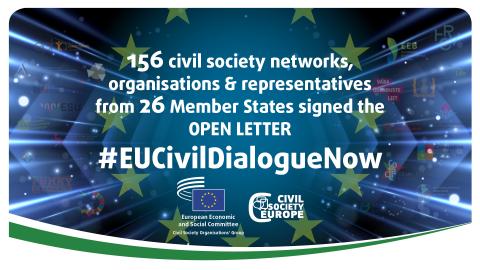
On 24 January, European civil society sent an open letter to the presidents of the European Commission and European Parliament, and to the Belgian Presidency of the Council of the European Union. The signatories of the letter urged the three main institutions of the European Union (EU) involved in EU decision-making to take concrete measures to implement an open, transparent and regular dialogue with civil society organisations, as set out in Article 11 of the Treaty on European Union, in all policy areas.

The open letter was initiated by the EESC's Civil Society Organisations' Group and Civil Society Europe, and includes specific proposals for implementation. The letter gained the support of a total of 156 signatories from 26 Member States. The signatories included 39 European networks, 85 national organisations and 60 Members of the EESC's Civil Society Organisations' Group.

Civil dialogue remains patchy and unstructured across the EU institutions, despite legal provisions. This is why the signatories of the open letter #EUCivilDialogueNow are calling on the EU institutions to:

  • initiate an inter-institutional agreement on civil dialogue;
  • establish within each institution leadership positions in charge of relations with civil society;
  • encourage and promote greater cooperation between civil and social actors.

These efforts must build on the recommendations of the Conference on the Future of Europe. As a first step, the signatories suggested a European Commission communication on strengthening civil dialogue at EU level.

The open letter is available in 24 languages at: https://www.eesc.europa.eu/en/agenda/our-events/events/eu-civil-dialogue-now/open-letter.

More information can be found in the press release announcing the open letter, available in 24 languages, at: https://www.eesc.europa.eu/en/agenda/our-events/events/eu-civil-dialogue-now.

Editors
  • Ewa Haczyk-Plumley (editor-in-chief)
  • Laura Lui (ll)
Contributors to this issue
  • Daniela Marangoni (dm)
  • Daniela Vincenti (dv)
  • Ewa Haczyk-Plumley (ehp)
  • Agata Berdys (ab)
  • Giorgia Battiato (gb)
  • Jasmin Kloetzing (jk)
  • Katerina Serifi (ks)
  • Katharina Radler (kr)
  • Laura Lui (ll)
  • Marco Pezzani (mp)
  • Margarita Gavanas (mg)
  • Margarida Reis (mr)
  • Millie Tsoumani (mt)
  • Pablo Ribera Paya (prp)
  • Thomas Kersten (tk)
Coordination
  • Agata Berdys (ab)
  • Giorgia Battiato (gb)
Address

European Economic and Social Committee
Jacques Delors Building,
99 Rue Belliard,
B-1040 Brussels, Belgium
Tel. (+32 2) 546.94.76
Email: eescinfo@eesc.europa.eu

EESC info is published nine times a year during EESC plenary sessions. EESC info is available in 24 languages
EESC info is not an official record of the EESC’s proceedings; for this, please refer to the Official Journal of the European Union or to the Committee’s other publications.
Reproduction permitted if EESC info is mentioned as the source and a link  is sent to the editor.
 

February 2024
02/2024

Follow us

  • Facebook
  • Twitter
  • LinkedIn
  • Instagram