The European Economic and Social Committee (EESC) has adopted an opinion that aims to safeguard citizens' fundamental rights in the midst of the implementation of AI technology in public services.
Focussing on five EU Member States (Belgium, Bulgaria, France, Italy and Portugal), this study aims to provide a comprehensive overview of the role and increasing significance of the national Economic and Social Councils (NESCs), while also putting forward a set of policy recommendations on how to involve the NESCs more constructively, and how to make sure that the EESC's relationship with the NESCs, and henceforth its involvement as the EU's institutional bridge with civil society, can be further strengthened.
adopting digitalisation and AI (artificial intelligence) could revolutionise the way public services are provided, offering innovative solutions for dealing more efficiently and more quickly with people’s needs;
AI can help make these services more accessible, in particular to the most vulnerable people in society;
the possibility to automate complex and repetitive processes could increase efficiency while reducing workload for individual workers.
This resolution presents recommendations of the European Economic and Social Committee to the legislature 2024-2029. They are based on discussions with social partners and civil society organizations from all walks of life, including young people during the first EESC Civil Society Week, and contain a comprehensive set of actionable steps to strengthen and safeguard democratic principles.
New mandate, new challenge - reaffirming TSD amid economic security ambitions
Location
Brussels
Belgium
The third edition of the EESC Civil Society Forum on Trade and Sustainable Development (TSD) took place on Thursday, 5 December, from 13:45 to 17:30 at the EESC premises in Brussels. Under the theme "New mandate, new challenge: reaffirming TSD amid economic security ambitions," this year's Forum focused on ensuring that the EU's economic security agenda is consistent with and delivers for TSD. As we welcome a new EU Commission, this is the moment to influence policy direction and ensure that trade policy fosters resilience and security alongside long-term development and social justice for all partners.
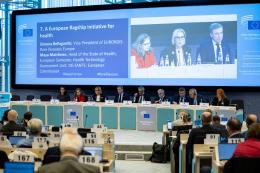
The European Economic and Social Committee (EESC) calls for a European flagship initiative for health, aiming to build a cross-cutting health architecture within the European Union. It also calls on the European Commission to publish an Action Plan on Rare Diseases with clearly achievable targets.
stresses the urgent need to adapt strategies for work-life balance taking into consideration the shifting demographics, new forms of work, flexible working arrangements and rising care demands, in view of the 2027 revision of the Directive (EU) 2019/1158 on work-life balance for parents and carers;
notes that ageing populations require increased resources for care services and recommends the Council ask the Commission to develop a Care Toolbox with indicators for long-term care;
emphasises that needs-based measures should provide affordable, accessible, high-quality services benefiting workers, families, companies, and public authorities.
launch the proposal for a comprehensive European Action Plan on Rare Diseases (APRD) with SMART targets that can be achieved by 2030 to enable the diagnosis of rare disease patients within one year;
set up a Steering Group for the European APRD composed of experts from Member States, EURORDIS members and the EESC to ensure coordination and cooperation, monitoring and supervision of the APRD;
encourage agreements with Member States on the content, updating, application and monitoring of national plans for RD.
welcomes the proposal for updated guidelines on employment policies, aimed at fostering a competitive and sustainable economy, reflecting new labour market needs;
highlights the importance of upward convergence and of enhancing the European Semester’s role in coordinated economic policy responses;
stresses the need to strengthen social partners' roles through social dialogue and collective bargaining and the involvement of civil society in employment reforms and policy-making.