Jacques Delors Building - Rue Belliard 101 - 1040 Brussels - Meeting room: Atrium 5
In order to attract talents and a skilled workforce, close cooperation must be developed between regional authorities, social partner organisations, employment services, and education and training providers. Social dialogue needs to be used effectively in order to attract companies to disadvantaged regions and ensure good quality jobs, good wages, job security via standard employment and access to social protection, and lifelong learning opportunities.
Join us in our Political lab ''Retaining talents and skills for regional growth. What is the role of civil society partners?'' which will take place on 11/10 from 16:30 to 18:00 in Atrium 5 in the Jacques Delors building (Rue Beliard 99-101)
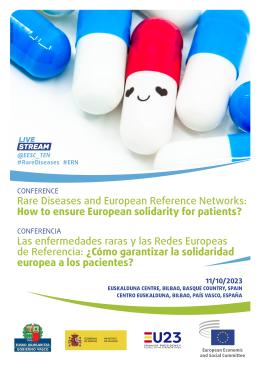
How to guarantee European solidarity for patients?
-
Event type
Conference
Location
11 October: Conference – "How to guarantee European solidarity for patients?" | Euskalduna Conference Centre
Bilbao
Spain
The European Economic and Social Committee organised a major conference on Rare diseases and European reference networks under the auspices of the Spanish Presidency of the EU Council and in cooperation with the authorities of the Basque Country. It took place on 11 October 2023 in the Euskalduna Conference Centre in Bilbao, Spain.
The EESC and the Spanish Economic and Social Council (CES) are organising this joint conference in the context of the Spanish Presidency of the Council of the EU, dedicated to "The impact of the climate crisis on migration flows in the Mediterranean region". This event will contribute to the EESC's mandate to establish and reinforce a Euro-Mediterranean network of Economic and Social Councils and Similar Institutions. It will provide CSOs with an opportunity to meet, exchange best practices and discuss an issue of importance throughout the Mediterranean region.
L'audition vise à recueillir les points de vue de différents acteurs de la société civile sur les mesures que l'UE devrait prendre pour établir un cadre politique global pour une transition juste.
Le CESE a souligné à plusieurs reprises son soutien à la recherche de nouvelles ressources propres pour le budget de l’UE. Ceci est devenu encore plus important dans le contexte de la hausse des taux d'intérêt, qui a créé un manque de moyens pour le remboursement des sommes empruntées sur les marchés de capitaux. Le débat public se concentrera sur la proposition de la Commission relative à une prochaine génération de ressources propres et sur les propositions politiques connexes du CESE.
L’investissement environnemental, social et de gouvernance (ESG), c’est-à-dire la prise en compte des facteurs ESG lors de décisions d’investissement (également appelé investissement durable), prend une part de plus en plus importante dans la finance. Les notations ESG fournissent une opinion sur le profil ou les caractéristiques de durabilité d’une entreprise ou d’un instrument financier, son exposition aux risques de durabilité, et son impact sur la société et/ou l’environnement. LE débat public portera sur la proposition législative de la Commission visant à améliorer la fiabilité, la comparabilité et la transparence des notations ESG, ainsi que sur les propositions politiques du CESE.
The 10th meeting of the EU-Georgia Domestic Advisory Group (DAG), and the first meeting of the new 2023-25 term, will take place on 4 October 2023. The DAG will elect a new chair, discuss the progress in implementing the Trade and Sustainable Development Chapter and make proposals for a work programme for the new term.
Une exposition organisée par le Groupe des organisations de la société civile du CESE dans le cadre de sa conférence «Souveraineté alimentaire européenne: le rôle de l’agriculture, de la pêche et des consommateurs».