Water is intrinsically linked to climate change and its impacts. Rivers, an essential and visible part of the great water cycle, bear witness to this: an increase in extreme droughts and floods; conflicts of use between energy, irrigation and drinking water; loss of biodiversity; tension between countries or territories for control of the resource.
What will a +1.5°C world look like with lower quality and more scarce freshwater resources? By 2050, the demand for water could increase by 55%, and 40% of the world's population will face water shortages. While mitigating the effects of climate change by drastically reducing greenhouse gas emissions into the atmosphere is essential, water must also be better integrated into the various sectoral adaptation strategies: agriculture, environment, energy, industry, transport and consumption.
How can the preservation of water resources be better taken into account in public policies to develop the resilience of European territories and provide effective responses to the cross-cutting challenges of climate, biodiversity and the health of ecosystems and humans?
In October 2023 the EESC presented its Call for an EU Blue Deal to comprehensively address these issues. In the context of the forthcoming European elections and the announcement of a Water Resilience Initiative by the European Commission, this event will help identify the levers to better promote and implement integrated and concerted water management in Europe by focusing on the concrete example of rivers, which are easily accessible water reserves and providers of many services to societies.
This meeting is hosted by the European Economic and Social Committee (EESC), as a follow-up of its call for an EU Blue Deal. It is proposed in partnership with the European Parliament Intergroup on “Climate Change, Biodiversity and Sustainable Development” and the Compagnie Nationale du Rhône (CNR).
Civil society representatives of both sides to hold a debate on the Deep and Comprehensive Free Trade Agreement (DCFTA) negotiations between the EU and Morocco and adopt a joint statement to be sent to the negotiating parties.
584e session plénière, aves les invités suivants: Pierre-Yves DERMAGNE, vice-premier ministre et ministre belge de l’économie et du travail; David CLARINVAL, vice-premier ministre et ministre belge des classes moyennes, des indépendants, des PME et de l’agriculture, des réformes institutionnelles et du renouveau démocratique; Tinne VAN DER STRAETEN, ministre belge de l’énergie. Web streaming
The 10th meeting of the EU Domestic Advisory Group (DAG) under the EU-Japan Economic Partnership Agreement (EPA), and second meeting of the new 2023-25 term, took place on 9 January, 2024.
The 9th meeting of the EU DAG set up under the EU-UK TCA, the last one chaired by Tanja Buzek (now vice-chair), was mostly dedicated to a debriefing on the DAG-to-DAG meeting and the 2nd Civil Society Forum (CSF) held in London on 6 and 7 November 2023.
During this 9th meeting of the EU DAG set up under the EU-UK TCA, while looking already ahead to 2024 work and upcoming events, an exchange of views on the joint meetings took place, including a debriefing on the DAG-to-DAG meeting and CSF held in London on 6 and 7 November as well as a discussion on the improvement of methodology in preparation for joint statement exercise and of the EU DAG's working methods in general. Following best practices, structured dialogue with the Commission carried on, this time with a debrief of the 3rd meeting of the Trade Partnership Committee under the UK-EU TCA on 7 December 2023 and of the latest Trade Specialised Committees and stocktake on the 2nd Civil Society Forum.
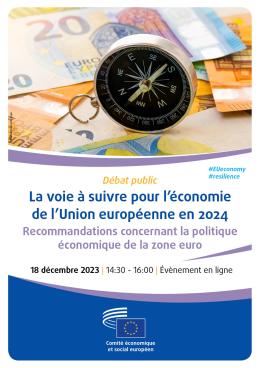
Recommandations de politique économique de la zone euro
Event type
Debate
Location
Evénement en ligne
Belgium
À la fin du mois de novembre, la Commission européenne devrait lancer le cycle annuel de coordination des politiques économiques, qui comprend la publication de nouvelles recommandations relatives à la zone euro pour 2024. Le CESE contribuera à la discussion interinstitutionnelle en élaborant un avis qui proposera une réflexion du point de vue de la société civile.
The 14th meeting of the EU-Ukraine Civil Society Platform (CSP) will take place on 15 December 2023. During the meeting, a debate will focus on assessing the implementation of the European Commission's opinion and the state of play of the implementation of the EU-Ukraine Association Agreement.
In addition, the CSP will discuss the initiatives for Ukraine's green recovery, economic integration of Ukraine to the EU, as well as current challenges related to labour market.
A joint declaration, prepared by both sides, will be discussed and adopted.
Le vendredi 15 décembre 2023, le CESE organisera une audition publique afin de recueillir les avis de la Commission européenne, des acteurs du développement rural et de diverses parties prenantes sur la manière de favoriser la mise en œuvre de la vision à long terme des zones rurales de l'UE.