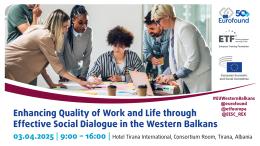
The European Foundation for the Improvement of Living and Working Conditions (Eurofound), the European Training Foundation (ETF) and the European Economic and Social Committee (EESC) are jointly organising an event on social dialogue in the Western Balkans. This initiative, led by the EESC President and the directors of the two agencies, will focus on the quality of life and work, youth, and the exchange of experiences on social dialogue between the EU and the Western Balkans.
Civil Society Perspectives on Security, Digital Threats, and EU Relations
The 35th meeting of the EEA Consultative Committee focused on several timely and relevant topics, including: Ariane Rodert (EESC) presented on European security and the role of civil society in times of crisis – Lukas Lanzrein (Mission of Switzerland to the EU) updated participants on recent EU–Switzerland developments, including the December 2024 package deal – Alice Stollmeyer (Defend Democracy) and John Comer (EESC) addressed strategies to combat disinformation and safeguard democracy – Franca Salis-Madinier (EESC) discussed opportunities and challenges of using artificial intelligence in the workplace.
State of progress in the EU after the 2021 UN Food Systems Summit
Location
Brussels
Belgium
The UN Food Systems Summit (UNFSS) 2021 launched global actions to transform food systems and advance the SDGs. The second Stocktaking Moment (27–29 July 2025, Addis Ababa) will assess progress, highlight innovations, and address challenges. To contribute, the EESC, in collaboration with the FAO, will host an online public hearing on the EU’s progress toward sustainable food systems. The event will engage key stakeholders and explore governance gaps, with online participation.
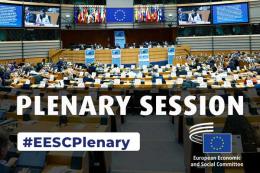
595e session plénière, avec les invités suivants: Michael McGRATH, commissaire européen à la démocratie, à la justice, à l’état de droit et à la protection des consommateurs, Brikena XHOMAQI, coprésidente du Groupe de liaison, et Kristýna BULVASOVÁ, représentante de la jeunesse; Christophe HANSEN, commissaire européen à l’agriculture et à l’alimentation, et Valdis DOMBROVSKIS, commissaire européen à l’économie et à la productivité et commissaire à la mise en œuvre et à la simplification. Vous pourrez suivre les débats en web streaming. Web streaming
This 14th meeting of the EU DAG set up under the EU-UK TCA featured the participation of Mr Sandro Gozi, Chair of the EP's Delegation to the EU-UK Parliamentary Partnership Assembly - as the result of efforts done to reconnect and engage with the European Parliament and the PPA - as well as of Mr Mike Clancy, Chair of the UK DAG under the TCA, following the increase and improvement of cooperation and engagement with the UK DAG.
The 15th meeting of the EU-Moldova Civil Society Platform will took place on 24 March 2025. During the meeting, the debate focused on assessing the state of play on the implementation of the EU-Moldova Association Agreement and the progresses towards opening negotiations on the Cluster 1 Fundamentals.
During the meeting, the EU DAG will receive an update from the European Commission's DG TRADE on EU-Vietnam FTA trade statistics and the implementation of the TSD chapter, as well as a report on the Joint Forum on Trade and Sustainable Development held in November 2024. Furthermore, EU DAG members will exchange with the European Parliament's standing rapporteur on Vietnam. Important features of the meeting will be the Commission’s assessment of the Vietnam Workers’ complaint to the Single Entry Point (SEP) and a discussion with the ILO.
The 8th meeting of the CARIFORUM-EU Consultative Committee took place in Nassau, bringing together civil society representatives from the Caribbean and the European Union. The agenda covered key discussions on the 5-year review of the CARIFORUM-EU Economic Partnership Agreement (EPA), its impact on trade, SMEs, and labour standards, as well as the evolving situation in Haiti. Participants engaged in high-level dialogues, expert briefings, and the adoption of a Joint Statement, shaping the future of CARIFORUM-EU cooperation.
On 20 March 2025, the European Economic and Social Committee (EESC) and Montenegro convened the 20th Civil Society Joint Consultative Committee (JCC) in Podgorica. This platform, established between the EESC and Montenegrin civil society, provides a civil society perspective within the EU institutional framework related to the Stabilisation and Association Agreement between the EU and Montenegro. The JCC enables civil society organisations from both sides to monitor Montenegro's accession negotiations, discuss common interests, and inform the public about the challenges during the accession period.
CESE, salle VMA 22 - Rue van Maerlant 2, Bruxelles
Bruxelles
Belgium
Promouvoir la participation politique de la communauté rom au niveau local et lui permettre de devenir des membres actifs de la société sont deux aspects principaux du cadre stratégique actuel de l'UE pour les Roms. Bien que certains membres de la communauté rom soient maires ou maires adjoints, dans la plupart des États membres, les Roms ne sont pas représentés dans le processus décisionnel local et sont parfois privés, par des moyens directs et indirects, légaux et extralégaux, de l'exercice de leurs propres droits politiques. L'audition discutera les obstacles rencontrés par la communauté rom qui l'empêchent de devenir des citoyens actifs, ainsi que des changements nécessaires. Elle examinera également les bonnes pratiques des municipalités où des mesures sont prises pour améliorer la représentation et l'inclusion de la communauté rom.