Bulgarian Chamber of Commerce and Industry (9 Iskar Str, Sofia, Bulgaria), and remotely via online platform
Sofia
Bulgaria
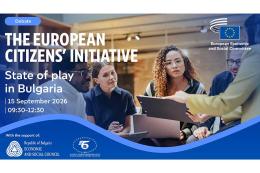
On 15 September 2026, the EESC Group on the European Citizens’ Initiative, with the support of the Economic and Social Council of the Republic of Bulgaria and the Bulgarian Chamber of Commerce and Industry, will organise a debate in Sofia on the state of play of the European Citizens’ Initiative in Bulgaria.
The event will bring together ECI stakeholders and communicators, such as representatives of EU institutions, civil society, youth, academia and local authorities, to discuss how awareness, visibility and participation in the European Citizens’ Initiative can be further strengthened at national level.
Participants will exchange experiences, good practices and ideas on how to make this unique EU participatory democracy tool more accessible and impactful for Bulgarian citizens.
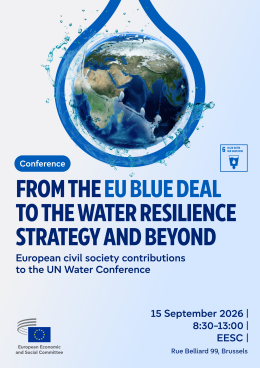
Save the date! On 15 September, the CCMI will organise a high-level event bringing together European civil society and key stakeholders to help shape the EU’s contribution to the UN Water Conference 2026. Building on the EESC’s work on the EU Blue Deal and its recently adopted opinion on this process, the event will foster dialogue and deliver key recommendations from civil society to EU and global decision-makers, feeding into global water policy discussions.
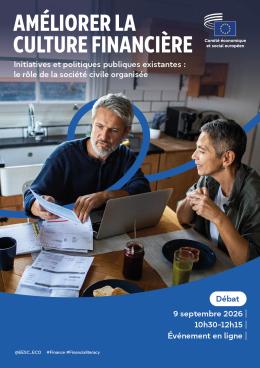
Nous discuterons des points de vue du Parlement européen, des progrès réalisés dans la stratégie de la Commission et tirerons les enseignements des initiatives avec de l’impact par une association du secteur financier et un syndicat. Un débat avec les membres et les participants à distance suivra.
Débat public au sein de la section ECO sur «Le cadre financier pluriannuel après 2027: évaluation des progrès et des défis à relever». Cet événement permettra de faire le point sur l'évolution des négociations depuis la présentation par la Commission de ses propositions pour le prochain cadre financier pluriannuel et d'aborder les défis en suspens.
EU enlargement is a key priority for the European Economic and Social Committee (EESC). The Committee considers enlargement to be a geostrategic investment in a strong, stable, secure and united Europe, grounded in shared democratic values.
Actively engaging farmers, fishers, and forest owners' organisations in the CBD negotiations
Location
Online
Belgium
This partnership event hosted by the EESC together with the European Bureau for Conservation and Development aims to explore how farmers, fishers, and forest owners’ organisations (at the EU and international level) can better coordinate, strengthen their engagement, and contribute more effectively to the CBD process ahead of COP17.
Salle VMA 22, bâtiment CESE, rue Van Maerlant 2, 1040 Bruxelles and Interactio
Bruxelles
Belgium
Cet événement présentera des contributions des institutions de l’UE et mettra en lumière les recommandations des personnes ayant une expérience vécue, ainsi que de la société civile et des organisations de personnes handicapées. #EndForcedSterilisation. #DisabilityRights
The EESC is organising a public hearing to feed into a timely own-initiative opinion which will examine civil society proposals on how to reform climate governance, including decision-making processes, negotiation frameworks, and the participation and impact of civil society organisations at global climate summits. It will also assess how international climate litigation is shaping climate negotiations and may further influence the governance of the UNFCCC, particularly in light of the International Court of Justice’s advisory opinion of 23 July 2025.