A steep rise in child and forced labour as well as continued exploitation of workers across the globe make EU action on decent work ever more urgent, according to an EESC hearing.
The Commission's initiatives on a European child guarantee and an EU Strategy on the rights of the child call on European and national policy-makers to work toward the common good of all children growing up in the EU. Ambitious and bold in their approach to ensuring a life free from any discrimination for each and every child, both initiatives have won the EESC's approval.
In the context of the own-initiative opinion on Volunteers – Citizens building the future of Europe, the European Economic and Social Committee (EESC) is organising a remote public hearing on Monday 20 September 2021. The aim of the hearing is to gather the points of view of social partners and other civil society organisations, experts and coordinators of projects related to volunteering, on the topic, and to hold a discussion on the impact of civil society trends for volunteering and the current state of play of volunteering at European level.
Thanks to their bold ambition to ensure a life free of any discrimination and intimidation for each and every child and to break down the cycle of disadvantage across generations, the EU's two new comprehensive initiatives on children's rights have been receiving positive reactions. However, there are concerns as to whether their implementation in the Member States will go as smoothly as hoped, an EESC hearing has found
The Strategy on the Rights of the Child and the Child Guarantee aim to provide better protection to children. The Strategy on the rights of the child focuses on six thematic areas, amongst which socioeconomic inclusion and combatting violence against children. The Child Guarantee aims to fight against child poverty and social exclusion by guaranteeing access to basic rights and services for children in need, amongst which healthcare and education.
The hearing aims to gather viewpoints on these initiatives, with the participation of organisations and other stakeholders working in the field.
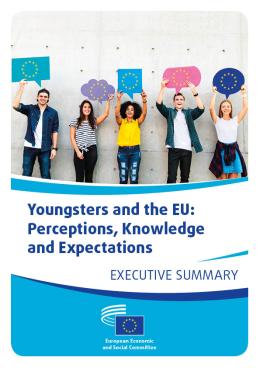
This study is conducted to better understand youngsters' relationship with the EU. The study examines 14- to 18-year-old youngsters' perceptions, and knowledge of the EU as well as their expectations towards the EU, and openness to the European diversity.
This study is conducted to better understand youngsters' relationship with the EU. The study examines 14- to 18-year-old youngsters' perceptions, and knowledge of the EU as well as their expectations towards the EU, and openness to the European diversity.
In this own-initiative opinion, the EESC calls on the European Union to develop a coherent and uniform approach to protecting unaccompanied foreign minors in Europe. It urges the European Commission to draw up a Directive on the protection of unaccompanied minors that serves the best interests of the child. The principle of "the best interests of the child" should take precedence over all other national and international law. The EESC calls on the Member States to evaluate minority based on a body of evidence, consisting principally of the declarations by the person in question, civil status documents presented and interviews with the person. Given that bone tests are not really reliable, the EESC calls for them to simply be stopped.
Download format:
Download — EESC opinion: The protection of unaccompanied migrant minors in Europe (own-initiative opinion)