The Water Resilience Stakeholder Platform will be launched on 21 September 2026, co-hosted by the European Commission, the European Economic and Social Committee and the Committee of the Regions. The afternoon will see the launch of the European Water Academy
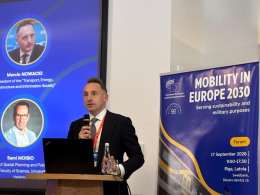
At a high-level event held in Riga, the European Economic and Social Committee (EESC),in cooperation with the Latvian association ‘Sustainability Cluster’, stressed the need for substantial progress on delivering the EU’s vision for an improved system of mobility.
President von der Leyen’s 2026 State of the Union speech sent a positive signal to Europe’s business community. Many of the priorities highlighted by the Commission reflect what employers have been calling for over many years: a stronger Single Market, simpler rules, competitive energy prices, faster permitting and investment procedures, and better access to capital. Yet the challenge is no longer identifying what needs to be done. The challenge is delivering.
At its September 2026 plenary session, the European Economic and Social Committee responded, through Opinion ECO/699, to a request from the European Commission on how organised civil society can contribute to financial education.
Enlargement is a geopolitical imperative for the European Union. However, its potential impact on EU climate policies has remained under the radar. As the European Union moves towards its 2040 climate target and climate neutrality by 2050, we must consider how they are achieved in a larger union of potentially over 30 Member States. In our Opinion on Enlargement and EU climate policy, we highlight the need to integrate enlargement fully into Europe’s climate strategy.
Europe’s ambitions on competitiveness, strategic autonomy, the green and digital transitions, defence and resilience require investment on a scale that our currently fragmented capital markets cannot provide. This is why our Opinion calls for a stronger role for the European Investment Bank Group, including the European Investment Fund (EIF), and national promotional banks. They should act as public investors, directing patient capital towards projects that strengthen Europe’s productive capacity and generate lasting economic and social value.
The EU Single Market is one of Europe's greatest achievements, but in an increasingly uncertain global environment, it must be seen as a strategic asset that can strengthen Europe's resilience, prosperity and competitiveness.
Small and medium-sized enterprises (SMEs) represent more than 99% of EU businesses and are fundamental to Europe’s employment, innovation and regional development. Yet they face growing regulatory complexity, rising compliance costs and fragmented implementation of EU rules across Member States.