
European Economic
and Social Committee
The EU institutions and all relevant actors must team up to enhance civil-military cooperation
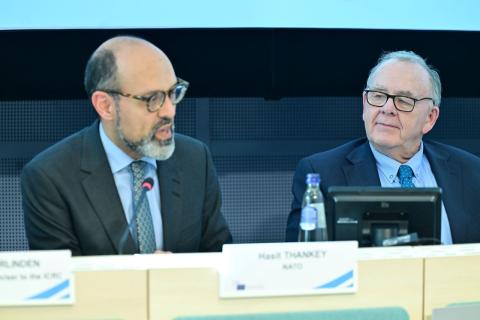
The debate held at the EESC March plenary highlighted the importance of stronger civil-military cooperation aimed at building trust. Military mobility is the key component of European independence and must focus on infrastructure, social respect and borders.
The European Economic and Social Committee (EESC) is placing a very heavy stone at the heart of the EU’s military mobility debate, noting that the European institutions must join forces with all relevant stakeholders to make the European Union safe and ready to act, both in times of crisis and in times of peace.
The European Union is currently facing a paradox: it has built the world’s most sophisticated single market, where goods cross borders quickly and seamlessly. However, when it comes to moving the tools and assets of its own security, there are still obstacles, both literal and bureaucratic.
‘Further action and stronger civil-military cooperation are needed. This is not optional – it is the only way forward, and it must be built on trust and transparency’, said EESC President Séamus Boland. ‘Military mobility is not about tanks on highways – it is about trust between soldiers and civilians, between governments and transporters. We either build that trust, or we risk breaking under pressure’.
Mr Boland added: ‘this is not a job for governments alone. It is a job for all of us: the policymakers who write the rules, the military planners, the companies that build the networks, the transport operators who move more cargo in a week than some armies do in a year, the workers who keep everything running, the medics who must be on alert, the drivers who deliver, and above all, the citizens who depend on all of them’.
Along the same lines, Maja Bakran, Deputy Director-General of the European Commission’s Directorate-General for Mobility and Transport (DG MOVE), confirmed the need to join hands at all levels. She referred to the proposal Military Mobility Package, which was presented by the European Commission and High Representative for Foreign Affairs and Security Policy in November 2025 to ensure that troops, equipment and military assets can move swiftly across the EU.
This is exactly the point. According to Hasit Thankey, Head of the Defence Enablement and Logistics Defence Policy and Planning Division at NATO, military mobility is essential for deterrence, because if we can position our forces in time, then we can convince our adversary that aggression is not worth the cost.
However, before designating civilian infrastructure for military purposes, it is important to assess the risk, because the protection of civilians must remain at the heart of this effort. Nele Verlinden, Senior Legal Adviser to the International Committee of the Red Cross delegation to the EU, NATO and the Kingdom of Belgium, warned about the dual civilian-military use of infrastructure, pointing out that civilian objects might rapidly turn into military targets, so it is essential to clearly define which tasks civilians may perform and which practical protection they must be provided.
Civil-military cooperation is essential
By adopting the opinion drafted by Tomas Arvidsson, the EESC provides an essential contribution in order to overcome the barriers to military mobility.
Military mobility is the backbone of European independence. It is not only the concern of generals and defence officials, and it must be made possible through three key angles: infrastructure, social respect and borders.
First, infrastructure is only as strong as the people who operate it. However, the current workforce crisis, with 100 000 missing drivers, is a strategic vulnerability that threatens both the EU’s economies and security.
Second, resilience is linked to social respect. In order to make drivers part of the EU’s crisis response, they must be treated as partners. This means fair compensation for disrupted routes, comprehensive training for handling military cargo, and insurance and legal protections that do not stop at the border but follow them home to their families.
Third, focus must be on borders. The EU needs a single framework for prioritising military transport – one that compensates operators fairly, streamlines customs for defence material, and ensures that no driver is left stranded because their paperwork did not travel as fast as they did.
The EESC opinion includes the views of organised civil society
Representing the EESC’s Employers’ Group, Marcin Nowacki, President of the Section for Transport, Energy, Infrastructure and the Information Society (TEN), said: ‘military mobility tests Europe’s response to today’s security challenges. Deterrence relies on logistics and rapid force movement, not just capabilities. Investing in mobility improves Europe’s connectivity and the single market and enhances Europe’s strategic autonomy’.
Thomas Kattnig, Vice-President of the Workers’ Group and of the TEN section, highlighted that ‘military mobility using civilian sectors can only be sustainable if it is based on strategic planning, but it cannot lead to job insecurity or to loose standards. Military mobility is a key aspect of the EU’s security policy, and the EU’s defence readiness needs to be based on military strength which takes into account social fairness’.
Finally, Christian Moos, member of the Civil Society Organisations’ Group and rapporteur for the EESC opinion on the Roadmap for European Defence Readiness, said: ‘Europe urgently needs to expand its dual-use infrastructure, particularly at its east-west junction. This means accelerating infrastructure renewal, enabling innovation, and building a resilient, sustainable transport system that meets our future mobility and security needs’.
Work organisation
Downloads
-
The EU institutions and all relevant actors must team up to enhance civil-military cooperation